Physics · Ch 1 — Waves
Displacement Relation in a Progressive Wave
Displacement Relation in a Progressive Wave
The Displacement Relation: What It Means
A progressive wave (also called a travelling wave) carries energy from one point to another without any bulk transfer of matter. The key question is: how do we describe the displacement of any particle in the medium at any instant? That description is the displacement relation — a function of both position and time .
For a wave travelling along a string (or any one-dimensional medium), every particle oscillates about its mean position. The displacement of a particle at location at time is given by a function . The exact form of depends on the shape of the wave and the direction it travels.
The General Form for a Travelling Wave
Consider a wave pulse moving to the right along the -axis with a constant speed . Suppose at , the shape of the wave is described by some function . This means the displacement of the particle at position at time zero is .
Now, after a time , the entire wave pattern has moved a distance to the right. A particle at a fixed location at time will have the same displacement that the particle at position had at . Why? Because the wave has simply shifted; the shape is unchanged.
Therefore, the displacement relation for a wave travelling to the right (positive -direction) is:
For a wave travelling to the left (negative -direction), the pattern shifts in the opposite direction, so:
Here and are arbitrary functions that describe the wave's shape. The argument or is the phase of the wave.
The function can be any shape — a pulse, a step, a sine wave. The only requirement is that the argument is . This is the mathematical signature of a wave that propagates without changing shape.
The Harmonic Progressive Wave
The most important special case is a harmonic (sinusoidal) wave. Here, every particle in the medium executes simple harmonic motion. The wave itself is a sine (or cosine) curve in space at any instant.
At , let the displacement be:
where is the amplitude (maximum displacement) and is a constant called the angular wave number (or propagation constant). For a wave travelling to the right with speed , we replace by :
This is the displacement relation for a sinusoidal progressive wave moving in the positive -direction.
Introducing the Key Parameters
The argument of the sine function is the phase :
We can rewrite this in terms of more familiar quantities.
Angular frequency : Since the wave moves with speed , and has units of inverse length, the product has units of inverse time — it is the angular frequency :
So the phase becomes:
And the displacement relation is:
Time period and frequency : At a fixed position , the particle oscillates in time. The sine function repeats when increases by . Hence:
The frequency (number of oscillations per second) is:
Wavelength : At a fixed time , the wave pattern in space repeats when increases by . Thus:
Wave speed : From , we get:
This is the fundamental relation connecting wave speed, frequency, and wavelength.
where , , and .
Alternative Forms of the Displacement Relation
The same wave can be written in several equivalent forms, each useful in different contexts.
- Using and :
- Using frequency :
- Using wave speed :
All these are identical; they just express the same phase in different units.
A common mistake is to mix the signs. For a wave travelling to the right, the phase is . For a wave travelling to the left, it is . The sign of the term tells you the direction: minus means forward, plus means backward.
Properties of the Harmonic Progressive Wave
The textbook lists several important properties that follow directly from the displacement relation. Each is derived below.
›Proof
Property 1: The wave is periodic in both space and time.
Periodicity in time: At a fixed , . Since , this equals . So the motion repeats after time .
Periodicity in space: At a fixed , . So the wave pattern repeats after distance .
›Proof
Property 2: The phase velocity is .
Consider a point of constant phase, say the crest of the wave. For this point, the phase is constant. Differentiate with respect to time:
Hence . This is the speed at which the wave pattern moves — the phase velocity.
›Proof
Property 3: The particle velocity is not the wave velocity.
The velocity of a particle at position is the time derivative of at that fixed :
This is the speed of the oscillating particle, which varies sinusoidally between and . It is completely different from the wave speed . The particle does not travel with the wave; it just oscillates about its mean position.
›Proof
Property 4: The wave equation.
Take partial derivatives of :
…
Drawn by us to help you understand the concept clearly, and verified to make sure it's accurate. For exams, practice from your textbook's own diagram.
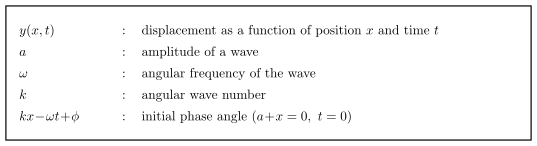
Fig. 14.5 is a legend — a visual key — for the symbols that appear in the standard wave equation. It does not show a graph or a plot. Instead, it is a simple two-column box. The left column lists the symbols , , , , and . The right column gives their physical meanings: displacement, amplitude, angular frequency, angular wave number, and initial phase angle, respectively.
The purpose of this figure is to anchor every symbol in the displacement relation before you see the full formula. The textbook develops that relation in this very section. For a progressive wave travelling along the direction, the displacement of a particle at position and time is given by
Here is what each symbol means:
- — the displacement of the particle from its mean position. It is a function of both position and time .
- — the amplitude, the maximum magnitude of . It is a constant for a given wave.
- — the angular frequency, related to the time period by . It tells you how fast the wave oscillates in time.
- — the angular wave number (often just called wave number), related to the wavelength by . It tells you how fast the wave oscillates in space.
- — the initial phase angle (or phase constant). It sets the displacement at and . If , then .
The argument is the phase of the wave. For a fixed value of this phase, the wave profile moves forward in as increases — that is what makes it a progressive wave.
A common mistake is to confuse (angular wave number) with the wave number . They differ by a factor of . Always check which definition your formula uses. In NCERT, . …
Drawn by us to help you understand the concept clearly, and verified to make sure it's accurate. For exams, practice from your textbook's own diagram.
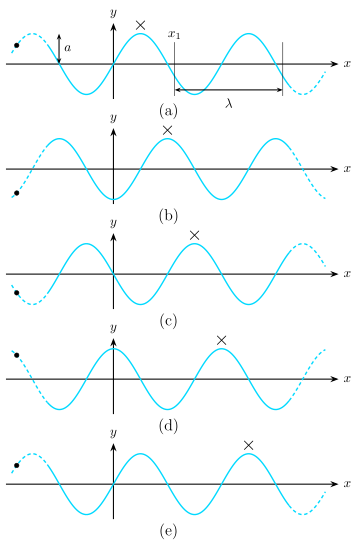
Fig. 14.6 is a sequence of five snapshots of a harmonic wave travelling to the right. Each panel (a) through (e) shows the wave shape at a different instant of time, stacked vertically so you can see how the entire pattern shifts.
The horizontal axis in every panel is position along the direction of propagation. The vertical axis is the displacement of the medium — the height of a particle from its equilibrium position. In panel (a), the textbook marks the amplitude (the maximum displacement from the axis), a crest (the highest point of the wave), the distance (the position of that crest at that instant), and the wavelength (the distance between two successive crests). A small dot on the -axis in panel (a) indicates the displacement of a particular particle at ; in subsequent panels that same dot moves up and down as the wave passes, showing that a fixed point in the medium oscillates in time.
The key physical idea is that a progressive wave is a moving disturbance, not a moving medium. The wave shape — a sine curve — does not change form as it travels; it simply slides to the right. If you follow a particular crest, it advances by a distance equal to one wavelength in one time period. The dot on the -axis demonstrates that a particle at a fixed location executes simple harmonic motion: its displacement varies sinusoidally as the wave goes by.
From this figure the textbook derives the displacement relation for a harmonic wave travelling in the direction. At time , the wave shape is , where is the angular wave number. At a later time , the entire pattern has moved right by , so the displacement of a particle at position is the same as the displacement at position at . Hence:
Here is the amplitude, is the wave number, is the angular frequency, and is the wave speed. The minus sign in the argument indicates propagation to the right (positive direction). If the wave were moving left, the sign would be . …