Question of 15
Q.Draw a neat labelled diagram of L.S. of a tooth.
Telangana TsbieTelangana Board of Intermediate Education 2018Subjective· 4mImportance★★★★★
0% · 0/15 Questions
You're viewing a preview — the full solution, concept, methods & PYQ mapping are locked.
Start your 14-day free trial to unlock the full solution →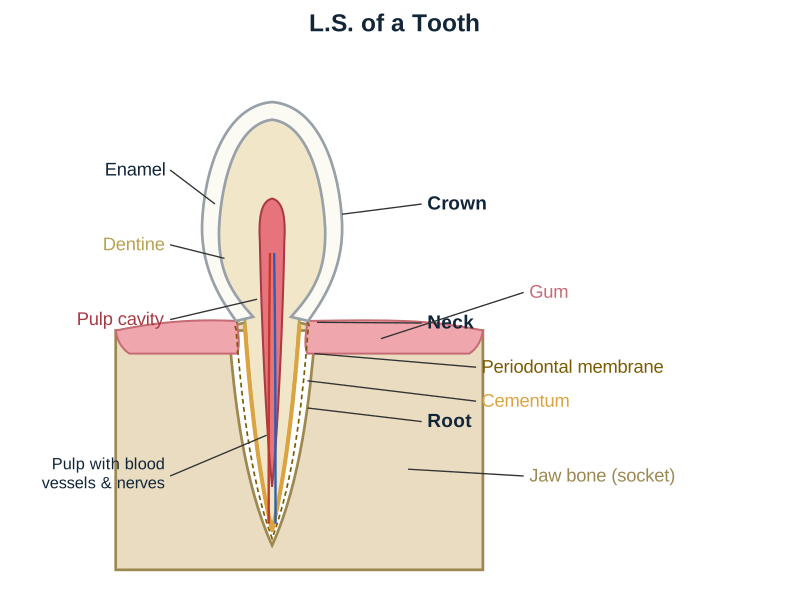
An L.S. of a tooth shows crown, neck and root, made of enamel over dentine enclosing a pulp cavity, with cement, periodontal membrane and gum fixing the root in the jaw-bone socket.
A human tooth (thecodont, diphyodont dentition — Digestion and Absorption, NCERT Class 11 Biology) has three parts and several layers. Since a diagram cannot be drawn here, its structure and the key labels are described so it can be reproduced:
Regions (top to bottom):
- Crown — the part projecting above the gum, covered by shining white enamel.
- Neck — the slightly narrowed region surrounded by the gum.
- Root — the part fixed inside the socket (alveolus) of the jaw bone.
Layers and internal structures (labels):
- Enamel — the hardest, outermost covering of the crown (made of calcium salts).
- Dentine — the thick bone-like layer beneath the enamel forming the bulk of the tooth.
- Pulp cavity — the central hollow filled with soft pulp containing blood vessels and nerve fibres that enter through the root canal.
- Cement (cementum) — the layer covering the dentine of the root.
- Periodontal membrane (ligament) — fibres anchoring the cement to the bony socket.
- Gum (gingiva) — soft tissue around the neck. …
Unlock everything free for 14 days
- Full step-by-step solutions
- Concept-first explanations
- Methods, shortcuts & mistakes
- PYQ mapping + timed mock tests
Full access for 14 days. No credit card required.