The human skeleton provides the framework and the joints that muscles pull against, and the skull is one of its most distinctive parts. The cranium (braincase) is built of several separate flat bones — the frontal, the two parietals, the two temporals, the occipital, the sphenoid and the ethmoid — that interlock at immovable, jagged joints called sutures; for example, the coronal suture joins the frontal bone to the two parietal bones, the sagittal suture runs between the two parietal bones along the midline, and the lambdoid suture joins the parietal bones to the occipital bone at the back of the skull. Sitting centrally at the base of the cranium, the sphenoid bone touches and helps lock together nearly every other cranial bone, much as a keystone locks the stones of an arch in place — which is why it is called the “keystone bone” of the cranium.
The skull rests on the vertebral column through two rounded knobs on the occipital bone, called occipital condyles, which fit into matching depressions on the first neck vertebra (the atlas). Because there are two condyles rather than one, the human skull is described as dicondylic; this two-point articulation gives a stable, largely fixed connection (unlike the single-condyle, more mobile joint of reptiles and birds) while still allowing controlled nodding movements at the atlanto-occipital joint.
Inside the middle ear lie three tiny bones — the malleus, incus and stapes, together called the ear ossicles — which form a lever chain that carries and amplifies sound vibrations from the eardrum to the fluid-filled inner ear. Their evolutionary origin lies in the jaw apparatus of reptilian ancestors: the malleus and incus are derived from bones that once formed part of the lower and upper jaw joint (the articular and quadrate bones respectively), while the stapes has an even older origin, tracing back to the hyomandibula of early jawed vertebrates. Their repurposing from jaw-joint bones to sound-conducting ossicles is one of the most often cited examples of how existing structures are modified for a new function over evolutionary time.
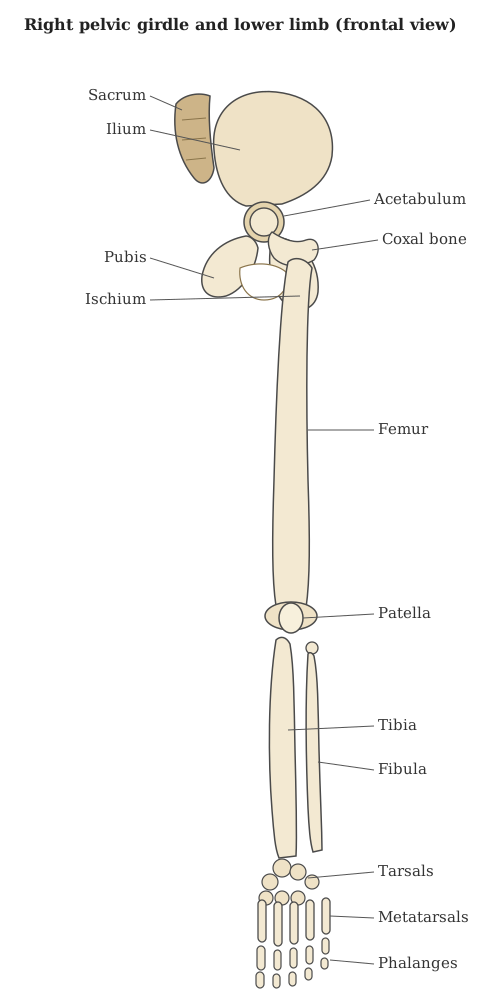
Away from the skull, different joints of the body are shaped for the particular movement each location needs. The joint between the atlas and the axis (the first two neck vertebrae) is a pivot joint, allowing the head to rotate from side to side; the joint at the base of the thumb, between its carpal and metacarpal bone, is a saddle joint, which is what lets the thumb swing across the palm to oppose the fingers. The atlanto-axial joint (again, atlas on axis) is this same pivot joint, while the joint between the femur and the acetabulum of the hip bone is a ball-and-socket joint, permitting movement in almost every direction — flexion, extension, abduction, adduction and rotation. The sutures joining the bones of the cranium are fibrous, immovable joints, in clear contrast to the joints between the small tarsal bones of the foot, which are gliding (plane) joints allowing only a limited sliding movement against one another. …