Q.What is heterogamety ? Explain the mechanism of sex determination in Drosophila.
🔒You're viewing a preview — the full solution, concept, methods & PYQ mapping are locked.
🔒 Start your 14-day free trial to unlock the full solution →Part (a)Concept understanding — Sex Determination — Ethics and Social Misuse
Sex Determination Ethics: A First Look
Imagine a family waiting for a baby. Relatives whisper, "Hope it's a boy" or "Thank God it's a girl." That casual reaction carries a heavy ethical weight. Sex determination ethics is the study of the moral questions surrounding the practice of choosing or knowing the sex of a child before birth, and the social consequences that follow.
The Core Idea
At its simplest, sex determination ethics examines whether it is morally right to use medical technology to find out whether an unborn baby is male or female, and then to act on that information — especially by aborting a fetus of the "unwanted" sex. The ethical problem is not about the technology itself (ultrasound, amniocentesis), but about what people do with that knowledge.
The NCERT textbook for Class 12 (Biology, Chapter 4: Reproductive Health) states this clearly: "Amniocentesis — a technique to determine the sex of the unborn child — is being misused to kill the female foetuses." The textbook calls this a "severe" misuse and links it directly to the declining child sex ratio in India.
Why Does This Become an Ethical Issue?
Three things make sex determination an ethical problem, not just a medical one:
- Discrimination against females. The practice is overwhelmingly used to abort female fetuses. This treats being female as a defect or a burden, which is a form of gender-based violence before birth.
- Social imbalance. When many more boys are born than girls, society faces a shortage of women. This leads to forced marriages, trafficking, and increased violence against women. The NCERT notes that the child sex ratio in India has dropped alarmingly — from 945 females per 1000 males in 1991 to 919 in 2011.
- Violation of the child's right to exist. The fetus is not given a chance to live simply because of its sex. This raises deep questions about equality and the value of every human life.
The Indian government made sex determination illegal under the Pre-Conception and Pre-Natal Diagnostic Techniques (PCPNDT) Act, 1994. This law bans doctors from telling parents the sex of the fetus, and bans any advertisement or test done solely for sex selection. Violation can lead to imprisonment and heavy fines.
The Everyday Intuition
Think of it this way: if you were told that your school would only admit boys next year, you would immediately see that as unfair. Sex determination ethics extends that same intuition to the womb. It asks: Is it fair to decide that a girl should not be born, simply because she is a girl?
The answer, from an ethical standpoint, is no. Every child — boy or girl — has equal moral worth. Using technology to eliminate an entire sex is a form of systematic discrimination that harms individuals and destabilises society.
Why It Matters for a Commerce/Humanities Student
You might think this is a "science topic," but it is deeply connected to what you study:
- Economics: A skewed sex ratio affects labour markets, marriage markets, and long-term economic growth. Fewer women mean fewer workers, consumers, and entrepreneurs.
- Political Science: Laws like the PCPNDT Act are examples of the state intervening to protect fundamental rights (right to life, right to equality). You can analyse how effective such laws are.
- Sociology: Sex determination reflects deep-rooted patriarchy, son preference, and dowry practices. It is a case study in how social norms shape — and are shaped by — technology.
- Ethics (if you study it): This is a classic dilemma: individual choice (parents wanting a son) versus social good (gender balance). Where do you draw the line?
A Few Key Points to Remember …
Part (b)Concept understanding — Gene Expression Regulation
Imagine a library with thousands of books. Every cell in your body has the same library — the same complete set of genes in your DNA. But a skin cell does not need to read the book on "how to make stomach acid," and a stomach cell does not need the book on "how to make skin pigment." If every cell tried to read every book at once, the library would be chaos. Gene expression regulation is the system that decides which books are opened, which are kept closed, and when to put a book back on the shelf.
At its simplest, gene expression is the process by which information from a gene is used to make a functional product — usually a protein. Regulation means this process is not automatic; it is controlled. Cells turn genes on or off, or adjust how much product is made, depending on what the body needs at that moment.
Why does this matter? Without regulation, every cell would be identical and useless. Regulation is what makes a muscle cell different from a nerve cell, even though both contain the same DNA. It also allows your body to respond to changes — like producing more red blood cells when you move to high altitude, or repairing damage after a cut.
Think of gene regulation like a dimmer switch, not just an on/off button. Some genes are turned up high, some are turned down low, and many are in between. This fine-tuning is essential for health.
The NCERT textbook explains that regulation can happen at several stages. The most important stage in bacteria (like E. coli) is at the start of transcription — when the gene is first copied into RNA. In higher organisms, regulation is more complex and can occur at multiple points: before transcription, during RNA processing, during translation (making protein), and even after the protein is made.
Key points to remember:
- All cells have the same DNA, but different sets of genes are active in different cells.
- Regulation is dynamic — genes can be turned on and off in response to signals from inside or outside the cell.
- Mistakes in regulation can lead to diseases like cancer, where genes that should be off stay on, or genes that should be on stay off. …
Part (a)
Heterogamety is the condition in which one sex produces two different kinds of gametes with respect to sex chromosomes, while the other sex produces only one kind.
Sex determination in Drosophila: Males are heterogametic (XY → produce X-bearing and Y-bearing sperm); females are homogametic (XX). Sex is actually decided by the ratio of X chromosomes to autosome sets (X : A), not by the Y:
- XX / 2A → ratio 1.0 → female
- XY (X / 2A) → ratio 0.5 → male
- intermediate ratios (e.g. 2X/3A = 0.67) → intersex. …
Part (a): heterogamety = one sex forms two gamete types; Drosophila males are XY (heterogametic) and sex is set by the X:A ratio (1.0 female, 0.5 male), Y only for fertility.
Part (b): hnRNA → mRNA by capping + tailing + splicing, all in the nucleus.
Part (a)
Heterogamety
Heterogamety is the situation where one sex produces two different types of gametes (differing in the sex chromosome they carry), while the other sex (homogametic) produces only one type. The heterogametic parent's gamete therefore decides the offspring's sex. In humans and Drosophila the male is heterogametic (XY → X- or Y-bearing sperm); in birds it is the female (ZW).
Mechanism of sex determination in Drosophila melanogaster
Although males are XY, the deciding factor is not the Y but the ratio of X chromosomes to sets of autosomes (X : A) (Bridges' genic-balance mechanism):
| Genotype | X : A ratio | Sex |
|---|---|---|
| XX / 2A | 1.0 | Female |
| XY (X / 2A) | 0.5 | Male |
| 2X / 3A | ~0.67 | Intersex |
- A ratio of 1.0 → female, 0.5 → male, and intermediate values give intersexes. …
Showing the 12 most recent of 34 on this concept.
- TG EAPCET 2026Set ap-2026-05-04-AN1 markMCQQ.Consider the following statements Assertion (A): The RNAi can be introduced in an organism by insertion of gene encoding ssRNA only. Reason (R): RNAi takes place in all eukaryotic organisms as a method of cellular defence The correct answer is (A) Both (A) and (R) are true, (R) is the correct explanation of (A) (B) Both (A) and (R) are true, (R) is not the correct explanation of (A) (C) (A) is true, but (R) is false (D) (A) is false, but (R) is true
›Reveal solutionSolution
RNA interference (RNAi) can be triggered by dsRNA, not just ssRNA, so Assertion (A) is false; RNAi does occur in many eukaryotes as a defence mechanism, so Reason (R) is true. The correct answer is (D).
The question tests your understanding of RNA interference (RNAi), a fascinating gene-silencing mechanism. Let's break down the biology behind each statement.
RNAi is a process where small RNA molecules (like siRNA or miRNA) bind to complementary mRNA, preventing its translation or marking it for destruction. This is a powerful tool for regulating gene expression and defending against viruses and transposons.
The key trigger for RNAi is double-stranded RNA (dsRNA). When a cell encounters dsRNA, an enzyme called Dicer chops it into small fragments (siRNAs). These siRNAs then guide the RISC complex to complementary mRNA, silencing the gene. Single-stranded RNA (ssRNA) alone does not efficiently trigger this pathway — it needs to be double-stranded to be recognized by Dicer.
Now, let's evaluate each statement.
-
Assertion (A): "The RNAi can be introduced in an organism by insertion of gene encoding ssRNA only."
This is false. To induce RNAi, you typically introduce a gene that produces dsRNA (often by designing an inverted repeat that forms a hairpin). A gene encoding only ssRNA would not produce the double-stranded trigger required for the RNAi machinery to act. While some ssRNA can form secondary structures that mimic dsRNA, the statement says "ssRNA only," which is misleading and incorrect in the standard sense.
-
Reason (R): "RNAi takes place in all eukaryotic organisms as a method of cellular defence." …
-
- TG EAPCET 2026Set ap-2026-05-04-AN1 markMCQQ.A DNA is having guanines and adenines in 2 : 1 ratio. Adenines are bonded with thymine by 80 hydrogen bonds. If this DNA transcribes information into m-RNA, how many t-RNA's are required to translate that. (A) 36 (B) 41 (C) 42 (D) 39
›Reveal solutionSolution
The key is to use the hydrogen-bond count to find the number of adenine–thymine pairs, then the G:A ratio to find the total base pairs, and finally the number of codons in the mRNA to determine the number of tRNAs required. The answer is 39.
The problem ties together DNA structure, transcription, and translation. You need to work backwards from the given hydrogen bonds to the number of base pairs, then to the number of codons in the mRNA, and finally to the number of tRNAs needed. Each tRNA brings one amino acid, and each amino acid corresponds to one codon (three bases) on the mRNA. The tricky part is that the stop codon does not code for any amino acid, so no tRNA binds to it.
Let’s break it down step by step.
- Understand the hydrogen bonding in DNA. In a DNA double helix, adenine (A) pairs with thymine (T) via 2 hydrogen bonds, and guanine (G) pairs with cytosine (C) via 3 hydrogen bonds. The problem says adenines are bonded with thymine by 80 hydrogen bonds. Since each A–T pair contributes 2 bonds, the number of A–T pairs is:
280=40
So there are 40 adenine bases and 40 thymine bases in the DNA.
- Use the given ratio of guanines to adenines. The ratio of guanines (G) to adenines (A) is 2:1. Since A = 40, we have:
AG=12⇒G=2×40=80
So there are 80 guanine bases. Because G pairs with C, there are also 80 cytosine bases.
- Find the total number of base pairs in the DNA. Each base pair consists of one purine and one pyrimidine. The total number of base pairs is the sum of A–T pairs and G–C pairs:
40+80=120
So the DNA has 120 base pairs.
-
Transcription produces an mRNA with the same number of bases as one strand of the DNA.
During transcription, only one strand of DNA (the template strand) is used to synthesize mRNA. The mRNA will have a sequence complementary to that template strand, but the number of bases in the mRNA equals the number of bases in the DNA strand (which is the same as the number of base pairs). So the mRNA has 120 bases.
-
Translate the mRNA into a protein: codons and tRNAs. …
- TG EAPCET 2026Set ap-2026-05-04-AN1 markMCQQ.Damage to cerebellum of brain causes (A) Coma (B) Excessive hunger (C) Loss of speech (D) Loss of balance
›Reveal solutionSolution
The cerebellum is vital for coordinating voluntary movements, maintaining posture, and ensuring balance. Damage to it primarily results in a loss of balance and coordination.
The brain is an incredibly complex organ, and different regions are specialized for different functions. To understand the effect of damage to the cerebellum, we first need to understand its normal role.
Concept and Intuition
The cerebellum, Latin for "little brain," is located at the back of the brain, beneath the occipital and temporal lobes of the cerebrum, and posterior to the brainstem. Despite its relatively small size (about 10% of the brain's volume), it contains over half of the brain's neurons.
Its primary functions are:
- Coordination of voluntary movements: It fine-tunes motor activity, ensuring movements are smooth, precise, and well-timed. For example, reaching for an object or walking in a straight line.
- Maintenance of posture and balance: The cerebellum receives sensory input from the vestibular system (inner ear, responsible for head position and movement) and proprioceptors (sensors in muscles and joints that tell the brain about body position). It integrates this information to adjust muscle activity, allowing us to stand upright and maintain equilibrium.
- Motor learning: It plays a role in adapting and refining motor skills through practice, like learning to ride a bicycle or play a musical instrument.
When the cerebellum is damaged, these functions are impaired. The specific symptoms depend on the extent and location of the damage, but they generally relate to problems with coordination and balance.
Step-by-step analysis of the options:
-
Analyze option (A) Coma:
- A coma is a state of prolonged unconsciousness where a person is unresponsive to their environment.
- This condition is typically caused by widespread damage to the cerebral hemispheres or, more commonly, to the brainstem, which contains the reticular activating system crucial for arousal and consciousness.
- While severe brain trauma can affect multiple areas, damage primarily limited to the cerebellum is not the direct cause of a coma.
-
Analyze option (B) Excessive hunger:
- The regulation of hunger, satiety (feeling full), and other basic drives like thirst and body temperature is primarily controlled by the hypothalamus, a small but vital structure located deep within the brain, below the thalamus.
- Damage to the cerebellum does not typically lead to disorders of appetite or hunger.
-
Analyze option (C) Loss of speech: …
- TG EAPCET 2026Set ap-2026-05-05-FN1 markMCQQ.Trisomy of 23rd chromosome in male results in (A) Turner syndrome (B) Down syndrome (C) Edward syndrome (D) Klinefelter syndrome
›Reveal solutionSolution
Trisomy of the 23rd chromosome in a male means an extra sex chromosome (XXY), which causes Klinefelter syndrome. The correct option is (D).
The key here is understanding what "trisomy of the 23rd chromosome" means. Humans have 23 pairs of chromosomes — 22 pairs of autosomes and 1 pair of sex chromosomes (the 23rd pair). In a normal male, the sex chromosome pair is XY. Trisomy means having three copies of a particular chromosome instead of the usual two. So trisomy of the 23rd chromosome in a male means the sex chromosome constitution is XXY — two X chromosomes and one Y.
Now, which syndrome does XXY produce? That is Klinefelter syndrome. Let’s walk through the options to see why the others are wrong.
-
Turner syndrome results from monosomy of the X chromosome in females — a single X (45,X). That is a missing sex chromosome, not an extra one. So it cannot be trisomy of the 23rd.
-
Down syndrome is trisomy of chromosome 21, not the 23rd. It is an autosomal trisomy, not a sex chromosome trisomy. So this is a common confusion — students sometimes mix up the chromosome numbers.
-
Edward syndrome is trisomy of chromosome 18, another autosomal trisomy. Again, not the 23rd. …
-
- TG EAPCET 2026Set ap-2026-05-05-FN1 markMCQQ.If the blood groups of parents are homozygous for A and homozygous for B blood groups, these blood groups are not expected in their children (A) A, AB, O (B) A, B, O (C) B, AB, O (D) A, B, AB
›Reveal solutionSolution
When one parent is homozygous A (genotype IAIA) and the other is homozygous B (IBIB), all children inherit one IA and one IB allele, giving only blood group AB. So groups A, B, and O are not expected.
The key here is understanding how blood groups are inherited. The ABO system is controlled by a single gene with three alleles: IA, IB, and i. Both IA and IB are dominant over i, but they are codominant with each other — meaning if both are present, both are expressed, giving the AB blood group.
When a parent is homozygous for a blood group, it means they carry two copies of the same allele. So a homozygous A parent has genotype IAIA, and a homozygous B parent has genotype IBIB.
Now let’s work through what happens in their children.
-
Gamete formation
The IAIA parent can only produce gametes carrying the IA allele.
The IBIB parent can only produce gametes carrying the IB allele.
-
Fertilization
Every child receives one allele from each parent. So every child gets exactly one IA and one IB — the only possible genotype is IAIB.
-
Resulting blood group
Since IA and IB are codominant, the IAIB genotype expresses as blood group AB.
No other combination is possible.
-
Which groups are not expected?
The children cannot have: …
-
- TG EAPCET 2025Set ap-2025-04-29-AN1 markMCQQ.In several fungi and plants, the bisexual condition is denoted by (A) Homothallic and monoecious (B) Heterothallic and monoecious (C) Homothallic and dioecious (D) Heterothallic and dioecious
›Reveal solutionSolution
The question asks for the terms that describe the bisexual condition in fungi and plants. In fungi, “homothallic” means both sexes on the same thallus (bisexual); in plants, “monoecious” means male and female flowers on the same plant (bisexual). So the correct pairing is homothallic and monoecious.
The key here is to match the biological terminology to the concept of bisexuality — having both male and female reproductive structures in the same organism. Different kingdoms use different words for the same idea, and this question tests your ability to translate across them.
-
In fungi, the term “thallus” refers to the body of the fungus. If a single thallus produces both male and female gametes (or gametangia), it is called homothallic (“same thallus”). If two different thalli are needed — one male, one female — it is heterothallic. So the bisexual condition in fungi is homothallic.
-
In plants, the term “monoecious” comes from Greek monos (single) and oikos (house) — meaning “one house.” A monoecious plant has separate male and female flowers on the same individual (e.g., maize, cucumber). That is the bisexual condition at the organism level. “Dioecious” (“two houses”) means male and female flowers are on separate plants (e.g., papaya, date palm), which is unisexual at the organism level. …
-
- TG EAPCET 2025Set ap-2025-04-29-AN1 markMCQQ.Consider the following statements Assertion (A): In human beings, Y-linked genes of non homologous part are called holandric genes. Reason (R): Y-chromosome is present in males only The correct answer is (A) Both (A) and (R) are true, (R) is the correct explanation of (A) (B) Both (A) and (R) are true, (R) is not the correct explanation of (A) (C) (A) is true, but (R) is false (D) (A) is false, but (R) is true
›Reveal solutionSolution
Holandric genes are Y-linked genes found only in males since the Y chromosome is male-specific; the reason correctly explains why these genes show this pattern of inheritance. The correct option is (A).
Understanding Sex Chromosomes and Gene Inheritance
In human genetics, sex chromosomes (X and Y) determine biological sex and carry genes beyond just sex determination. The X and Y chromosomes have both homologous regions (where they can pair during meiosis) and non-homologous regions (unique to each chromosome).
The key concept here involves understanding what happens with genes located in the non-homologous portion of the Y chromosome—the part that has no corresponding region on the X chromosome.
Evaluating the Assertion
Assertion (A): "In human beings, Y-linked genes of non homologous part are called holandric genes."
Let's break this down:
-
Holandric genes are indeed genes located on the Y chromosome, specifically in the non-homologous region (the region unique to Y that doesn't pair with X).
-
These genes are passed exclusively from father to son, creating a strict patrilineal inheritance pattern.
-
Examples include genes for testis development (SRY gene), some spermatogenesis factors, and certain genes controlling male-specific traits.
This assertion is TRUE.
Evaluating the Reason
Reason (R): "Y-chromosome is present in males only"
-
In humans, the typical sex chromosome composition is:
- Males: XY (one X, one Y)
- Females: XX (two X chromosomes, no Y)
-
Therefore, the Y chromosome is indeed present only in males (barring rare chromosomal abnormalities).
This reason is TRUE.
Determining the Relationship
Now the critical question: Does (R) correctly explain (A)? …
-
- TG EAPCET 2025Set ap-2025-04-29-AN1 markMCQQ.Study the following and choose the correct statements: I. Haemophilia-A and Haemophilia-B are X-linked disorders due to recessive genes II. Sickle cell anaemia is caused by a point mutation where valine at 6th position is replaced by glutamic acid III. Protonopia is red colour blindness IV. Phenyl ketonuria is an allosomal metabolic genetic disorder (A) I, III (B) II, IV (C) I, II (D) III, IV
›Reveal solutionSolution
The key idea is to recall the genetic basis and inheritance patterns of each disorder. Only statements I and III are correct, so the answer is option (A).
Let’s go through each statement one by one, understanding the biology behind it.
-
Statement I: Haemophilia-A and Haemophilia-B are X-linked disorders due to recessive genes
Haemophilia-A (deficiency of factor VIII) and Haemophilia-B (deficiency of factor IX) are both caused by recessive mutations on the X chromosome. Males (XY) are affected if they inherit one defective X; females (XX) need two defective copies to show the disease. This is textbook X-linked recessive inheritance. So statement I is correct.
-
Statement II: Sickle cell anaemia is caused by a point mutation where valine at 6th position is replaced by glutamic acid
This is a classic trap. In sickle cell anaemia, the mutation is in the β-globin gene: a single base change (GAG to GTG) leads to glutamic acid being replaced by valine at the 6th position of the β-chain — exactly the opposite of what the statement says. The statement has the amino acids swapped. So statement II is incorrect.
Watch outA common mistake is to reverse the amino acids. Remember: in sickle cell anaemia, glutamic acid (hydrophilic) is replaced by valine (hydrophobic), not the other way around.
-
Statement III: Protonopia is red colour blindness …
-
- TG EAPCET 2025Set ap-2025-04-29-FN1 markMCQQ.Transduction was discovered by 'X' in 'Y'. Identify 'X' and 'Y' respectively? (A) X – Lederberg and Tatum, Y – E. coli (B) X – Lederberg and Zinder, Y – S. typhimurium (C) X – Lederberg and Ehrenberg, Y – S. Pneumoniae (D) X – Griffith and Zinder, Y – C. tetani
›Reveal solutionSolution
Transduction was discovered by Lederberg and Zinder in Salmonella typhimurium. The correct option is (B).
The question tests a specific fact from the history of molecular genetics: who discovered transduction and in which organism. This is a classic memory-based point, but understanding the context helps you lock it in without confusion.
Transduction is the process by which bacterial DNA is transferred from one bacterium to another via a bacteriophage (a virus that infects bacteria). It was discovered in 1952 by Norton Zinder and Joshua Lederberg while they were studying genetic recombination in Salmonella typhimurium. They initially thought they were observing conjugation (like Lederberg and Tatum had found in E. coli), but experiments showed that the transfer was mediated by a filterable agent — later identified as a phage — and thus transduction was born.
Let’s walk through the options:
-
Option (A) – Lederberg and Tatum, E. coli: This pair discovered conjugation (not transduction) in E. coli in 1946. So this is wrong for transduction.
-
Option (B) – Lederberg and Zinder, S. typhimurium: This is correct. Zinder was a graduate student in Lederberg’s lab, and together they demonstrated transduction in Salmonella typhimurium.
-
Option (C) – Lederberg and Ehrenberg, S. Pneumoniae: Ehrenberg is not associated with this discovery. S. pneumoniae was used by Griffith (transformation) and later by Avery, MacLeod, and McCarty. So this is incorrect.
-
Option (D) – Griffith and Zinder, C. tetani: Griffith discovered transformation (not transduction) in Streptococcus pneumoniae. Zinder worked on transduction, but not with C. tetani. So this is wrong. …
-
- TG EAPCET 2025Set ap-2025-04-29-FN1 markMCQQ.Consider the following statements Assertion (A): In hymenopteran insects, sperms are produced by mitosis Reason (R): Male hymenopteran insects are haploid The correct answer is (A) Both (A) and (R) are true, (R) is the correct explanation of (A) (B) Both (A) and (R) are true, (R) is not the correct explanation of (A) (C) (A) is true, but (R) is false (D) (A) is false, but (R) is true
›Reveal solutionSolution
In hymenopteran insects (ants, bees, wasps), males are haploid and produce sperm by mitosis, not meiosis. Both Assertion and Reason are true, and the Reason correctly explains the Assertion.
The key here is understanding haploidy and sex determination in hymenopterans. In these insects, females develop from fertilized (diploid) eggs, while males develop from unfertilized (haploid) eggs through a process called arrhenotokous parthenogenesis. This means males have only one set of chromosomes — they are haploid.
Now, think about what happens when a haploid organism needs to produce gametes. Normal meiosis would halve the chromosome number, but a haploid cell cannot undergo reduction division — it would produce inviable gametes with zero chromosomes. So nature has a clever workaround: male hymenopterans produce sperm by mitosis instead. Each sperm is an exact copy of the male's haploid genome, which is exactly what's needed to fertilize an egg and restore diploidy in the female offspring.
Let's break it down step by step.
-
Why the Reason (R) is true
Male hymenopterans (drones in honeybees, for example) develop from unfertilized eggs. Since no sperm contributed genetic material, the egg's nucleus alone forms the embryo — it is haploid (n). This is a well-established biological fact.
-
Why the Assertion (A) is true
Because the male is haploid, it cannot undergo meiosis to produce sperm — meiosis would reduce the chromosome number to n/2, which is not viable. Instead, the cells in the testes divide by mitosis, producing haploid sperm that are genetically identical to the male parent. This is a direct adaptation to haploidy.
-
How (R) explains (A) …
-
- TG EAPCET 2024Set ap-2024-05-08-FN1 markMCQQ.The following type of ribosome sub-units are present in an eukaryotic cell (A) 30S, 50S only (B) 40S, 60S only (C) 50S, 60S only (D) 30S, 40S, 50S and 60S
›Reveal solutionSolution
A eukaryotic cell contains both 80S (40S+60S) and organellar 70S (30S+50S) ribosomes, so all of 30S, 40S, 50S, 60S occur — option (D).
Concept: Ribosome types by sedimentation coefficient:
- 80S ribosomes in the cytoplasm of eukaryotes = 60S + 40S subunits.
- 70S ribosomes in prokaryotes and inside eukaryotic mitochondria and chloroplasts = 50S + 30S subunits. …
- TG EAPCET 2024Set ap-2024-05-08-FN1 markMCQQ.Match the followingThe correct answer is (A) A-III, B-IV, C-I, D-II (B) A-III, B-IV, C-II, D-I (C) A-III, B-I, C-II, D-IV (D) A-III, B-II, C-I, D-IV
List – I List – II A. pBR322 I To join DNA fragments B. T – DNA II Plasmid with ‘cos’ site C. COSMID III E. Coli D. DNA Ligase IV Agrobacterium tumifaciens 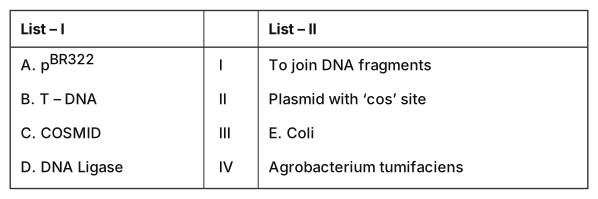
›Reveal solutionSolution
pBR322 is an E. coli plasmid, T-DNA comes from Agrobacterium tumefaciens, a cosmid is a plasmid carrying a phage cos site, and DNA ligase is the enzyme that joins DNA fragments — giving A–III, B–IV, C–II, D–I, i.e. option (B).
The concept first: the toolkit of genetic engineering
Recombinant DNA work needs three kinds of tool, and this question samples all three.
1. Vectors (the vehicles).
- pBR322 — the first widely used artificial cloning vector, built from plasmid DNA of Escherichia coli. It carries an ori, two selectable antibiotic-resistance genes (ampR and tetR) and unique restriction sites (PstI in ampR, BamHI and SalI in tetR) that allow insertional inactivation as a screen.
- Cosmid — a hybrid of a plasmid and phage λ. It is simply a plasmid that has been given the λ 'cos' (cohesive-end) site. The cos site lets the recombinant DNA be packaged inside a phage coat, so a cosmid can carry much larger inserts than an ordinary plasmid while still replicating as a plasmid inside the host.
- Ti plasmid / T-DNA — Agrobacterium tumefaciens is a soil bacterium that naturally infects dicots and transfers a piece of its tumour-inducing (Ti) plasmid — the T-DNA — into the plant genome, causing crown gall. Genetic engineers disarm the tumour genes and use the T-DNA as the delivery vehicle for a gene of interest. So T-DNA's home is Agrobacterium.
2. Enzymes (the tools).
- Restriction endonucleases are the "molecular scissors" — they cut. …
🎓Unlock everything free for 14 days
- ✓Full step-by-step solutions
- ✓Concept-first explanations
- ✓Methods, shortcuts & mistakes
- ✓PYQ mapping + timed mock tests
Full access for 14 days. No credit card required.