Q.The method of directly injecting a sperm into ovum in Assisted Reproductive Technology is called:
Concept understanding — Reproductive Health
Reproductive Health Significance — A First Look
Think of health as a state of complete well-being — not just the absence of disease. Now apply that to the part of your life that involves reproduction, the biological process by which new individuals are created. That is reproductive health: it is not merely about being free from infections or disorders of the reproductive system. It means having a healthy body, a clear understanding of reproductive processes, and the ability to make informed, responsible choices.
The NCERT textbook defines reproductive health as "a total well-being in all aspects of reproduction — physical, emotional, behavioural, and social." That is the core idea. It is not a narrow medical term; it is a broad, positive concept that touches every person, regardless of gender or age.
Why does it matter?
Reproductive health is significant because it directly affects the quality of life of individuals, families, and communities. When people are reproductively healthy, they can:
- Make informed decisions about marriage, family size, and childbearing.
- Prevent and manage sexually transmitted infections (STIs), including HIV/AIDS.
- Avoid unwanted pregnancies and unsafe abortions, which are major causes of maternal death.
- Ensure safe motherhood — proper care during pregnancy, delivery, and after birth reduces risks for both mother and child.
- Recognise and address problems like infertility, menstrual disorders, or reproductive cancers early.
Reproductive health is not only about problems. It also includes positive aspects like sexual well-being, the ability to have a satisfying and safe sex life, and the freedom to decide if, when, and how often to reproduce.
The bigger picture
On a national scale, reproductive health is linked to population control, maternal and child mortality rates, and the spread of diseases. The Indian government has run programmes like the Reproductive and Child Health (RCH) programme to improve access to services, education, and contraception. The goal is not just to reduce numbers — it is to ensure that every birth is wanted, every pregnancy is safe, and every child is healthy.
Reproductive health is a fundamental right, not a privilege. It requires awareness, access to healthcare, and the removal of social taboos that prevent open discussion.
Key components you should know
- Family planning — spacing and limiting births through contraception.
- Maternal and child health care — antenatal care, safe delivery, postnatal care, immunisation.
- Prevention and treatment of STIs — including HIV/AIDS.
- Adolescent reproductive health — education about puberty, menstruation, safe practices.
- Gender equality — empowering women to make decisions about their own bodies.
Reproductive health is not a separate, isolated topic. It is woven into everyday life — from the biology you learn in school to the social norms you encounter, and from personal choices to public policy. Understanding its significance helps you see why governments invest in it, why doctors emphasise it, and why every individual deserves to be reproductively healthy.
Many learners look this topic up as "Reproductive Health notes class 12 biology", "Reproductive Health important questions", or "Reproductive Health diagram and explanation". This concept is directly part of the Reproductive Health chapter in the NCERT/CBSE Class 12 Biology syllabus, and it is also an important topic for NEET and state medical/CET entrance exams, making it worth mastering for both board and competitive-exam preparation.
The question tests your knowledge of the specific Assisted Reproductive Technology (ART) procedures covered in NCERT. Each acronym stands for a distinct technique.
- GIFT (Gamete Intra-Fallopian Transfer) involves transferring both sperm and egg into the fallopian tube, so fertilisation happens inside the body.
- ZIFT (Zygote Intra-Fallopian Transfer) involves fertilising the egg in the lab first, then transferring the resulting zygote into the fallopian tube.
- ICSI (Intra Cytoplasmic Sperm Injection) is the precise method where a single sperm is directly injected into the cytoplasm of the ovum (egg) to achieve fertilisation in the lab.
- ET (Embryo Transfer) is the step of placing an early embryo into the uterus, not the injection of sperm into the egg.
The key phrase in the question is "directly injecting a sperm into ovum." That is the defining feature of ICSI, used when sperm count or motility is very low.
The method of directly injecting a sperm into the ovum is called ICSI (Intra Cytoplasmic Sperm Injection).
The technique of directly injecting a single sperm into an ovum is called Intracytoplasmic Sperm Injection (ICSI).
In Assisted Reproductive Technology (ART), several procedures have been developed to help couples who face infertility. The key difference among these methods lies in where and how the sperm meets the egg. Some techniques bring sperm and egg together in a lab dish and let fertilisation happen naturally; others go a step further and physically place the sperm inside the egg.
The method described in the question — directly injecting a sperm into the ovum — is the most precise form of assisted fertilisation. It is used when the sperm count is very low, or when the sperm are unable to penetrate the egg on their own. In this procedure, a single sperm is picked up with a fine glass needle and injected straight into the cytoplasm of the egg. This bypasses all natural barriers and ensures that fertilisation can occur.
The NCERT textbook specifically mentions ICSI as the technique where "a sperm is directly injected into the ovum." This is a clear, exam-relevant distinction.
Let us look at the other options to understand why they are not correct:
- GIFT (Gamete Intra-Fallopian Transfer) — Here, both sperm and egg are placed together into the fallopian tube, but fertilisation happens inside the woman's body, not in a lab dish. There is no direct injection of sperm into the egg.
- ZIFT (Zygote Intra-Fallopian Transfer) — In this method, the egg is fertilised in the lab (usually by standard IVF), and the resulting zygote is transferred into the fallopian tube. Again, no direct injection is involved.
- ET (Embryo Transfer) — This is the final step in many ART procedures, where an embryo (already formed) is placed into the uterus. It does not involve any manipulation of sperm or egg at the fertilisation stage.
ICSI is a specialised form of IVF. While standard IVF lets sperm and egg meet in a culture dish, ICSI forces the entry by injection. Both are in vitro (outside the body) techniques, but only ICSI involves direct injection into the ovum.
The NCERT textbook for Class 12 Biology (Chapter 4: Reproductive Health) clearly lists ICSI under assisted reproductive technologies and describes it as the method where "a sperm is directly injected into the ovum." This is the exact wording used in the question, making the answer unambiguous.
In short, the method of directly injecting a sperm into an ovum is called Intracytoplasmic Sperm Injection (ICSI), which corresponds to option (C).
Showing the 12 most recent of 72 on this concept.
- TG EAPCET 2026Set ap-2026-05-04-AN1 markMCQQ.Study the following and choose the incorrect statements I. Schizocoelomates and enterocoelomates are together called acoelomates II. The regions characterized by high levels of species richness and high degree of endemism are called biodiversity hotspots III. The threatened species are listed in the Red Data Book IV. Cryopreservation is a type of in-situ conservation (A) I, IV (B) II, III (C) I, II (D) III, IV
›Reveal solutionSolution
The question tests your understanding of key biology terms: coelom classification, biodiversity hotspots, Red Data Book, and conservation methods. The incorrect statements are I (schizocoelomates and enterocoelomates are coelomates, not acoelomates) and IV (cryopreservation is ex-situ, not in-situ conservation). So the correct option is (A) I, IV.
Let’s break down each statement one by one.
-
Statement I: "Schizocoelomates and enterocoelomates are together called acoelomates"
This is fundamentally wrong. In animal classification based on body cavity:
- Acoelomates have no coelom (e.g., flatworms).
- Schizocoelomates develop a coelom by splitting of mesoderm (e.g., annelids, arthropods, molluscs).
- Enterocoelomates develop a coelom from outpocketings of the archenteron (e.g., echinoderms, chordates). Both schizocoelomates and enterocoelomates are coelomates (true coelom animals), not acoelomates. So statement I is incorrect.
-
Statement II: "The regions characterized by high levels of species richness and high degree of endemism are called biodiversity hotspots"
This is correct. A biodiversity hotspot must meet two criteria: (a) at least 1,500 species of vascular plants as endemics, and (b) have lost at least 70% of its original habitat. High species richness and endemism are indeed the defining features.
-
Statement III: "The threatened species are listed in the Red Data Book"
This is correct. The Red Data Book (or Red List) published by IUCN categorizes species as extinct, extinct in the wild, critically endangered, endangered, vulnerable, etc. — all of which are threatened categories.
-
Statement IV: "Cryopreservation is a type of in-situ conservation"
This is incorrect. In-situ conservation means conserving species in their natural habitats (e.g., national parks, wildlife sanctuaries). Ex-situ conservation involves preserving components of biodiversity outside their natural habitats. Cryopreservation (preserving genetic material at very low temperatures) is done in labs or gene banks — clearly ex-situ, not in-situ.
Watch outA common mistake is confusing "in-situ" with "ex-situ". Remember: in-situ = on-site (natural habitat); ex-situ = off-site (zoos, botanical gardens, seed banks, cryopreservation).
So the incorrect statements are I and IV.
✓Final answerThe incorrect statements are I and IV, so the correct option is (A) I, IV.
-
- TG EAPCET 2026Set ap-2026-05-04-AN1 markMCQQ.Vector for Plasmodium vivax is (A) Periplaneta (B) Musca (C) Anopheles (D) Culex
›Reveal solutionSolution
The vector for Plasmodium vivax is the female Anopheles mosquito, which transmits the malaria parasite during a blood meal. The correct option is (C).
The question asks about the biological vector — the organism that carries and transmits the pathogen from one host to another. For malaria, the pathogen is a protozoan of the genus Plasmodium, and P. vivax is one of the species that causes malaria in humans. The vector is not the pathogen itself, but the agent that spreads it.
The key concept here is the life cycle of Plasmodium. The parasite requires two hosts: a human (where it reproduces asexually) and a female Anopheles mosquito (where it reproduces sexually). The mosquito picks up the parasite when it bites an infected human, and later injects it into a new human host during a subsequent bite. Only female mosquitoes feed on blood (needed for egg development), so only females act as vectors.
Now, let's eliminate the other options:
-
Periplaneta — This is the genus for cockroaches. Cockroaches are mechanical vectors for some bacteria (like Salmonella) but have no role in malaria transmission. They are not involved in the Plasmodium life cycle.
-
Musca — This is the genus for houseflies. Houseflies can carry pathogens on their body parts (e.g., for typhoid, dysentery) but do not transmit malaria. Plasmodium cannot complete its life cycle inside a fly.
-
Anopheles — This is the correct genus. Female Anopheles mosquitoes are the definitive host for Plasmodium (where sexual reproduction occurs) and the vector that transmits it to humans. Different Anopheles species are vectors for different Plasmodium species; Anopheles culicifacies and Anopheles stephensi are common vectors for P. vivax in India.
-
Culex — This is another mosquito genus, but it transmits different diseases: Culex mosquitoes are vectors for filariasis (caused by Wuchereria bancrofti) and some viral diseases like Japanese encephalitis. They are not vectors for Plasmodium.
Watch outA common mistake is to confuse Anopheles with Culex. Both are mosquitoes, but Anopheles transmits malaria, while Culex transmits filariasis and Japanese encephalitis. Also, remember that only female mosquitoes of the correct genus act as vectors — males do not bite.
TipA quick way to recall: Anopheles for malaria (both start with 'A'), Culex for filariasis (both have 'c' and 'l'), and Aedes for dengue (both start with 'Ae').
✓Final answerThe correct option is (C) Anopheles.
-
- TG EAPCET 2026Set ap-2026-05-04-AN1 markMCQQ.Consider the following statements Statement I: Use of cocaine produces a sense of euphoria and increased energy Statement II: Excessive use of cocaine cause hallucinations The correct answer is Options : (A) Both statement I and statement II are true (B) Both statement I and statement II are false (C) Statement I is true, but statement II is false (D) Statement I is false, but statement II is true
›Reveal solutionSolution
Cocaine is a stimulant that first produces euphoria and energy, but excessive use can lead to hallucinations — both statements are true.
Cocaine belongs to the class of drugs called central nervous system stimulants. Unlike depressants (like alcohol) or hallucinogens (like LSD), stimulants primarily increase the activity of the brain's reward pathways and alertness centers. The key to this question is understanding the dose-dependent effects of stimulants: what happens at low/moderate use versus what happens with excessive or chronic use.
Let's examine each statement carefully.
-
Statement I: "Use of cocaine produces a sense of euphoria and increased energy"
Cocaine works by blocking the reuptake of dopamine, norepinephrine, and serotonin in the brain. This leads to a rapid buildup of these neurotransmitters in the synaptic cleft. The surge of dopamine in the nucleus accumbens (the brain's pleasure center) produces intense euphoria, while norepinephrine increases heart rate, blood pressure, and alertness — giving a feeling of heightened energy. This is a well-documented, immediate effect of cocaine use. So Statement I is true.
-
Statement II: "Excessive use of cocaine cause hallucinations"
At high doses or with prolonged use, cocaine can indeed cause hallucinations — both visual and tactile (like the sensation of bugs crawling under the skin, called "cocaine bugs"). This happens because excessive dopamine stimulation can overexcite sensory pathways and lead to psychotic symptoms, including paranoia and hallucinations. This is a recognized effect of cocaine toxicity and chronic abuse. So Statement II is also true.
Watch outA common mistake is to think that because cocaine is a stimulant, it cannot cause hallucinations — but stimulant psychosis is a real phenomenon. Hallucinations are not exclusive to "hallucinogens" like LSD.
TipIn exam questions about drug effects, remember the three categories: stimulants (euphoria, energy, then psychosis), depressants (sedation, relaxation), and hallucinogens (altered perception). Cocaine is firmly in the stimulant category, but its overdose effects include hallucinations.
✓Final answerBoth statement I and statement II are true, so the correct option is (A).
-
- TG EAPCET 2026Set ap-2026-05-04-AN1 markMCQQ.Sexual phenotype of Drosophila with the karyotype AA+XXX is (A) Female (B) Metafemale (C) Inter sex (D) Triploid female
›Reveal solutionSolution
Sex determination in Drosophila is governed by the ratio of X chromosomes to sets of autosomes (X:A ratio). For the karyotype AA+XXX, the X:A ratio is 1.5, which results in a metafemale phenotype.
In Drosophila melanogaster (fruit fly), sex is determined not by the mere presence or absence of a Y chromosome, but by the balance between the number of X chromosomes and the number of sets of autosomes. This is known as the X:A ratio mechanism. The Y chromosome in Drosophila is primarily involved in male fertility, not sex determination itself.
Here's how the X:A ratio dictates the sexual phenotype:
- X:A = 1.0: Normal female
- X:A > 1.0: Metafemale (also called superfemale) — these individuals are often sterile and have developmental abnormalities.
- X:A between 0.5 and 1.0: Intersex — individuals with a mixture of male and female characteristics.
- X:A = 0.5: Normal male
- X:A < 0.5: Metamale (also called supermale) — these individuals are often sterile and have developmental abnormalities.
Let's apply this concept to the given karyotype.
-
Identify the number of X chromosomes:
The given karyotype is AA+XXX. This indicates there are three X chromosomes.
So, number of X chromosomes (NX) = 3.
-
Identify the number of sets of autosomes:
The notation 'AA' signifies two complete sets of autosomes. Each 'A' represents one haploid set of autosomes.
So, number of sets of autosomes (NA) = 2.
-
Calculate the X:A ratio:
The X:A ratio is calculated as the number of X chromosomes divided by the number of sets of autosomes.
X:A ratio=NANX=23=1.5
- Determine the sexual phenotype:
Comparing the calculated X:A ratio of 1.5 with the established categories:
- Since 1.5>1.0, the individual will be a metafemale.
Watch outDo not confuse Drosophila sex determination with human sex determination. In humans, the presence of a Y chromosome (specifically the SRY gene) determines maleness, while its absence leads to femaleness. In Drosophila, the Y chromosome is not sex-determining.
✓Final answerThe sexual phenotype of Drosophila with the karyotype AA+XXX is (B) Metafemale.
- TG EAPCET 2026Set ap-2026-05-04-FN1 markMCQQ.Match the following A Operator site I Binding site of mRNA polymerase B Promoter site II Binding site for repressor molecule C Regulator gene III Codes for protein / enzyme D Structural gene IV Codes for repressor molecule Options : (A) A – II, B – I, C – III, D – IV (B) A – II, B – I, C – IV, D – III (C) A – IV, B – III, C – I, D – II (D) A – II, B – III, C – I, D – IV
›Reveal solutionSolution
This question tests your understanding of the components of an operon and their roles in gene regulation. The operator site binds the repressor, the promoter site binds RNA polymerase, the regulator gene codes for the repressor, and structural genes code for proteins/enzymes. The correct match is (B).
The regulation of gene expression in prokaryotes, such as bacteria, often occurs through a mechanism called an operon. An operon is a unit of genetic material that functions in a coordinated manner to regulate the expression of a group of genes. It typically includes a promoter, an operator, and one or more structural genes, along with a separate regulatory gene. Understanding the specific role of each component is key to matching them correctly.
Here's a breakdown of each component and its function:
-
Operator site (A):
The operator is a specific DNA sequence located adjacent to the promoter region, usually between the promoter and the structural genes. Its primary role is to act as a switch for transcription. It is the binding site for a repressor molecule. When a repressor protein binds to the operator, it physically obstructs the RNA polymerase from moving along the DNA and transcribing the structural genes, thereby switching off gene expression.
Therefore, A (Operator site) matches II (Binding site for repressor molecule).
-
Promoter site (B):
The promoter is a DNA sequence located upstream of the structural genes. It serves as the recognition and binding site for RNA polymerase. RNA polymerase must bind to the promoter to initiate the transcription of the structural genes into mRNA. Without a functional promoter, transcription cannot begin.
Therefore, B (Promoter site) matches I (Binding site of mRNA polymerase).
-
Regulator gene (C):
The regulator gene (also known as the regulatory gene or i gene in the lac operon) is typically located outside the operon itself, though it controls the operon's activity. This gene codes for a regulatory protein, which is often a repressor protein. This repressor protein then binds to the operator site to control the transcription of the structural genes.
Therefore, C (Regulator gene) matches IV (Codes for repressor molecule).
-
Structural gene (D):
Structural genes are the genes within the operon that actually code for the proteins or enzymes required for a specific metabolic pathway. In the lac operon, for example, the structural genes (lacZ, lacY, lacA) code for enzymes like β-galactosidase, permease, and transacetylase, which are involved in lactose metabolism. These are the genes whose expression is regulated by the promoter and operator.
Therefore, D (Structural gene) matches III (Codes for protein / enzyme).
Combining these matches:
- A – II
- B – I
- C – IV
- D – III
This set of matches corresponds to option (B).
✓Final answerThe correct option is (B).
-
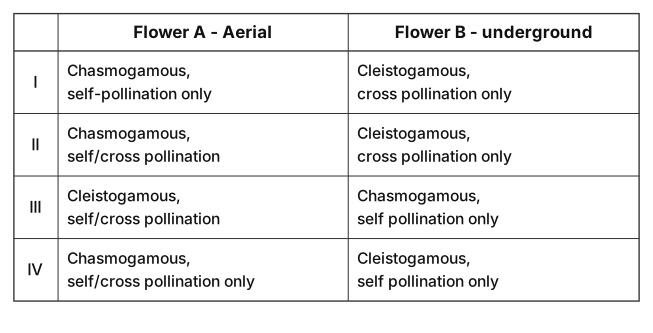
- TG EAPCET 2026Set ap-2026-05-04-FN1 markMCQQ.Commelina species produce two different types of bisexual flowers "A" and "B". Select the correct option regarding types of flowers and modes of pollination from the Table given below (A) I and II only (B) II and III only (C) I and III only (D) IV only
›Reveal solutionSolution
The aerial flower of Commelina is chasmogamous (open ⇒ self or cross pollination) and the underground flower is cleistogamous (never opens ⇒ self-pollination only, and assured seed set). Only row IV states this — option (D).
The concept: what "open" and "closed" really commit a flower to
- Chasmogamous flowers (chasmo = gaping) open normally: anthers dehisce and the stigma is exposed to the outside world. Pollen may land from the same flower (autogamy/geitonogamy) or be brought by an insect or the wind from another plant (xenogamy). So a chasmogamous flower permits both self- and cross-pollination — it does not guarantee either.
- Cleistogamous flowers (cleisto = closed) never open at all. The anthers and stigma lie in contact within the closed bud, so the pollen released must fall directly on the stigma of the same flower. Consequently:
- pollination is compulsorily autogamous — self-pollination only;
- no pollinator is required, and seed set is assured, which is the evolutionary pay-off (a fail-safe against years when pollinators are scarce);
- the cost is complete loss of genetic recombination through outcrossing.
Commelina is the standard textbook example of a plant carrying both kinds on the same individual: chasmogamous flowers in the air, cleistogamous ones borne underground.
Step-by-step through the table
- Flower A is aerial. It must be chasmogamous — this eliminates row III, which calls the aerial flower cleistogamous.
- Flower B is underground. A subterranean flower cannot be visited by pollinators and never opens, so it must be cleistogamous — and therefore self-pollinating only. This eliminates rows I and II, both of which claim the cleistogamous flower shows cross pollination only — impossible, because a closed flower can receive no foreign pollen.
- What can flower A do? Being open, it can be self-pollinated and cross-pollinated. Row IV says exactly this: "Chasmogamous, self/cross pollination".
- Row IV therefore is the only correct pairing:
- A (aerial): chasmogamous — self and cross pollination.
- B (underground): cleistogamous — self-pollination only.
- Hence the answer is "IV only".
✓Final answerOnly row IV correctly matches the flower types and their modes of pollination, so the correct option is (D).
ANSWER: D
- TG EAPCET 2026Set ap-2026-05-04-FN1 markMCQQ.Study the following and choose the correct statements I. The anti-cancer drug vinblastin is obtained from the plant Digitalis II. The concept of biodiversity hot spots was proposed by Paul Ehrlich III. In protostomes cleavages are spiral and determinate IV. As the species share the same ecological niche, it is described on ecological unit. (A) III, IV (B) I, II (C) I, IV (D) II, III
›Reveal solutionSolution
The question tests factual recall from biology — only statements III and IV are correct, so the answer is option (A).
Let’s examine each statement carefully, one by one.
-
Statement I: “The anti-cancer drug vinblastin is obtained from the plant Digitalis”
This is false. Vinblastine is an anti-cancer drug derived from the Madagascar periwinkle (Catharanthus roseus), not from Digitalis (foxglove). Digitalis yields cardiac glycosides like digoxin, used for heart conditions. A classic mix-up.
-
Statement II: “The concept of biodiversity hot spots was proposed by Paul Ehrlich”
This is false. The biodiversity hotspot concept was developed by Norman Myers in 1988, not Paul Ehrlich (who is known for work on population and extinction). Myers identified regions with high endemism and severe habitat loss.
-
Statement III: “In protostomes cleavages are spiral and determinate”
This is true. Protostomes (e.g., annelids, molluscs, arthropods) typically exhibit spiral cleavage (cells divide at oblique angles) and determinate cleavage (the fate of each cell is fixed early). This contrasts with deuterostomes (e.g., chordates, echinoderms), which have radial and indeterminate cleavage.
-
Statement IV: “As the species share the same ecological niche, it is described on ecological unit.”
This is true, though the phrasing is a bit awkward. An ecological niche refers to the role and position a species has in its environment — including its habitat, resource use, and interactions. When multiple species share the same niche, they form an ecological unit (e.g., a guild or functional group). The statement is accepted as correct in standard biology texts.
Watch outA common error is mixing up Digitalis with Catharanthus roseus for vinblastine, or attributing the hotspot concept to Paul Ehrlich instead of Norman Myers.
✓Final answerThe correct option is (A) III, IV.
-
- TG EAPCET 2026Set ap-2026-05-04-FN1 markMCQQ.Ernst Haeckel proposed the (A) Theory of Natural selection (B) Germplasm theory (C) Theory of recapitulation (D) Mutation theory
›Reveal solutionSolution
Haeckel is famous for the biogenetic law, which states that ontogeny recapitulates phylogeny — this is the Theory of recapitulation, option (C).
The question asks you to match Ernst Haeckel, a 19th-century German biologist, with the correct theory he proposed. This is a classic fact from the history of evolutionary biology, often tested in Indian exams. The key is to know the specific contribution of each major figure — Haeckel’s name is tied to a single, distinctive idea that is not shared by Darwin, Weismann, or de Vries.
Haeckel was a strong supporter of Darwin’s theory of evolution, but he went further and proposed his own law about how embryos develop. He observed that during development, an organism passes through stages that resemble the adult forms of its evolutionary ancestors. For example, a human embryo at one point has pharyngeal pouches (like a fish) and a tail. Haeckel called this the biogenetic law, or the theory of recapitulation: "ontogeny recapitulates phylogeny." Ontogeny is the development of an individual; phylogeny is the evolutionary history of the species. So, the developing embryo replays the evolutionary past.
Let’s check each option to see why only one fits.
-
Theory of Natural selection — This is Charles Darwin’s core idea, published in On the Origin of Species (1859). Haeckel popularized Darwin’s work in Germany but did not propose natural selection himself. So (A) is wrong.
-
Germplasm theory — This was proposed by August Weismann in the late 1800s. It states that hereditary information is carried only in the germ cells (sperm and egg), and changes to the body (soma) are not inherited. Haeckel had a different view (he believed in inheritance of acquired characteristics, like Lamarck). So (B) is wrong.
-
Theory of recapitulation — This is exactly Haeckel’s biogenetic law. He published it in his 1866 book Generelle Morphologie der Organismen. While modern biology has largely rejected the strict form of this idea (embryos do not literally pass through adult ancestral stages), it remains Haeckel’s most famous and defining contribution. So (C) is correct.
-
Mutation theory — This was proposed by Hugo de Vries in the early 1900s, based on his work with evening primroses. It suggested that new species arise suddenly through large mutations, not gradually. Haeckel died in 1919, but mutation theory came after his main work and is not his. So (D) is wrong.
Watch outA common mistake is to confuse Haeckel with Darwin or Weismann. Remember: Darwin = natural selection, Weismann = germplasm, de Vries = mutation, Haeckel = recapitulation. Each name has one signature theory.
TipTo recall Haeckel’s theory, think of the phrase "ontogeny recapitulates phylogeny." The word "recapitulation" is right there in the option — it’s a direct match. If you see that phrase in a question, Haeckel is the answer.
✓Final answerThe correct option is (C) Theory of recapitulation.
-
- TG EAPCET 2026Set ap-2026-05-05-FN1 markMCQQ.Choose the correct statement from the following (A) Cleistogamous flowers always exhibit autogamy (B) Chasmogamous flowers always exhibit geitonogamy (C) Cleistogamous flowers exhibits both autogamy and geitonogamy (D) Chasmogamous flowers never exhibit autogamy
›Reveal solutionSolution
The key idea is that cleistogamous flowers never open, forcing self-pollination (autogamy), while chasmogamous flowers open and can use any mode. The correct statement is (A).
The question tests your understanding of two flower types defined by their opening behaviour and how that dictates the mode of pollination. Let’s get the definitions straight first.
Cleistogamous flowers are flowers that never open. Their anthers and stigma remain enclosed within the bud, so pollen from the same flower can only land on its own stigma. This makes autogamy (self-pollination within the same flower) the only possible mode — no external agent (wind, insect) can enter, and pollen cannot travel to another flower.
Chasmogamous flowers are the typical flowers that open at maturity, exposing their reproductive parts. Once open, they can undergo autogamy (if pollen lands on the same flower’s stigma), geitonogamy (pollen from another flower on the same plant), or xenogamy (pollen from a different plant). There is no restriction — all three are possible.
Now evaluate each option:
-
Option (A): “Cleistogamous flowers always exhibit autogamy.”
Since the flower never opens, the only pollen source is its own anthers. Self-pollination within the same flower is guaranteed. This is true.
-
Option (B): “Chasmogamous flowers always exhibit geitonogamy.”
“Always” is the trap. Chasmogamous flowers can also self-pollinate (autogamy) or cross-pollinate with another plant (xenogamy). Geitonogamy is just one possibility, not a certainty. This is false.
-
Option (C): “Cleistogamous flowers exhibit both autogamy and geitonogamy.”
Geitonogamy requires pollen to travel to a different flower on the same plant. Since cleistogamous flowers never open, pollen cannot leave the flower. Only autogamy occurs. This is false.
-
Option (D): “Chasmogamous flowers never exhibit autogamy.”
“Never” is another trap. Many chasmogamous flowers are self-fertile and do self-pollinate (e.g., pea, tomato). Autogamy is possible whenever the anthers and stigma mature together. This is false.
Watch outA common mistake is to think “chasmogamous = cross-pollination” and “cleistogamous = self-pollination”. While cleistogamous flowers are indeed obligate selfers, chasmogamous flowers are not obligate outcrossers — they can self too. The words “always” and “never” in options (B) and (D) are the red flags.
✓Final answerThe correct option is (A).
-
- TG EAPCET 2026Set ap-2026-05-05-FN1 markMCQQ.Family Fabaceae differs from Solanaceae and Liliaceae in relation to stamens. Identify the characteristics specific to family Fabaceae (A) Monadelphous and monothecous anthers (B) Epiphyllous and dithecous anthers (C) Diadelphous and dithecous anthers (D) Polyadelphous and epipetalous stamens
›Reveal solutionSolution
The key difference is in stamen fusion: Fabaceae typically has diadelphous stamens (9 fused + 1 free) with dithecous anthers, which is not seen in Solanaceae or Liliaceae. The correct option is (C).
The question asks you to pick the stamen characteristic that is specific to Fabaceae — meaning it should be present in Fabaceae but absent (or different) in Solanaceae and Liliaceae. So you need to recall the stamen morphology of each family and find the unique combination.
Let’s break it down.
-
Recall the stamen features of each family
- Fabaceae (pea family): Stamens are typically diadelphous — 9 filaments fused into a tube and 1 free. Anthers are dithecous (two thecae, i.e., two pollen sacs per anther).
- Solanaceae (potato family): Stamens are epipetalous (attached to petals) and usually polyadelphous or simply free; anthers are dithecous. No diadelphous condition.
- Liliaceae (lily family): Stamens are epiphyllous (attached to the perianth) and free; anthers are dithecous. No diadelphous condition.
-
Analyze each option
- (A) Monadelphous and monothecous anthers: Monadelphous (all filaments fused into one bundle) occurs in Malvaceae, not Fabaceae. Monothecous anthers (single theca) are also not typical of Fabaceae. So this is wrong.
- (B) Epiphyllous and dithecous anthers: Epiphyllous stamens are characteristic of Liliaceae, not Fabaceae. So this is not specific to Fabaceae.
- (C) Diadelphous and dithecous anthers: Diadelphous is a hallmark of Fabaceae (especially subfamily Papilionoideae). Dithecous anthers are common to all three families, but the combination of diadelphous + dithecous is unique to Fabaceae among these three. This matches.
- (D) Polyadelphous and epipetalous stamens: Polyadelphous (many bundles) occurs in some families like Rutaceae; epipetalous is typical of Solanaceae. Neither is specific to Fabaceae.
-
Why the combination matters
The question asks for characteristics “specific to family Fabaceae.” Option (C) gives a pair where diadelphous is the distinctive feature — it is not found in Solanaceae or Liliaceae. The dithecous anther is a shared trait, but the question doesn’t require both to be unique; it requires the set to be specific. Since diadelphous is exclusive to Fabaceae among these families, (C) is correct.
Watch outA common mistake is to think that “dithecous” alone is the key — but all three families have dithecous anthers. The real differentiator is diadelphous fusion.
TipRemember the mnemonic: Fabaceae = 9+1 diadelphous (like a football team: 9 players in a huddle, 1 striker free). Solanaceae stamens are epipetalous (attached to petals), Liliaceae are epiphyllous (attached to perianth leaves).
✓Final answerThe correct option is (C) — diadelphous and dithecous anthers.
-
- TG EAPCET 2026Set ap-2026-05-05-FN1 markMCQQ.Match the following List-1 List-2 A. Dehydrogenases I. C−C bearing X and Y on adjacent carbons →X−Y+C=C B. Transferases II. CO2+H2O→H2CO3 C. Lyases III. S−G+S′′→S+S′′−G D. Carbonic anhydrase IV. S reduced + S′ oxidized → S oxidized + S′ reduced The correct answer is (A) A-III, B-II, C-I, D-IV (B) A-IV, B-III, C-I, D-II (C) A-IV, B-I, C-III, D-II (D) A-II, B-III, C-I, D-IV
›Reveal solutionSolution
Each enzyme class is defined by the type of reaction it catalyses. Dehydrogenases catalyse redox reactions (IV), transferases move a group (III), lyases cleave C–C bonds without hydrolysis (I), and carbonic anhydrase hydrates CO₂ (II). The correct match is A‑IV, B‑III, C‑I, D‑II, which is option (B).
The question tests your understanding of the IUBMB enzyme classification — the six major classes based on reaction type. You don’t need to memorise every subclass; you just need to recognise the kind of chemical change each description represents.
-
Dehydrogenases are oxidoreductases. They catalyse the transfer of electrons (hydride ions or hydrogen atoms) from one substrate to another. The giveaway is the language “S reduced + S′ oxidized → S oxidized + S′ reduced” — that’s a textbook redox reaction. So A matches IV.
-
Transferases move a functional group (like a glycosyl, methyl, or phosphate group) from a donor to an acceptor. The reaction shown, S−G+S′′→S+S′′−G, is exactly that: the group G is transferred from S to S″. So B matches III.
-
Lyases cleave C–C, C–O, C–N, or other bonds by means other than hydrolysis or oxidation, often leaving a double bond. The description “C–C bearing X and Y on adjacent carbons → X–Y + C=C” is a classic lyase elimination — two groups X and Y are removed from adjacent carbons, forming a double bond. So C matches I.
-
Carbonic anhydrase is a specific enzyme that catalyses the reversible hydration of carbon dioxide: CO2+H2O⇌H2CO3. That’s exactly the reaction given in II. So D matches II.
Watch outA common mistake is to confuse lyases with hydrolases. Lyases do not use water to break bonds; they eliminate a group to form a double bond. Hydrolases use water. Here, the elimination of X–Y from adjacent carbons is a lyase reaction, not a hydrolase.
TipIf you ever see “S reduced + S′ oxidized” in a matching question, immediately think oxidoreductase (dehydrogenase is a subclass). If you see a group being moved from one molecule to another, think transferase. For CO₂ + H₂O → H₂CO₃, that’s always carbonic anhydrase — a lyase, but here it’s named explicitly.
✓Final answerThe correct option is (B).
-
- TG EAPCET 2025Set ap-2025-04-29-AN1 markMCQQ.Mating between male parent and female offspring or female parent with male offspring is called (A) Line breeding (B) Cross breeding (C) Close breeding (D) Out crossing
›Reveal solutionSolution
The question asks for the term used when mating involves a parent and its own offspring — this is the most intense form of inbreeding, known as close breeding. The correct option is (C).
The concept here is inbreeding — the mating of individuals that are more closely related than the average of the population. In animal breeding, different levels of inbreeding have specific names depending on how close the relatives are. The most extreme case is when you mate a parent directly with its own offspring (father-daughter or mother-son). That is not just "line breeding" (which is milder, keeping a common ancestor a few generations back) nor "out crossing" (which is mating unrelated individuals). It is the tightest possible genetic pairing, and the standard term for it is close breeding.
Let’s walk through the options:
-
Line breeding — This is a form of inbreeding where you mate individuals that share a common ancestor, but the ancestor is usually a few generations back (e.g., mating a granddaughter back to her grandfather). It aims to concentrate the genes of that ancestor without going as far as parent-offspring mating. So this is not the answer.
-
Cross breeding — This is the opposite of inbreeding: mating individuals from different breeds or distinct genetic lines. It increases genetic diversity. Clearly not what is described.
-
Close breeding — This is the most intense form of inbreeding, where the mates are very close relatives — parent-offspring or full-sibling matings. The question specifically says "male parent and female offspring or female parent with male offspring", which is exactly parent-offspring mating. That is the textbook definition of close breeding.
-
Out crossing — This is a mild form of outbreeding, where you mate individuals within the same breed but from different, unrelated families. It is not inbreeding at all. So this is wrong.
Watch outA common mistake is to confuse "line breeding" with "close breeding". Remember: line breeding keeps a common ancestor at a distance (like grandparent-grandchild), while close breeding is the direct parent-offspring or brother-sister pairing. The question explicitly says parent and offspring — that is the closest possible, so it must be close breeding.
TipIn many competitive exams, if you see "mating between parent and offspring" or "brother and sister", the answer is almost always close breeding. Line breeding is reserved for more distant but still deliberate inbreeding.
✓Final answerThe correct option is (C) Close breeding.
-
🎓Unlock everything free for 14 days
- ✓Full step-by-step solutions
- ✓Concept-first explanations
- ✓Methods, shortcuts & mistakes
- ✓PYQ mapping + timed mock tests
Full access for 14 days. No credit card required.