Chemistry · Ch 2 — Structure of Atom
Discovery of Electron
Discovery of Electron
The Path to the Electron: Faraday's Clue
The story of the electron begins not with a single experiment, but with a pattern. In 1830, Michael Faraday discovered that passing electricity through a solution of an electrolyte caused chemical reactions at the electrodes — matter was liberated and deposited. He formulated laws (which you will study in Class XII) that suggested a startling idea: electricity itself is particulate. It comes in discrete, indivisible units.
This was the first hint. The second came from a simple glass tube.
The Cathode Ray Tube: The Stage is Set
By the mid-1850s, scientists, led by Faraday, began studying electrical discharge through gases at very low pressures. The device they used was the cathode ray discharge tube.
A cathode ray tube is a sealed glass tube containing two metal plates called electrodes. The tube is partially evacuated — the gas pressure inside is very low. When a sufficiently high voltage is applied across the electrodes, a current flows.
The key observation was this: the current flowed as a stream of particles moving from the negative electrode (cathode) to the positive electrode (anode) . These invisible particles were named cathode rays.
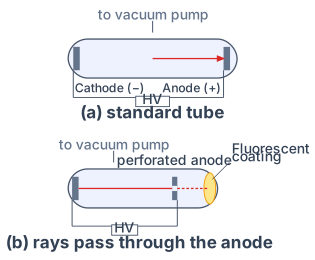
To study them, scientists made a clever modification: they drilled a hole in the anode and coated the back of the tube with a phosphorescent material like zinc sulphide. The cathode rays, passing through the hole, struck the coating and produced a bright spot. This made the invisible rays visible.
Drawn by us to help you understand the concept clearly, and verified to make sure it's accurate. For exams, practice from your textbook's own diagram.
Fig. 2.1 shows two versions of a cathode ray discharge tube — the apparatus that led to the discovery of the electron. Both are horizontal glass cylinders with a flat metal cathode (negative electrode) sealed into the left end and a flat metal anode (positive electrode) sealed into the right end. A high-voltage source is connected across them, and a tube at the top leads to a vacuum pump, which removes air from the cylinder until the pressure inside is very low.
In panel (a), the tube is simple: the cathode and anode face each other directly. When the voltage is high enough and the pressure low enough, a stream of particles — the cathode rays — flows from the cathode toward the anode. These rays are invisible to the eye, but their path can be inferred from the effects they produce.
Panel (b) shows a crucial modification. The anode is now perforated — it has a hole in its centre. Beyond the anode, at the far right end of the tube, the glass is coated with a fluorescent material (zinc sulphide). A dashed red line in the diagram traces the path of the cathode rays: they leave the cathode, travel straight across the tube, pass through the hole in the anode, and continue until they strike the fluorescent coating. Where they hit, a bright spot appears. This spot proves that the rays travel in straight lines and that they carry enough energy to make the coating glow.
The physical idea is simple but profound. By creating a narrow beam of cathode rays that emerges from the far side of the anode, scientists could study the rays in isolation — free from the electric fields near the electrodes. This beam could then be bent by external electric or magnetic fields, allowing precise measurements of the particles' properties.
The fluorescent coating is essential because the cathode rays themselves are invisible. The bright spot is the only direct evidence that the rays have passed through the anode and struck the screen. This same principle is used in old television picture tubes, where an electron beam scans a fluorescent screen to create an image.
The textbook uses this figure as the foundation for J.J. Thomson's measurement of the charge-to-mass ratio of the electron. By applying perpendicular electric and magnetic fields to the beam (as shown in a later figure, Fig. 2.2), Thomson could balance the forces so that the beam hit the centre of the screen undeflected. From the field strengths required, he calculated:
Here, is the magnitude of the charge on the electron (in coulombs), and is the mass of the electron (in kilograms). The ratio is enormous because the electron is extremely light — about 1836 times lighter than the hydrogen atom. This large value of tells us that the electron carries a substantial charge for its tiny mass, which is why it deflects so easily in electric and magnetic fields. …
The Five Properties of Cathode Rays
The experiments with the cathode ray tube yielded five definitive properties. Each one is a piece of the puzzle.
- Direction of Travel: Cathode rays start from the cathode and move towards the anode. This is the fundamental direction of their flow.
- Visibility: The rays themselves are invisible. Their presence is only detected when they strike a fluorescent or phosphorescent material, causing it to glow. This is the principle behind the television picture tube — a modern cathode ray tube where electrons strike a phosphor-coated screen to create the image.
- Straight-Line Travel in the Absence of Fields: In the absence of any external electric or magnetic field, cathode rays travel in perfectly straight lines.
- Deflection by Fields — The Negativity Test: This is the critical property. When an electric field or a magnetic field is applied, the cathode rays are deflected. The direction of deflection is exactly what you would expect from a stream of negatively charged particles.
These negatively charged particles were named electrons. …Watch out
A common mistake is to confuse the direction of deflection. Remember: a negatively charged particle is attracted to the positive plate and repelled by the negative plate. The deflection of cathode rays towards the positive plate is the direct evidence for their negative charge.