Chemistry · Ch 2 — Structure of Atom
Rutherford's Nuclear Model of Atom
Rutherford's Nuclear Model of Atom
The Alpha-Particle Scattering Experiment
Rutherford’s nuclear model of the atom was born from a single, decisive experiment. Along with his students Hans Geiger and Ernest Marsden, Rutherford bombarded an extremely thin gold foil with a beam of alpha-particles. These alpha-particles are positively charged, heavy particles (they are, in fact, helium nuclei). The idea was to see what happened when these tiny, fast projectiles passed through the atoms of the foil.
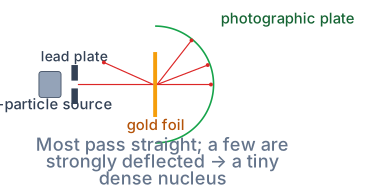
Drawn by us to help you understand the concept clearly, and verified to make sure it's accurate. For exams, practice from your textbook's own diagram.
Rutherford’s alpha-particle scattering experiment is one of the most important experiments in atomic physics. Figure 2.5 in your textbook shows this experiment in two complementary views.
The figure is a schematic of the apparatus. A radioactive source emits a narrow beam of alpha-particles (helium nuclei, ). This beam passes through a slit in a lead plate, which collimates it into a fine, well-defined ray. The beam then strikes a very thin gold foil, only a few thousand atoms thick. Curving around the foil is a semicircular photographic plate — the detector the textbook's own figure shows — which records where each alpha-particle lands. From the recorded marks, Rutherford's team could count the number of alpha-particles scattered at each angle measured from the original beam direction. (Historically the detection used a zinc-sulphide scintillation screen watched through a microscope; the photographic plate in the diagram is the standard schematic representation.)
The ray paths drawn through the foil tell the whole story at a glance. Most rays pass straight through, completely undeflected — this is what the vast majority of alpha-particles do. A few bend through small angles as they pass near a nucleus. And a rare one rebounds sharply back toward the source — the alpha-particle that made a nearly head-on approach to a nucleus and was repelled backward. (The book's own version additionally zooms in on a row of gold atoms to show these same three fates at the atomic scale.)
The key physical idea is that the atom is mostly empty space. The nucleus occupies only about m of the atom’s m diameter — a factor of smaller. This is why almost all alpha-particles go straight through: they simply miss the tiny nucleus. Only those that come very close to the nucleus experience the strong electrostatic repulsion that causes large-angle scattering.
From this experiment, Rutherford derived the formula for the number of alpha-particles scattered through an angle :
Where:
- = number of alpha-particles scattered through angle
- = number of incident alpha-particles
- = number of atoms per unit volume in the foil
- = thickness of the foil
- = atomic number of the foil (for gold, )
- = elementary charge ( C)
- = distance from the foil to the screen
- = Coulomb constant factor ( is the permittivity of free space)
- = kinetic energy of the incident alpha-particles
- = scattering angle measured from the original direction
The dependence is the most striking prediction. It means that the number of particles scattered at large angles falls off extremely rapidly — for example, at , , but at , . This huge variation is exactly what the experiment confirmed. …
If the prevailing "plum pudding" model of the atom were correct — where the positive charge was spread out like a pudding — the alpha-particles should have passed through the foil with only very slight, if any, deflection. The results were shocking.
Most of the alpha-particles did indeed pass straight through the foil, as if the atoms were mostly empty space. But a small number were deflected through large angles, and a very few — about one in 20,000 — actually bounced back, almost reversing their direction. Rutherford famously remarked that it was as if you had fired a 15-inch shell at a piece of tissue paper and it came back and hit you.
The experiment also involved beta-particles (which are fast-moving electrons) and gamma-rays (high-energy, neutral electromagnetic radiation). For the purpose of understanding the atom's structure, the alpha-particle scattering results were the most revealing. The penetrating power of these radiations increases from alpha (least) to beta (100 times that of alpha) to gamma (1000 times that of alpha).
Observations and the Inescapable Conclusion
The only way to explain these results was to conclude that the positive charge and almost all the mass of an atom are concentrated in an incredibly tiny, dense central core. This core was named the nucleus.
To grasp the scale: if a cricket ball represented the nucleus of an atom, the entire atom would have a radius of about 5 kilometers. The atom is mostly empty space.
The Nuclear Model of the Atom
Based on these observations, Rutherford proposed a new model for the atom. It has three central postulates:
(I) The Nucleus: The positive charge and the vast majority of the atom's mass are densely packed into an extremely small region at the center of the atom. This region is called the nucleus.
(II) The Planetary Electrons: The nucleus is surrounded by electrons that move around it at very high speeds in circular paths. These paths are called orbits. This arrangement is strikingly similar to the solar system, where the nucleus plays the role of the sun and the electrons are like the planets revolving around it. …