Mathematics · Ch 9 — Straight Lines
Angle Between Two Lines
Angle Between Two Lines
Angle Between Two Lines
When we work with just one line in a plane, we talk about its slope and inclination. But the moment we consider two lines, a natural question arises: what is the angle between them? Two lines in a plane can either intersect or be parallel. For intersecting lines, we need a way to find the angle between them using their slopes — and that is what this section is about.
Setting Up the Problem
Consider two non-vertical lines and with slopes and respectively. Let their inclinations (angles with the positive x-axis) be and . From the definition of slope, we have:
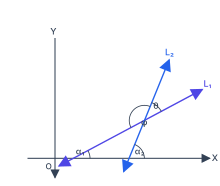
When two lines intersect, they form two pairs of vertically opposite angles. The sum of any two adjacent angles is . Let and be the two adjacent angles between and , as shown in the figure.
From the geometry of the situation, one of these angles equals the difference of the inclinations:
This holds provided (so that the slopes are defined). Using the tangent subtraction formula:
This expression is valid as long as .
The other adjacent angle is supplementary to :
Therefore:
The formula gives the tangent of one of the two adjacent angles. It could be acute or obtuse depending on the sign of the expression. Do not assume it always gives the acute angle.
Two Cases Arise
The sign of the expression determines which of and is acute and which is obtuse.
Case I: If is positive, then is positive and is negative. This means is acute (since positive for acute angles) and is obtuse.
Case II: If is negative, then is negative and is positive. This means is obtuse and is acute.
The acute angle between two lines with slopes and is always given by:
The absolute value ensures we get the acute angle. The obtuse angle can then be found from .
The Formula for Acute Angle
The textbook presents the acute angle formula as:
This formula gives the acute angle between any two non-vertical lines. If , the lines are perpendicular (since ), and the angle between them is .
Worked Example 2: Finding the Slope of the Other Line
Problem: The angle between two lines is and the slope of one line is . Find the slope of the other line.
Solution:
Let and let be the unknown slope. The acute angle .
Using the formula:
Since , we have:
This gives two possibilities (removing the absolute value):
Case 1:
Case 2:
Therefore, the slope of the other line is either or .
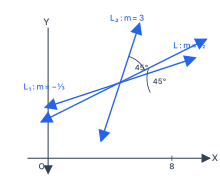
Two answers arise because the given angle could be the acute angle between the lines in two different configurations. The figure in the textbook (Fig 9.7) shows this geometrically — the line with slope can make an angle of with two different lines, one steeper and one shallower. …
Drawn by us to help you understand the concept clearly, and verified to make sure it's accurate. For exams, practice from your textbook's own diagram.
Fig 9.6 is a simple coordinate-plane sketch with two non-vertical lines, L₁ and L₂, crossing each other above the x-axis. L₁ is the shallower line (smaller slope), L₂ the steeper one (larger slope). Each line meets the x-axis at a distinct point, and at those crossing points the angle each line makes with the positive x-axis is marked: α₁ for L₁, α₂ for L₂. Both α₁ and α₂ are measured anticlockwise from the positive x-axis, so α₂ > α₁.
At the intersection point of L₁ and L₂, two adjacent angles are labelled: θ (the acute angle) and φ (the obtuse angle). The figure makes clear that θ = α₂ − α₁, because the exterior angle of a triangle equals the sum of the opposite interior angles — or, more directly, because the angle between the two lines is simply the difference of their inclinations.
The physical idea is simple: the steepness of a line is captured by its slope, and the angle between two lines can be expressed purely in terms of their slopes, without needing to draw the lines or measure angles with a protractor. The figure anchors the derivation that follows.
where is the acute angle between the lines, , , and .
The obtuse angle is , so .
The figure also illustrates why two answers appear when solving for an unknown slope: depending on which line is taken as L₁ and which as L₂, the acute angle formula gives either the slope of the steeper line or the shallower one. In Example 2, the two possible slopes (3 and ) correspond to the two lines that make a angle with a given line of slope — one on each side of it. …
Drawn by us to help you understand the concept clearly, and verified to make sure it's accurate. For exams, practice from your textbook's own diagram.
Fig. 9.7 is a geometric demonstration of why the angle-between-lines formula gives two possible slopes for the second line when the angle is fixed. The figure shows three lines that all pass through a single point (they are concurrent). One line, labelled L, has slope . A second line, labelled L₂, has slope . A third line, labelled L₁, has slope . Between L and L₂, and between L and L₁, a small arc is drawn. An '8' tick appears on the x‑axis (likely a coordinate label or a distance mark, though its exact meaning is not elaborated in the text).
The physical idea is this: if you know the slope of one line () and the acute angle between it and another line (), there are two distinct lines that satisfy that condition — one on each side of the given line. The line L₂ makes a angle with L when measured in one direction; the line L₁ makes the same angle when measured in the opposite direction. Their slopes are different because the angle is measured from L to each line in opposite senses.
The textbook develops this with the formula for the acute angle between two lines of slopes and :
Here is the known slope (), (), and is the unknown slope. Removing the absolute value gives two equations:
Solving the first yields (line L₂). Solving the second yields (line L₁). The figure makes this concrete: both lines L₂ and L₁ are at to L, but on opposite sides, so their slopes are not the same. …