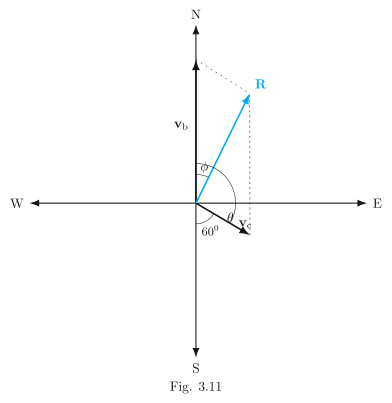
Q.A motorboat is racing towards north at 25km/h and the water current in that region is 10km/h in the direction of 60∘ east of south. Find the resultant velocity of the boat.
Imagine you're sitting in a train that's moving smoothly. The person sitting opposite you appears to be perfectly still — yet both of you are hurtling past trees and buildings outside at 80 km/h. Which is the "real" velocity? The answer is: there is no single real velocity. Velocity always depends on who is measuring it.
That's the core idea of relative velocity: the velocity of an object as seen from a particular frame of reference. Change the frame, and the measured velocity changes.
The Intuition: Walking on a Moving Train
Let's build this step by step.
Step 1 — You on a stationary train.
You walk forward at 3 km/h inside the aisle. A friend on the platform sees you moving at exactly 3 km/h. Simple.
Step 2 — The train moves at 80 km/h, you stand still inside.
Your friend on the platform sees you moving at 80 km/h (the train's speed). You see the platform rushing backward at 80 km/h.
Step 3 — You walk forward at 3 km/h while the train moves at 80 km/h.
Your friend on the platform sees you moving at 80+3=83 km/h.
But the person sitting next to you sees you moving at just 3 km/h.
Same you, same walking speed — two different observers, two different velocities. That's relative velocity in action.
Note
The "velocity" you feel is always relative to something. When you say "a car is moving at 60 km/h", you usually mean relative to the ground. But the ground itself is moving (Earth rotates, orbits the Sun, etc.). There is no absolute rest frame.
The Precise Definition
Relative velocity of object A with respect to object B is the velocity of A as measured by an observer who is at rest with respect to B.
Mathematically, if vA and vB are velocities of A and B measured in the same frame (say, the ground), then:
vAB=vA−vB
Where vAB means "velocity of A relative to B".
Read this carefully: you subtract the velocity of the reference object (B) from the velocity of the object you're tracking (A).
Why Subtraction? — The Logic
Think of the train example again. Let:
vyou = your velocity relative to ground = 83 km/h forward
vtrain = train's velocity relative to ground = 80 km/h forward
Your velocity relative to the train is:
vyou,train=vyou−vtrain=83−80=3 km/h forward
That matches: the person on the train sees you walking forward at 3 km/h.
Now what about the platform's velocity relative to you?
Platform is at rest relative to ground: vplatform=0
vplatform, you=0−83=−83 km/h
The negative sign means the platform appears to move backward relative to you — which is exactly what you see from the moving train.
Watch out
A common mistake: thinking relative velocity is just adding speeds. It's vector subtraction. If two objects move in opposite directions, you subtract a negative — which becomes addition. Always use the vector formula.
One-Dimensional Cases (The Simplest)
When motion is along a straight line, we can use signs (+ for one direction, − for the opposite).
Concept: Relative velocity — the boat's velocity relative to ground is the vector sum of its velocity relative to water and the water current's velocity.
Take north =+j^, east =+i^. Boat: vb/w=25j^km/h.
Current (10km/h, 60∘ east of south): vw/g=53i^−5j^km/h.
Adding the boat's velocity through water to the water current's velocity (as vectors) gives a resultant boat velocity of 519≈21.8km/h, directed at tan−1(43)≈23.4∘ east of north.
Figure 3.11
Figure 3.11 shows both vectors on a compass: vb pointing due north (the boat's own velocity through the water) and vc pointing 60∘ east of south (the water current), with the resultant R and the angles θ (between vb and vc) and ϕ (between vb and R) marked.
Why this is a relative-velocity problem
A motorboat moves through the water, but the water itself is moving relative to the ground. The boat's velocity relative to the ground is the vector sum:
vb/g=vb/w+vw/g
where vb/w is the boat's velocity relative to water (25km/h north) and vw/g is the current's velocity relative to ground (10km/h, 60∘ east of south).
Step 1 — Set up axes
Let north be +j^ and east be +i^.
vb/w=25j^km/h
"60∘ east of south" means: starting from south, rotate 60∘ toward east.
Concept: Reusing the General Two-Vector Resultant Formula
Method: Direct Substitution into the Law-of-Cosines Result (no unit-vector components)
This is exactly a "resultant of two vectors at angle θ" problem -- the same situation solved in general in Method 3.5. Rather than re-deriving everything with i^,j^ components, this method finds the angle between the two given vectors from their compass directions, then substitutes straight into R=A2+B2+2ABcosθ and tanα=A+BcosθBsinθ.
Steps
Identify the two vectors and their compass bearings. Boat-through-water: A=25km/h, bearing 0∘ (due north). Current: B=10km/h, bearing 60∘ east of south =180∘−60∘=120∘ (measuring bearing clockwise from north).
Find the angle θ between the two vectors -- simply the difference of their bearings:
θ=120∘−0∘=120∘
Substitute directly into the general magnitude formula (no components written down at all):