Computer Science · Ch 10 — Computer Networks
Mesh Topology
Mesh Topology
A mesh topology is built on the principle of direct connection: every device in the network is connected to every other device. If there are devices, each device needs cables, and the total number of links in the network is . This is the most interconnected of all topologies.
The textbook highlights four key advantages of this arrangement.
First, a mesh network can handle large amounts of traffic because multiple nodes can transmit data simultaneously. There is no single shared cable that becomes a bottleneck — each pair of devices has its own dedicated path.
Second, the network is highly reliable. If one node fails or goes down, it does not break the transmission of data between any other pair of nodes. Data can always be rerouted through an alternative direct link.
Third, mesh topology is more secure than other topologies. Since each cable between two nodes carries different data, a single cable tap or failure only exposes the traffic between that specific pair, not the entire network's communication.
The textbook then turns to the drawbacks, which are significant.
Wiring is complex. Running cables between every pair of devices quickly becomes unmanageable as the number of devices grows.
Cabling cost is high. The sheer number of cables and the network interfaces required make this the most expensive topology to implement.
There are many redundant or unutilised connections. In practice, not every pair of devices needs to communicate constantly, so a large portion of the cabling sits idle most of the time. …
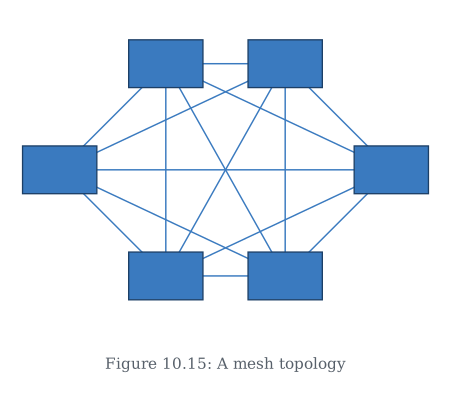
Drawn by us to help you understand the concept clearly, and verified to make sure it's accurate. For exams, practice from your textbook's own diagram.
In a mesh topology, every single node is directly wired to every other node — there's no central device at all. With 6 nodes here, that means 15 separate connections (the formula is n(n−1)/2 for n nodes).
The upside: it's extremely reliable, since losing any one connection still leaves plenty of other paths between nodes. The downside is obvious from the tangle of lines in the middle — a mesh needs a LOT of cabling, which mak …