Computer Science · Ch 10 — Computer Networks
Tree or Hybrid Topology
Tree or Hybrid Topology
A network topology is the physical or logical arrangement of devices. When a network is large and complex, it is rarely practical to use a single basic shape like a star or a ring. Instead, different topologies are combined to form a hybrid topology, also called a tree topology because of its hierarchical, branching structure.
In a tree or hybrid topology, there are multiple branches. Each branch can itself be a basic topology — a star, a ring, or a bus. This is not a single shape but a network of networks. Such arrangements are commonly seen in Wide Area Networks (WANs), where several Local Area Networks (LANs) are connected together. Each of those LANs might be a ring, a bus, or a star.
The textbook gives a specific example: a hybrid topology that connects four star topologies along a single bus. In this setup, data transmitted from a source device first reaches a centralised device (the hub or switch of its own star). From there, the data passes through every branch of the larger network. Each branch can have further links for more nodes, creating a hierarchy.
The textbook also poses a question for reflection: How will a Bus and Ring topology behave in case a Node is down? This is a prompt to think about fault tolerance — in a bus, a single node failure does not break the entire network, but a break in the backbone cable does. In a ring, a single node failure can break the entire loop unless a dual-ring or self-healing mechanism is used.
Key characteristics of a Tree/Hybrid Topology:
- Hierarchical structure: The network is organised in levels, with a main backbone (often a bus) and branches coming off it.
- Combination of topologies: A single network can contain star, ring, and bus segments working together.
- Centralised control at each level: Data flows from a source to a central device (like a switch or hub) within its local segment, and then to the backbone.
- Scalability: New branches or entire LANs can be added to the backbone without disrupting existing segments. …
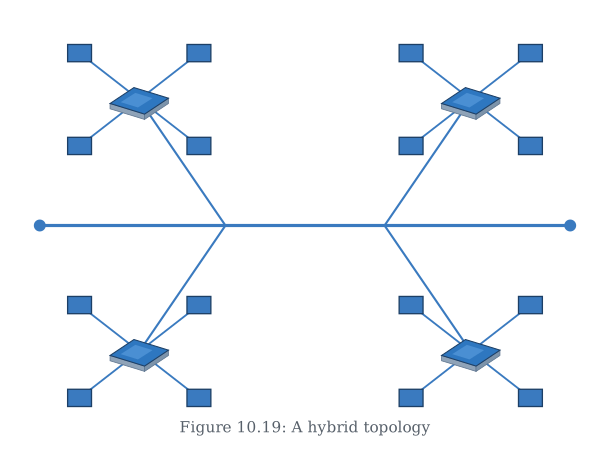
Drawn by us to help you understand the concept clearly, and verified to make sure it's accurate. For exams, practice from your textbook's own diagram.
A hybrid topology combines more than one basic topology into a single larger network. Here, four separate star topologies — each with its own central switch and its own set of connected nodes — are themselves linked together along one shared bus line. …