Physical Education · Ch 8 — Biomechanics and Sports
Application of Projectile in Sports
Application of Projectile in Sports
Application of Projectile in Sports
Projectile motion turns up throughout daily life, technology and especially sport. Because most sports involve the flight of a projectile — usually a ball — physics can be used to work out the optimal angle that maximises speed or distance. The following applications are a popular topic in NCERT Physical Education Class 12 real previous-year questions.
Baseball
Pitching analysis. Projectile motion applies both to throwing and to hitting. A thrown ball is in projectile motion while it is mid-air, because the only force acting on it is the acceleration due to gravity. The trajectory of a pitch depends on several things, including the pitcher's height, the arm angle and the spin put on the ball.
Hitting analysis. For hitting, advanced analytics use the "launch angle" — the angle at which the ball leaves the bat the instant they connect — as a good indicator of the best angle to strike the ball. The best launch angles, which produce line drives and home runs, work out to roughly 10–30 degrees, giving the ball flight needed to clear the fence at about 325 to 400 feet.
Basketball
Basketball is another clear example of projectile motion. For a shot to drop through the hoop it must be released at a certain angle and with a certain force, and the optimal angle varies with the height from which the ball is shot and the player's distance from the hoop. According to Professor John Fontanella, the ideal angles from the free-throw line vary from 48.7 degrees to 52.2 degrees for shorter players.
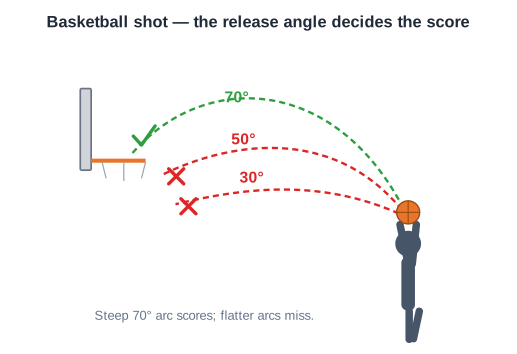
Drawn by us to help you understand the concept clearly, and verified to make sure it's accurate. For exams, practice from your textbook's own diagram.
A diagram of a basketball shot towards a schematic hoop, showing three dashed arcs released at 30, 50 and 70 degrees; the steep 70-degree arc (green, ticked) drops cleanly into the hoop while the flatter 50- and 30-degree arcs (red, crossed) miss, illustrating how th …
…