Physical Education · Ch 8 — Biomechanics and Sports
Factors Affecting Projectile Trajectory / Flight Path
Factors Affecting Projectile Trajectory / Flight Path
Factors Affecting Projectile Trajectory / Flight Path
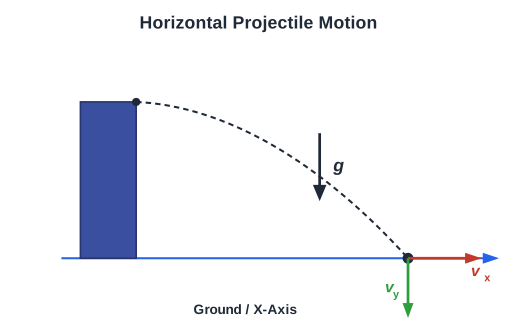
Drawn by us to help you understand the concept clearly, and verified to make sure it's accurate. For exams, practice from your textbook's own diagram.
A diagram titled 'Horizontal Projectile Motion' in which an object leaves the top of a raised block horizontally, follows a dashed curved path to the ground, and lands with its velocity split into a horizontal component (v_x) and a vertical component (v_y), wh …
The path a projectile follows — its trajectory or flight path — depends on six main factors: (a) gravity, (b) air resistance, (c) speed of release, (d) angle of release, (e) height of release, and (f) spin. These factors are a standard set of CBSE Class 12 Physical Education questions and answers.
- (a) Gravity — gravity is the force the earth exerts on every object towards its centre, and it is directly proportional to the mass of the body. Without gravity a thrown body would simply travel in a straight line.
- (b) Air resistance — several factors bring air resistance into play:
- Surface area — the larger the surface area, the more air resistance affects the object (a basketball compared with a golf ball).
- Speed — as speed increases, so does air resistance (the space shuttle is an extreme example).
- Surface of the object — a rough surface gives greater air resistance (the swinging cricket ball).
- Mass — the smaller the mass (the lighter the object), the more air resistance affects it (the badminton shuttle).
- (c) Speed of release — how fast the object is thrown or hit, largely set by muscle force. Generally, the greater the release speed, the greater the distance gained (as in throwing events such as the javelin and discus).
- (d) Angle of release (projection angle) — the angle at which the object is sent into the air; it varies with the activity. An angle above 45 degrees is needed for a basketball shot, while a much lower angle of about 3 to 15 degrees suits a tennis stroke. …