Chemistry · Ch 3 — Chemical Kinetics
Zero Order Reactions
Zero Order Reactions
What "zero order" means
A reaction is zero order when its rate does not change at all as the reactant is used up — the rate is proportional to the reactant concentration raised to the power zero. For a generic reaction
the rate law is written as
where is the concentration of the reactant at time and is the rate constant. Since anything raised to the power zero equals one, this simplifies to
so the rate is just a constant — it stays the same however much reactant is left.
Deriving the integrated rate equation
Rearranging the differential form so the variables separate,
Integrating both sides gives
where is the constant of integration. To pin down , use the condition that at the reactant is at its initial concentration, . Substituting,
Putting this value of back in gives the integrated rate equation for a zero order reaction:
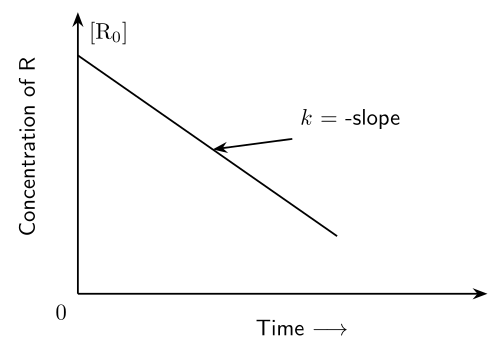
Matching this against the equation of a straight line, , shows that a plot of against is a straight line with slope and intercept (see the accompanying zero-order concentration-vs-time figure).
Drawn by us to help you understand the concept clearly, and verified to make sure it's accurate. For exams, practice from your textbook's own diagram.
The figure is a straight-line graph that shows how the concentration of a reactant changes with time for a zero-order reaction.
- The vertical axis (y-axis) is labelled "Concentration of R" (units: mol L⁻¹).
- The horizontal axis (x-axis) is labelled "Time" (units: s or min).
- The curve is a single straight line that begins at on the y-axis (the initial concentration at ) and slopes downward linearly as time increases.
- The line is annotated with "k = –slope", indicating that the slope of this line is negative and its magnitude equals the rate constant .
Physical idea: In a zero-order reaction, the rate is constant — it does not depend on the concentration of the reactant. Therefore, the concentration decreases at a steady, unchanging rate. This is why the plot is a straight line: equal decreases in occur in equal time intervals.
Key formula developed from this figure:
The equation of the straight line is derived from the integrated rate law for a zero-order reaction:
Comparing with the standard straight-line equation :
- is
- is
- slope
- intercept …
Rearranging the same equation for the rate constant gives an equally useful working form:
so can be read straight off a pair of concentration measurements taken at and at any later time .
Where zero order kinetics actually shows up
Zero order behaviour is uncommon among ordinary reactions in solution, but it does appear under special conditions — most notably in some enzyme-catalysed reactions and in reactions that proceed on the surface of a solid catalyst.
A reaction is zero order in a reactant only under the specific conditions that make its rate concentration-independent (e.g., a saturated catalyst surface) — it is a special case, not a general property of that reaction.
A classic example is the decomposition of gaseous ammonia on a hot platinum surface at high pressure:
…