Physics · Ch 12 — Atoms
Alpha-particle Trajectory
Alpha-particle Trajectory
The Trajectory of an Alpha Particle
When a beam of alpha particles is fired at a thin gold foil, each particle follows a curved path — a trajectory — determined by the repulsive electric force from the nucleus. The key quantity that decides the path is the impact parameter, denoted by .
The impact parameter is defined as the perpendicular distance between the initial velocity vector of the alpha particle and the centre of the nucleus. Imagine the alpha particle approaching the nucleus along a straight line that would miss the centre by some distance if there were no force. That distance is the impact parameter.
In a typical beam, different alpha particles have different impact parameters. Some pass very close to the nucleus (small ), while others pass far away (large ). Since all particles in the beam have nearly the same kinetic energy, the only thing that varies from particle to particle is . This variation causes the beam to scatter in all directions, with different probabilities for different scattering angles.
The scattering angle is the angle through which the alpha particle's direction changes. A head-on collision gives (rebound), while a near-miss gives (almost no deflection).
How the Impact Parameter Controls the Trajectory
The relationship between and the scattering angle is straightforward and physically intuitive:
-
Small impact parameter — the alpha particle comes very close to the nucleus. The repulsive Coulomb force is strong, so the particle suffers a large deflection. In the extreme case of a head-on collision, is minimum (effectively zero), and the alpha particle rebounds back along its original path, giving .
-
Large impact parameter — the alpha particle passes far from the nucleus. The Coulomb force is weak, so the particle goes nearly undeviated, with a small deflection . …
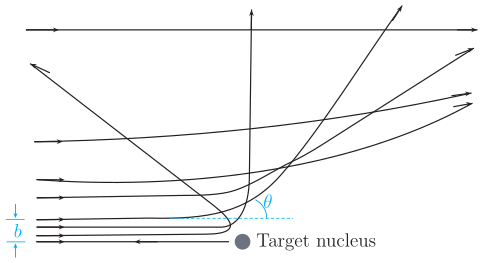
Drawn by us to help you understand the concept clearly, and verified to make sure it's accurate. For exams, practice from your textbook's own diagram.
Fig. 12.4 is a schematic diagram — not a plot with axes, but a trajectory map showing several incoming alpha particles approaching a single target nucleus from the left. The nucleus is drawn as a small dot at the centre. Each alpha particle follows a different path, and the key variable that determines which path it takes is the impact parameter .
The impact parameter is defined as the perpendicular distance from the centre of the nucleus to the initial straight-line path of the alpha particle (the line it would follow if no force acted). In the figure, is marked as a short line segment drawn from the nucleus to the initial velocity line, meeting it at a right angle. The scattering angle — the angle between the incoming and outgoing asymptotic directions — is also labelled on one of the trajectories.
The physical idea is beautifully simple. The alpha particle and the nucleus both carry positive charge, so they repel each other with a Coulomb force that varies as . A particle with a small impact parameter passes very close to the nucleus, feels a strong repulsive force, and is deflected through a large angle — in the extreme case of a head-on collision (), it rebounds almost straight back (). A particle with a large impact parameter stays far from the nucleus, feels only a weak force, and is deflected through a small angle (). The figure shows several such trajectories side by side, each with a different , so you can see the continuous variation from nearly undeviated to nearly back-scattered.
The figure makes a crucial point about atomic structure: only a tiny fraction of alpha particles in a beam have a small impact parameter and are scattered through large angles. This tells us that the positive charge and most of the mass of an atom are concentrated in a very small volume — the nucleus. If the positive charge were spread out over the whole atom, large-angle scattering would be far more common.
The textbook uses this geometric picture to derive the distance of closest approach for a head-on collision. When an alpha particle (charge ) approaches a nucleus of atomic number (charge ) head-on, it slows down as it climbs the Coulomb potential hill, comes momentarily to rest at a distance , and then reverses direction. Conservation of energy gives:
where is the initial kinetic energy of the alpha particle. Solving for :
For a 7.7 MeV alpha particle striking a gold nucleus (), this gives m (30 fm). Since the alpha particle reverses without touching the nucleus, the actual nuclear radius must be smaller than this — a powerful upper limit on nuclear size. …