Physics · Ch 12 — Atoms
Energy Levels
Energy Levels
The Meaning of Energy Levels
The energy of an atom is not a continuous quantity — it takes only certain discrete values. For a hydrogen atom, the energy is most negative (i.e., the lowest) when the electron is in the orbit closest to the nucleus, the one labelled by the principal quantum number . As increases to 2, 3, and so on, the absolute value of the energy becomes smaller. Since the energy itself is negative, a smaller absolute value means a larger (less negative) energy. So the energy of the atom increases as the electron moves to outer orbits.
The state of lowest energy is called the ground state. For hydrogen, the electron in the ground state revolves in the orbit of smallest radius, the Bohr radius . The energy of this state is
This is a fundamental result from Bohr's model. The negative sign indicates that the electron is bound to the nucleus — you must supply energy to remove it.
Ionisation Energy
The minimum energy required to completely free the electron from the ground state of a hydrogen atom is the difference between the energy at infinity (zero) and the ground state energy:
This value, predicted by Bohr's model, agrees excellently with the experimentally measured ionisation energy of hydrogen. At room temperature, almost all hydrogen atoms are in their ground state.
The ionisation energy of hydrogen is 13.6 eV. This is the energy needed to remove the electron from the ground state completely.
Excited States and Excitation Energy
When a hydrogen atom receives energy — for example, through collisions with electrons — it can absorb just the right amount to lift its electron to a higher energy level. The atom is then said to be in an excited state.
From the general formula for hydrogen energy levels (Eq. 12.10 in the textbook), the energy for any state is
Using this, we can compute the energies of the first few excited states and the energy required to reach them from the ground state.
- For (first excited state):
The excitation energy from the ground state is
- For (second excited state):
The excitation energy from the ground state is
The pattern is clear: to excite the atom to a higher state, you must supply exactly the energy difference between that state and the ground state. Once excited, the electron can fall back to a lower state, emitting a photon whose energy equals the difference between the two levels.
A common mistake is to think the energy of an excited state is the energy required to reach it. The energy of the state itself is (a negative number). The energy required to reach it from the ground state is (a positive number).
The Energy Level Diagram
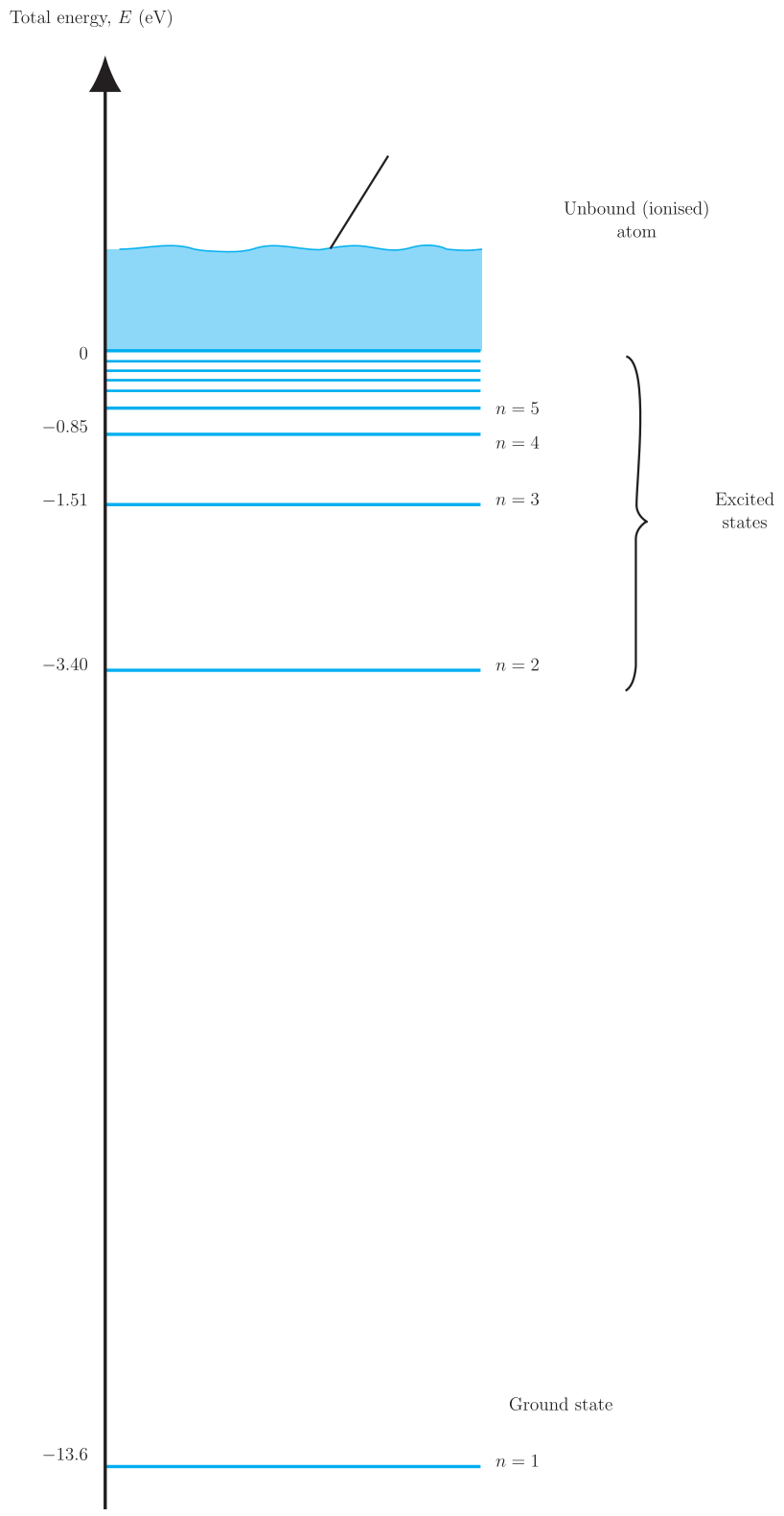
The stationary states of a hydrogen atom are often shown on an energy level diagram, computed from eV. The principal quantum number labels the states in ascending order of energy. The key features of this diagram are:
- The ground state () is at the bottom, at eV.
- Above it lie the excited states: at eV, at eV, at eV, and so on.
- As increases, the energy levels get closer and closer together. …
Drawn by us to help you understand the concept clearly, and verified to make sure it's accurate. For exams, practice from your textbook's own diagram.
The figure is a vertical energy-level diagram. The vertical axis is labelled "Total energy (eV)" and runs from negative values at the bottom up to zero at the top. Each horizontal line on this axis represents one allowed stationary state of the hydrogen atom. The lowest line, at , is labelled and is called the ground state. Above it, at , is the line; then at ; at ; and at a value even closer to zero. As increases, the lines crowd together, approaching from below. Above there is no longer a set of discrete lines — instead a shaded or blank region labelled "Unbound (ionised) atom" indicates a continuum of states where the electron is free.
The physical idea is simple but profound: the electron in a hydrogen atom cannot have just any energy. It can only occupy one of these specific, quantised levels. The lowest energy (most negative) is the most stable — the ground state. To move the electron to a higher level, the atom must absorb exactly the energy difference between the two levels. If the atom absorbs enough energy to reach or above, the electron escapes entirely; that is ionisation.
The key formula that generates every line in this diagram is the Bohr energy expression:
where is the principal quantum number. is the total energy of the atom when the electron is in the th orbit. The constant is the ionisation energy of hydrogen — the minimum work needed to remove the electron from the ground state.
From this formula, the textbook extracts several important numbers. The ground state energy is . The first excited state () has . The energy required to excite the atom from to is therefore:
Similarly, the second excited state () gives , and the excitation energy from the ground state is . As grows, the spacing between successive levels shrinks — the diagram shows this clearly as the lines bunch up near zero. At the limit , , which corresponds to a stationary electron infinitely far from the nucleus.
A common mistake is to think that the energy of the atom becomes positive for large . It does not — it approaches zero from below. Only when the electron is free (ionised) can the total energy be positive, and those states are not part of the discrete set shown in the diagram. …