Physics · Ch 9 — Ray Optics and Optical Instruments
Power of a Lens
Power of a Lens
What Does "Power of a Lens" Mean?
The power of a lens tells us how strongly it bends light.
- A lens with short focal length bends light a lot — it converges (convex) or diverges (concave) the rays sharply.
- A lens with long focal length bends light gently.
Definition of Power
Power is defined as the tangent of the angle by which the lens bends a ray of light that is:
- parallel to the principal axis,
- and falls at a unit distance from the optical centre.
From geometry (see Fig. 9.18 in the textbook), if unit and is the focal length:
For small angles, , so:
This is the fundamental formula for power.
Unit of Power
- SI unit: dioptre (D)
- A lens of focal length has power .
Sign Convention
- Convex (converging) lens: → (positive power)
- Concave (diverging) lens: → (negative power) …
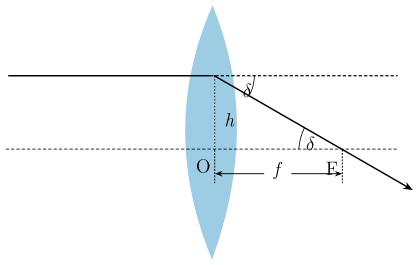
Drawn by us to help you understand the concept clearly, and verified to make sure it's accurate. For exams, practice from your textbook's own diagram.
What the figure shows
The figure depicts a thin convex lens placed on a horizontal principal axis. A ray of light, initially parallel to the principal axis, strikes the lens at a height above the axis. The point where the ray meets the lens is at a horizontal distance of one unit from the optical centre (the centre of the lens). After refraction, the ray bends and crosses the principal axis at the focus , which is at a distance (the focal length) from the optical centre.
The small angle is marked between the direction of the incident parallel ray and the direction of the refracted ray (the ray after it leaves the lens). The labels , , , optical centre, focus , and principal axis are all shown.
Physical idea
The figure illustrates the definition of power of a lens. A lens bends light; the more it bends, the shorter its focal length. The power is a quantitative measure of this bending ability. The key idea is to consider a ray that comes in parallel to the axis at a unit distance () from the optical centre. The angle through which this ray is bent (the deviation) is directly related to the focal length.
From the geometry of the figure, for a ray at height :
When (unit distance), this becomes:
For small angles, (in radians), so . The power is then defined as this tangent (or, for small angles, the angle itself):
Key formula and symbols
- : power of the lens (in dioptres, D)
- : focal length of the lens (in metres)
- : the angle (in radians) through which a ray parallel to the axis and at unit distance from the optical centre is deviated …