Q.(i) If f=0.5 m for a glass lens, what is the power of the lens?
🔒You're viewing a preview — the full solution, concept, methods & PYQ mapping are locked.
🔒 Start your 14-day free trial to unlock the full solution →Concept understanding — Lens Maker's Formula
The Intuition: Why a Lens Bends Light
A lens works because light slows down when it enters glass. When a wavefront hits a curved surface at an angle, different parts of it slow down at different moments, and the wavefront bends. The stronger the curvature, the more it bends.
A lens has two surfaces. Each surface bends light by an amount that depends on its radius of curvature R and the refractive index n of the glass. The net bending — the focal length f — is the combined effect of both surfaces.
If you had a single spherical surface separating air from glass, its contribution to bending power is Rn−1. A lens has two such surfaces: light goes from air into glass at the first surface, then from glass back into air at the second. Because the two surfaces face opposite directions relative to the travelling light, their radii typically carry opposite signs.
This uses the New Cartesian Sign Convention (the one used in NCERT and CBSE): all distances are measured from the optical centre, and the direction the incident light travels in is taken as positive. So R is positive if the centre of curvature lies on the side the light is travelling towards (the outgoing side), and negative if it lies on the side the light is travelling from (the incident side).
The Precise Statement
For a thin lens (thickness negligible compared to the radii), the Lens Maker's Formula is:
f1=(n−1)(R11−R21)
where:
- f is the focal length of the lens (positive for converging, negative for diverging)
- n is the refractive index of the lens material relative to the surrounding medium (usually air)
- R1 is the radius of curvature of the first surface (the one light reaches first)
- R2 is the radius of curvature of the second surface
f1=(n−1)(R11−R21)
How to Apply It: A Worked Example
Take a biconvex lens made of glass (n=1.5) with both surfaces having the same radius of curvature magnitude, 20 cm.
Light travels left to right. The first surface bulges toward the incoming light, so its centre of curvature lies to the right of the surface — on the side the light is travelling towards. By the rule above, R1=+20 cm.
The second surface also bulges outward (away from the lens), so its centre of curvature lies to the left of that surface — on the side the light is travelling from. So R2=−20 cm.
Plug in:
f1=(1.5−1)(201−−201)=0.5×(201+201)=0.5×202=201
So f=+20 cm. Positive means converging — correct for a biconvex lens.
The most common mistake is getting the sign of R2 wrong. For a biconvex lens, R1 is positive and R2 is negative. For a biconcave lens, it's the reverse: R1 negative, R2 positive. Always sketch the lens and mark where each surface's centre of curvature actually sits.
Why the Formula Works (Brief Derivation) …
Concept: Lens Maker’s Formula and Power of a Lens.
(i) Power P=f1 with f in metres.
P=0.51=2 D.
(ii) Lens Maker’s formula: f1=(μ−1)(R11−R21).
For double convex, R1=+10 cm, R2=−15 cm, f=12 cm.
121=(μ−1)(101+151)=(μ−1)(305)=(μ−1)61.
So μ−1=126=0.5, hence μ=1.5.
(iii) In air: fa1=(μg−1)(R11−R21).
In water: fw1=(μwμg−1)(R11−R21). …
The power of a lens is the reciprocal of its focal length in metres. The refractive index of glass can be found using the lens maker’s formula. The focal length of a lens changes when immersed in a different medium because the relative refractive index changes.
(i) Power of the lens
The power P of a lens is defined as the reciprocal of its focal length in metres:
P=f1
Given f=0.5 m:
P=0.51=2 D …
Method: Lens Maker’s Formula & Power of a Lens
This method connects the geometry (radii of curvature) and material (refractive index) of a lens to its focal length and power.
(i) Power from focal length
Formula:
P=f1
where f is in metres.
Steps:
- Given f=0.5 m.
- Apply formula:
P=0.51=2 D
Answer:
2 D
(ii) Refractive index from radii and focal length
Formula (Lens Maker’s Formula):
f1=(μ−1)(R11−R21)
Steps:
- For a double convex lens:
- R1=+10 cm (first surface convex toward object)
- R2=−15 cm (second surface convex, but sign convention makes it negative)
- Given f=12 cm.
- Substitute:
121=(μ−1)(101−−151)
- Simplify bracket:
101+151=303+2=305=61
- So:
121=(μ−1)×61
- Multiply both sides by 6:
126=μ−1⇒0.5=μ−1
- Therefore:
μ=1.5
Answer:
1.5
(iii) Focal length in water
Key idea: The lens maker’s formula uses relative refractive index of lens material with respect to surrounding medium.
Formula:
fmedium1=(μmediumμlens−1)(R11−R21)
Steps:
- In air:
fair1=(μglass−1)(R11−R21)
Given fair=20 cm, μglass=1.5.
2. In water:
fwater1=(1.331.5−1)(R11−R21)
- Take ratio: …
Common Mistakes & How to Avoid Them: Refraction at Spherical Surfaces & Lens Formula
Here are the most frequent errors students make on these three classic lens problems, along with the correct reasoning to avoid them.
(i) Power from Focal Length
Mistake 1: Forgetting the unit conversion
- Students often write P=0.51=2 D without checking units.
- Why it's wrong: The formula P=f1 requires f in metres. If f is given in cm, you must convert first.
Mistake 2: Confusing sign convention
- Some students write P=−f1 for a convex lens.
- Why it's wrong: For a convex (converging) lens, f is positive, so P is positive. The negative sign is for concave lenses.
✓ How to avoid:
- Always convert f to metres before plugging into P=f1.
- Remember: Convex lens → positive f → positive P.
Correct solution:
P=f1=0.51=2 D
(ii) Refractive Index from Radii & Focal Length
Mistake 1: Using the wrong sign for radii
- Students often take R1=+10 cm and R2=+15 cm for a double convex lens.
- Why it's wrong: By the Cartesian sign convention, for a double convex lens:
- First surface (left side): centre of curvature is to the right → R1=+10 cm
- Second surface (right side): centre of curvature is to the left → R2=−15 cm
Mistake 2: Forgetting the sign in the lens maker's formula
- The formula is:
f1=(μ−1)(R11−R21)
- Students often write R11+R21 instead of the subtraction.
Mistake 3: Unit inconsistency
- Using f=12 cm but R in metres, or vice versa.
✓ How to avoid:
- Always apply the sign convention systematically:
- Light travels from left to right.
- R is positive if the centre of curvature is to the right of the surface.
- R is negative if the centre of curvature is to the left.
- For a double convex lens: R1>0, R2<0.
- Keep all lengths in the same unit (cm or m).
Correct solution:
121=(μ−1)(101−−151)
121=(μ−1)(101+151)=(μ−1)×305
121=(μ−1)×61
μ−1=126=0.5
μ=1.5
(iii) Focal Length Change from Air to Water
Mistake 1: Using the wrong refractive index ratio
- Students often write:
fairfwater=μglass−μwaterμglass−1
but forget that the formula uses relative refractive indices.
Mistake 2: Confusing the lens maker's formula for different media
- The correct relation is:
fmediumfair=μglass−1(μglass/μmedium)−1
- Students often invert this ratio or use absolute indices incorrectly.
Mistake 3: Sign errors in the final answer …
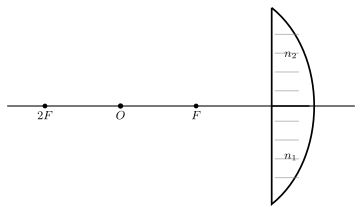
- Higher Secondary (+2 Stage) Examination 2026Set ANNUAL1 markMCQQ.The lens shown in the figure is made of two different materials having refractive indices n1 and n2. If a point-sized object is placed on the axis of the lens, how many images will be formed?(a) 1(b) 2(c) 3(d) 5
›Reveal solutionSolution
A lens split into two halves of different refractive index behaves like two lenses of different focal length sharing the same curvature — so a single point object produces two distinct images, one from each half.
When a lens is made of two materials of refractive indices n1 and n2 (split by a plane containing the principal axis), each half has the same radius of curvature but a different refractive index, so by the lens-maker's formula
f1=(n−1)(R11−R21) …
- Higher Secondary (+2 Stage) Examination 2024Set ANNUAL1 markQ.If red light is used instead of blue light, what change will occur in the focal length of a lens?
›Reveal solutionSolution
Because glass bends red light less than blue light (lower refractive index for longer wavelengths), a lens has a slightly longer focal length for red light than for blue.
By the lens maker's formula:
f1=(n−1)(R11−R21)
Due to dispersion, the refractive index of glass is slightly higher for blue light (shorter wavelength) than for red light (longer wavelength), i.e. nblue>nred. Since f1∝(n−1), a smaller n (red light) gives a smaller f1, i.e. a LARGER focal length.
…
🎓Unlock everything free for 14 days
- ✓Full step-by-step solutions
- ✓Concept-first explanations
- ✓Methods, shortcuts & mistakes
- ✓PYQ mapping + timed mock tests
Full access for 14 days. No credit card required.