Chemistry · Ch 4 — Chemical Bonding and Molecular Structure
Bonding in Some Homonuclear Diatomic Molecules
Bonding in Some Homonuclear Diatomic Molecules
4.8 Bonding in Some Homonuclear Diatomic Molecules
We now apply molecular orbital theory to specific homonuclear diatomic molecules — molecules made of two identical atoms. The pattern of filling molecular orbitals follows the same rules as atomic orbitals: electrons occupy the lowest available energy levels, obey the Pauli exclusion principle, and Hund's rule applies when degenerate orbitals are available. The key quantities we track are the electronic configuration, bond order, magnetic behaviour, and whether the molecule is stable enough to exist.
1. Hydrogen Molecule (H₂)
Each hydrogen atom contributes one electron in its 1s orbital. Two hydrogen atoms therefore supply two electrons total. These two electrons occupy the lowest-energy molecular orbital, which is the bonding σ1s orbital. The antibonding σ*1s orbital remains empty.
Electronic configuration:
Bond order calculation:
A bond order of 1 means the two hydrogen atoms are held together by a single covalent bond.
Experimental data: The bond dissociation energy of H₂ is 438 kJ mol⁻¹, and the bond length is 74 pm. (The book quotes 435.8 kJ mol⁻¹ in its valence-bond discussion and 438 kJ mol⁻¹ here — the same measurement to different precision.)
Magnetic property: Since all electrons are paired (no unpaired electrons), the H₂ molecule is diamagnetic — it is weakly repelled by a magnetic field.
The σ1s orbital is lower in energy than the 1s atomic orbitals from which it forms. The two electrons both go into this stabilised orbital, which is why the molecule is more stable than two separate atoms.
2. Helium Molecule (He₂)
Each helium atom has the configuration 1s², so two helium atoms together contribute four electrons. These four electrons fill both the σ1s and σ*1s molecular orbitals completely.
Electronic configuration:
Bond order calculation:
A bond order of zero means there is no net stabilisation. The bonding effect of the two electrons in σ1s is exactly cancelled by the antibonding effect of the two electrons in σ*1s. The He₂ molecule is therefore unstable and does not exist under ordinary conditions.
A bond order of zero does not mean the molecule cannot form momentarily in collisions — it means the molecule has no net bonding stability and will dissociate spontaneously.
Extension to Be₂: By the same reasoning, the Be₂ molecule would have the configuration:
Its bond order is also , so Be₂ does not exist either.
3. Lithium Molecule (Li₂)
Lithium has the electronic configuration 1s² 2s¹. Two lithium atoms contribute six electrons in total. The inner-shell electrons (1s² from each atom) fill the σ1s and σ*1s orbitals, while the two valence electrons (2s¹ from each atom) occupy the σ2s bonding orbital.
Electronic configuration:
A common shorthand notation uses "KK" to represent the filled K-shell (n=1) core:
Bond order calculation:
The four bonding electrons come from σ1s and σ2s; the two antibonding electrons come from σ*1s. The net result is a single bond.
Magnetic property: All electrons are paired — no unpaired electrons exist. Li₂ is diamagnetic.
Li₂ molecules are known to exist in the vapour phase, and they are indeed diamagnetic, confirming the prediction of molecular orbital theory.
4. Carbon Molecule (C₂)
Carbon has the configuration 1s² 2s² 2p². Two carbon atoms contribute twelve electrons. The filling order for second-row homonuclear diatomics follows the energy sequence we established earlier: σ1s, σ1s, σ2s, σ2s, then π2pₓ = π2p_y (degenerate), then σ2p_z, then π2pₓ = π2p_y, then σ*2p_z.
For C₂, the twelve electrons fill as follows:
Electronic configuration:
In shorthand:
Bond order calculation:
The eight bonding electrons come from σ1s, σ2s, π2pₓ, and π2p_y. The four antibonding electrons come from σ1s and σ2s.
Magnetic property: All electrons are paired — C₂ is diamagnetic. Diamagnetic C₂ molecules have indeed been detected in the vapour phase.
A remarkable feature of C₂ is that its double bond consists entirely of two pi bonds — there is no sigma bond between the carbon atoms in the valence region. The σ2s and σ*2s orbitals cancel each other out, leaving only the two π bonds. This is unusual: in most molecules, a double bond is composed of one sigma bond and one pi bond.
5. Oxygen Molecule (O₂)
Oxygen has the configuration 1s² 2s² 2p⁴. Two oxygen atoms contribute sixteen electrons. The filling proceeds through the same molecular orbital sequence.
Electronic configuration:
Bond order calculation:
The ten bonding electrons come from σ1s, σ2s, σ2p_z, π2pₓ, and π2p_y. The six antibonding electrons come from σ1s, σ2s, π2pₓ, and π2p_y.
A bond order of 2 means the oxygen atoms are held together by a double bond.
Magnetic property: The last two electrons occupy the degenerate π2pₓ and π2p_y orbitals singly, following Hund's rule. This gives two unpaired electrons. O₂ is therefore paramagnetic — it is attracted into a magnetic field.
O₂ at a glance: bond order 2, two unpaired π* electrons, paramagnetic.
| Property | Value |
|---|---|
| Bond order | 2 |
| Unpaired electrons | 2 |
| Magnetic behaviour | Paramagnetic |
| Bond type | Double bond (one σ, one π) |
The paramagnetism of oxygen is a famous triumph of molecular orbital theory. The older valence bond picture predicted O₂ to be diamagnetic. Experiment confirms that liquid oxygen is attracted by a magnet — exactly as MO theory predicts.
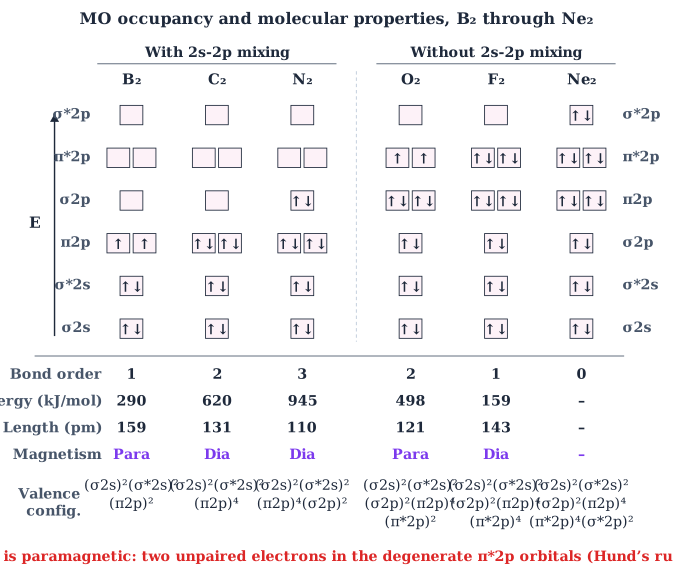
Summary of Second-Row Homonuclear Diatomics (B₂ through Ne₂) …
Drawn by us to help you understand the concept clearly, and verified to make sure it's accurate. For exams, practice from your textbook's own diagram.
Fig. 4.21 is a compact summary chart that runs across the six second-period homonuclear diatomics: B₂, C₂, N₂, O₂, F₂, and Ne₂. For each molecule, the figure shows three layers of information stacked vertically: the molecular orbital (MO) occupancy diagram, a set of numerical molecular properties, and the valence electron configuration.
What the diagram actually shows.
For each molecule, a vertical column lists the molecular orbitals in order of increasing energy. The orbitals are labelled as σ (sigma) and π (pi), with an asterisk () marking antibonding orbitals. The 2s-derived orbitals (σ2s, σ2s) appear lowest, then the 2p-derived set. For B₂, C₂, and N₂, the ordering is σ2pz above the π2p orbitals; for O₂, F₂, and Ne₂, the ordering reverses — σ2pz drops below π2p. Each orbital is drawn as a short horizontal line, and electrons are shown as arrows (up/down for spin) filling the orbitals according to Hund’s rule. The number of electrons in bonding vs. antibonding orbitals is thus visible at a glance.
Below each orbital diagram, a row of numbers gives the bond order, bond enthalpy (in kJ mol⁻¹), and bond length (in pm). A label indicates magnetic behaviour: “diamagnetic” or “paramagnetic” (O₂ is the only paramagnetic one here). Finally, the valence electron configuration is written in compact form, e.g., for O₂:
The physical idea the figure teaches.
The chart makes two key patterns visible. First, bond order — calculated as half the difference between bonding and antibonding electrons — rises from B₂ (bond order 1) to N₂ (bond order 3), then falls to Ne₂ (bond order 0). Bond enthalpy follows the same trend, while bond length is inversely related. Second, the filling order of π vs. σ orbitals changes after N₂, which explains why O₂ has two unpaired electrons in π* orbitals and is paramagnetic, whereas N₂ has no unpaired electrons and is diamagnetic. The figure thus ties together the MO energy-level diagram, the electron count, and the observable properties of each molecule.
The central formula that connects the diagram to the numbers is the bond order:
where is the number of electrons in bonding molecular orbitals and is the number in antibonding molecular orbitals. A bond order of zero means the molecule is unstable (does not exist as a stable species).
What the figure does not show. …