Informatics Practices · Ch 5 — Internet and Web
Wide Area Network (WAN)
Wide Area Network (WAN)
A Wide Area Network (WAN) is a network that spans a very large geographical area — much larger than a LAN or a MAN. While a Local Area Network connects computers within a single building or campus, and a Metropolitan Area Network covers a city, a WAN connects computers and other networks across different cities, countries, or even continents.
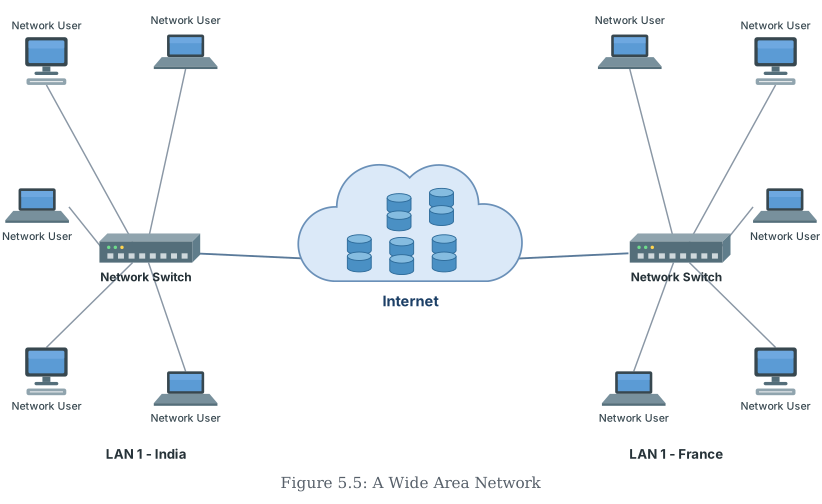
A WAN can be formed by connecting multiple LANs together. For example, a company with offices in Delhi, Mumbai, and New York can link its local networks in each city to create a single WAN. This connection can be made using either wired media (like fibre-optic cables) or wireless media (like satellite links). The textbook refers to this arrangement in Figure 5.5, which shows how several LANs are joined to form a WAN.
Large organisations — such as big businesses, educational institutions, and government agencies — rely on WANs to connect their branches located in different parts of the world. This allows employees in different offices to share data, access centralised resources, and communicate seamlessly.
The most well-known example of a WAN is the Internet itself. The Internet is the largest WAN in existence. It connects billions of computers, smartphones, and millions of LANs from every continent on Earth. In fact, the textbook notes that the Internet connects "billions of computers, smartphones and millions of LANs from different continents."
The Internet is the largest WAN in the world. It connects billions of devices and millions of smaller networks across the globe.
To summarise the key points about WANs: …
Drawn by us to help you understand the concept clearly, and verified to make sure it's accurate. For exams, practice from your textbook's own diagram.
Figure 5.5 is a schematic diagram that illustrates the core idea of a Wide Area Network: connecting separate local networks that are far apart. The diagram shows two distinct Local Area Networks, each drawn as a cluster of devices.
On the left side, one cluster is labelled LAN 1 – India. On the right side, another cluster is labelled LAN 1 – France. Each cluster contains several computers or user devices, all connected to a central device inside that cluster — a Network Switch. The switch acts as the hub for that LAN, managing traffic among the local devices.
Between these two LANs, the diagram places a large central cloud labelled Internet. Arrows or connecting lines run from the switch in LAN 1 – India into the Internet cloud, and from the Internet cloud out to the switch in LAN 1 – France. This shows that the two LANs are linked through the Internet, not through a direct cable between them.
The layout makes the geography clear: India and France are different countries, separated by thousands of kilometres. Yet the diagram shows that by routing traffic through the Internet, the two LANs can communicate as if they were part of a single larger network. That larger network is the WAN. …