Physical Education · Ch 2 — Children and Women in Sports
Kyphosis
Kyphosis
What is Kyphosis?
Kyphosis is a spinal deformity characterised by an excessive outward or backward curve of the thoracic region of the spine. In a healthy spine, the thoracic vertebrae naturally curve slightly outward (a normal kyphotic curve of about 20–40 degrees). When this curve becomes exaggerated beyond the normal range, the condition is called kyphosis. The visible result is a hunched or rounded upper back, often described as a "dowager's hump" or "hunchback."
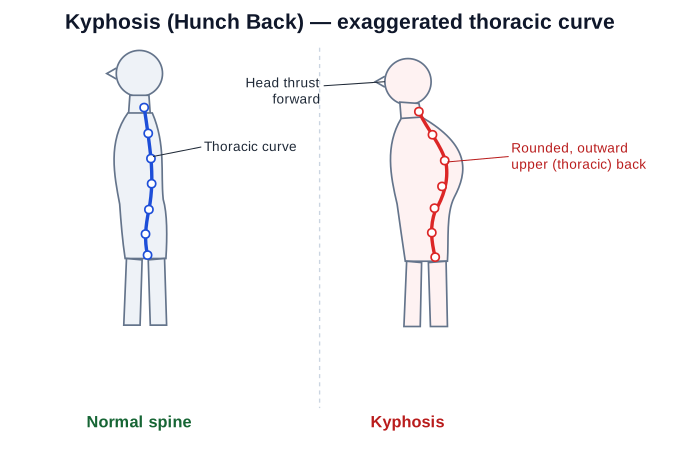
Drawn by us to help you understand the concept clearly, and verified to make sure it's accurate. For exams, practice from your textbook's own diagram.
A lateral (side) view of a human figure with the vertebral column drawn in vertebra by vertebra, showing the exaggerated outward, convex rounding of the upper/thoracic back - the h …
The spine has four natural curves: cervical lordosis (inward curve in the neck), thoracic kyphosis (outward curve in the upper back), lumbar lordosis (inward curve in the lower back), and sacral kyphosis (outward curve at the base). Kyphosis specifically refers to an abnormal increase in the thoracic outward curve.
Recognising Kyphosis
A student or teacher can recognise kyphosis through several visible signs:
- A rounded or hunched appearance of the upper back when standing or sitting
- The shoulders appear to roll forward
- The head may protrude forward relative to the shoulders
- When viewed from the side, the upper back shows a pronounced hump
- The chest may appear sunken or collapsed
- In severe cases, there may be a visible gap between the back and a flat wall when the person stands against it
A simple screening test involves asking the student to stand with their back against a wall. In a normal spine, the back of the head, shoulder blades, and buttocks should all touch the wall. In kyphosis, the head may not touch the wall, or the upper back may show a clear gap.
Causes of Kyphosis
The causes of kyphosis are varied and often interrelated. Understanding these causes helps in both prevention and correction.
Malnutrition — A diet deficient in calcium, vitamin D, and protein weakens the bones and muscles that support the spine. Without adequate nutrition, the vertebrae become soft and prone to deformation, and the back muscles lack the strength to maintain proper posture.
Illness — Certain diseases can cause or worsen kyphosis. Tuberculosis of the spine (Pott's disease) can destroy vertebral bone, leading to collapse and angulation. Osteoporosis, especially in older adults, causes vertebrae to become brittle and compress, creating a wedge-shaped deformity that increases the thoracic curve. Rickets in children, caused by vitamin D deficiency, softens bones and can produce kyphosis.
Weak muscles — The muscles of the upper back, particularly the rhomboids, trapezius, and erector spinae, are responsible for keeping the spine erect and the shoulders pulled back. When these muscles are weak, they cannot counteract the pull of the stronger chest muscles, allowing the shoulders to roll forward and the upper back to round.
Carrying heavy loads — Students who regularly carry heavy school bags, especially on one shoulder or in a backpack that is too heavy, place constant forward-pulling stress on the thoracic spine. Over time, this repeated loading encourages the spine to adopt a flexed, kyphotic posture.
Habitual stooping — Prolonged poor posture during daily activities — slouching while studying, hunching over a desk, bending over a mobile phone or tablet, or sitting in poorly designed chairs — trains the spine into a permanently flexed position. The body adapts to this habitual position, and the curve becomes fixed.
Poorly-fitted furniture — Desks and chairs that are not matched to a student's height force the student to lean forward or hunch to reach the work surface. A desk that is too low or a chair that is too high both encourage a rounded back posture.
A common mistake is to assume kyphosis is always caused by a single factor. In most cases, it is the result of multiple causes acting together — poor posture combined with weak muscles and heavy school bags, for example. Correction must address all contributing factors.
Problems Created by Kyphosis
Kyphosis is not merely a cosmetic issue. It creates several functional problems that affect a student's health and performance.
Pain and discomfort — The abnormal curve places uneven stress on the vertebrae, discs, and ligaments of the spine. This often leads to chronic pain in the upper back, neck, and shoulders. The pain may worsen with prolonged sitting or standing.
Reduced lung capacity — The forward collapse of the thoracic spine compresses the rib cage, limiting the space available for the lungs to expand. This reduces vital capacity — the maximum amount of air a person can exhale after a deep breath — which impairs endurance and athletic performance.
Digestive problems — The hunched posture compresses the abdominal cavity, which can interfere with normal digestion and cause discomfort after meals.
Fatigue — The muscles of the upper back must work harder than normal to hold the head and shoulders in position against gravity. This constant overwork leads to muscle fatigue, especially by the end of the day.
Restricted movement — The stiff, curved spine limits the range of motion in the upper back, making it difficult to perform movements that require extension, such as looking upward or reaching overhead.
Psychological impact — The visible deformity can affect a student's self-esteem and body image, leading to social withdrawal or reluctance to participate in physical activities.
Corrective Measures for Kyphosis
Correction of kyphosis focuses on three principles: stretching the tight front chest muscles, strengthening the weak upper back muscles, and retraining postural habits. The following measures are effective.
Postural awareness — The student must first learn to recognise correct posture and practise it consciously throughout the day. The key cue is to imagine a string pulling the crown of the head upward, lengthening the spine, while gently drawing the shoulder blades together and downward.
Ergonomic adjustments — Furniture should be adjusted so that when sitting, the student's feet rest flat on the floor, knees are at a 90-degree angle, and the desk surface is at elbow height. The computer screen or book should be at eye level to prevent looking downward.
Backward bending exercises — Any movement that extends the thoracic spine backward helps reverse the kyphotic curve. These exercises stretch the anterior chest and abdominal muscles while strengthening the spinal extensors.
Reverse or back-extension exercises — These specifically target the erector spinae and rhomboid muscles. Examples include lying face-down and lifting the chest off the floor, or using a back-extension bench.
Corrective Exercises for Kyphosis
Each of the following asanas and exercises works by a specific mechanism to correct the kyphotic curve. They should be performed regularly, with proper form, and under guidance when possible.
Dhanurasana (Bow Pose)
Dhanurasana is a backward-bending asana in which the body takes the shape of a bow. The student lies on the stomach, bends the knees, reaches back to grasp the ankles, and lifts the chest and thighs off the floor while pulling the legs upward.
How it corrects kyphosis — This pose opens the entire front of the body, stretching the chest, abdomen, and hip flexors. At the same time, it strengthens the back muscles, particularly the erector spinae and the muscles between the shoulder blades. The backward bend directly opposes the forward curve of kyphosis, encouraging the thoracic spine to extend.
Key points — The student should keep the knees hip-width apart and avoid straining the lower back. The breath should be held or breathed shallowly while in the pose, and the hold should be comfortable — 10 to 20 seconds to start.
Chakrasana (Wheel Pose)
Chakrasana is a deep backward bend performed from a lying position. The student lies on the back, places the palms flat on the floor beside the ears with fingers pointing toward the shoulders, bends the knees, and then pushes the entire body upward into an arch.
How it corrects kyphosis — This is one of the most effective poses for opening the thoracic spine. The full extension of the spine, combined with the stretch across the chest and shoulders, directly counteracts the rounded back. The pose also strengthens the arms, shoulders, and legs, which support the spine in an extended position.
Key points — Chakrasana requires adequate warm-up and should not be attempted by beginners without supervision. The student should lift slowly and avoid collapsing into the lower back. The pose is held for 10 to 15 seconds and repeated 2 to 3 times.
For students who cannot perform full Chakrasana, a simpler alternative is the bridge pose (Setu Bandhasana) — lying on the back with knees bent and lifting only the hips and lower back off the floor. This still provides extension of the thoracic spine.
Bhujangasana (Cobra Pose)
Bhujangasana is a gentle backward bend performed lying on the stomach. The student places the palms flat on the floor under the shoulders and slowly lifts the chest off the floor, keeping the lower body pressed down.
How it corrects kyphosis — This pose specifically targets the thoracic spine. The lift of the chest opens the front of the body and strengthens the spinal extensors. Unlike deeper backbends, Bhujangasana allows the student to control the degree of extension, making it suitable for all levels.
Key points — The student should use the back muscles to lift, not push with the arms. The elbows should remain slightly bent, and the shoulders should be drawn away from the ears. The pose is held for 15 to 30 seconds with normal breathing.
Backward Bending Exercises
Beyond specific asanas, general backward bending exercises are essential. These include:
- Standing backward bend — Stand with feet hip-width apart, place hands on the lower back for support, and gently lean backward, looking up. Hold for 5 to 10 seconds.
- Cat-cow stretch — On hands and knees, alternate between rounding the back upward (cat) and dropping the belly while lifting the head and tailbone (cow). The cow phase extends the thoracic spine.
- Wall stretch — Stand facing away from a wall, reach both arms overhead, and try to touch the wall with the hands while keeping the back straight. Walk the hands down the wall while maintaining contact.
Reverse/Back-Extension Exercises
These exercises isolate the muscles that pull the spine into extension.
- Prone back extension — Lie face-down on a mat with arms extended overhead. Slowly lift the chest, arms, and head off the floor, keeping the legs pressed down. Hold for 5 seconds and lower. Repeat 10 to 15 times.
- Superman exercise — From the same face-down position, simultaneously lift both arms and both legs off the floor, balancing on the abdomen. Hold for 5 to 10 seconds.
- Seated row with resistance band — Sit on the floor with legs extended, loop a resistance band around the feet, and pull the band toward the chest while squeezing the shoulder blades together. This strengthens the rhomboids and trapezius. …