Physical Education · Ch 2 — Children and Women in Sports
Round Shoulders
Round Shoulders
Round shoulders is a postural deformity in which the shoulders are drawn forward and drooped, the chest sinks inward, and the head is pushed forward from its natural alignment. The normal upright posture keeps the ears, shoulders, hips, knees, and ankles in a vertical line when viewed from the side. In round shoulders, that line breaks — the shoulder joint sits ahead of the ear, and the upper back curves excessively.
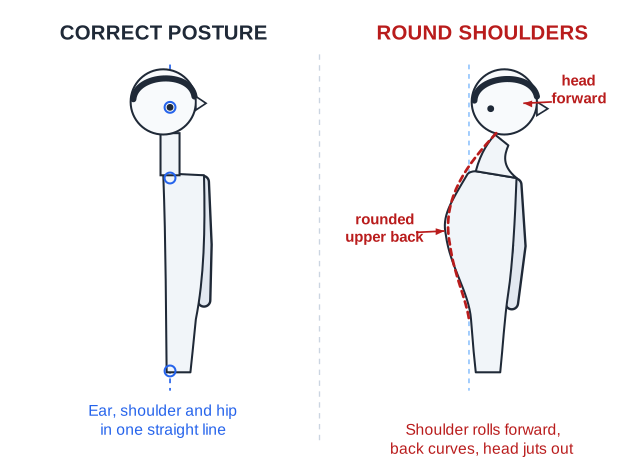
Drawn by us to help you understand the concept clearly, and verified to make sure it's accurate. For exams, practice from your textbook's own diagram.
A side profile of the head, neck and upper torso showing the round-shoulders posture - the head carried forward, the shoulders rolled forward and the upper back rounded - set against a straight vertical reference line marki …
This condition is not a fixed structural deformity of the bones; it is a postural habit that, if uncorrected, can become fixed. The muscles on the front of the chest (pectorals) become short and tight, while the muscles between the shoulder blades (rhomboids and middle trapezius) become weak and stretched. The imbalance pulls the shoulder girdle forward.
How It Is Recognised
Stand the person sideways against a wall or use a plumb line. In a normal posture, the tip of the shoulder should align vertically with the earlobe and the hip bone. In round shoulders, the shoulder tip is clearly in front of that line. From the front, the palms face backward more than usual (the arms are internally rotated), and the chest appears hollow or sunken. The head is often thrust forward as well — a common companion called forward head posture.
A simple classroom test: ask the student to stand naturally and look at the position of their thumbs. If the thumbs point toward each other (palms facing backward) rather than toward the thighs, it indicates internal rotation of the shoulders, a sign of round shoulders.
Causes
Poor sitting and writing posture. This is the most common cause. When a student sits at a desk and leans forward to write, the shoulders roll inward and the chest collapses. Doing this for hours every day, year after year, trains the muscles to hold that position even when standing.
Carrying heavy loads on the back. School bags worn over both shoulders but loaded heavily pull the shoulders backward at first, but the body compensates by leaning forward at the upper back. If the bag is worn on one shoulder only, the body tilts to one side, and the shoulders rotate forward on the opposite side. Over time, the forward pull becomes habitual.
Weak shoulder muscles. The muscles that retract the shoulder blades — the rhomboids and the middle fibres of the trapezius — are often underused in daily life. When they are weak, they cannot hold the shoulder blades flat against the rib cage, and the shoulders drift forward.
Working in a stooped position. Any activity that keeps the upper back bent forward for long periods — reading in bed, using a mobile phone, gardening, or certain sports like cycling with dropped handlebars — encourages the same forward collapse.
Problems Created by Round Shoulders
Breathing. The rib cage is designed to expand outward and upward when the diaphragm contracts. When the shoulders are rolled forward and the chest is sunken, the rib cage cannot expand fully. The intercostal muscles are compressed, and the diaphragm has less room to descend. The result is shallow, inefficient breathing — the person uses the accessory muscles of the neck and upper chest instead of the diaphragm. For an athlete, this means lower oxygen intake and earlier fatigue.
Sport performance. Any sport that requires overhead movement — throwing, serving in tennis, spiking in volleyball, swimming freestyle — is compromised because the shoulder joint cannot achieve full range of motion. The forward position of the shoulder reduces the leverage of the rotator cuff muscles and increases the risk of impingement. In running, the forward shoulders cause the arms to swing across the body rather than straight forward and back, wasting energy and reducing stride efficiency.
Corrective Measures
The principle of correction is simple: stretch the tight front muscles and strengthen the weak back muscles. Every corrective exercise does one or both of these.
Maintaining awareness. The first correction is conscious. The student must learn to feel when the shoulders are forward and actively pull them back and down. A useful cue: imagine holding a pencil between the shoulder blades. While walking, periodically check and reset the shoulder position.
Ergonomic adjustments. The desk and chair height should allow the student to sit with feet flat, hips at 90 degrees, and forearms parallel to the floor when writing. The screen or book should be at eye level so the head does not drop forward. The school bag should be worn on both shoulders, and its weight should not exceed 10–15% of the student's body weight.
Corrective Exercises
Each exercise below targets a specific part of the muscle imbalance. The student should perform these exercises daily, with slow controlled movements, never jerking or using momentum.
Chakrasana (Wheel Pose)
Chakrasana is a backward-bending yoga asana that opens the entire front of the body — chest, shoulders, abdomen, and hip flexors. It directly counteracts the forward collapse of round shoulders.
Procedure: Lie on the back with knees bent, feet flat on the floor close to the buttocks. Bend the elbows and place the palms on the floor beside the ears, fingers pointing toward the shoulders. Press into the palms and feet, lift the hips, then the back, and finally the head off the floor, straightening the arms fully. The crown of the head may rest on the floor initially. Hold for 10–15 seconds, then lower slowly.
How it works: The full extension of the arms and the backward arch of the spine stretch the pectoralis major and minor, the anterior deltoid, and the intercostal muscles. It also strengthens the spinal extensors and the muscles of the upper back that retract the shoulder blades.
Chakrasana is an advanced pose. Students with wrist, lower back, or neck injuries should not attempt it without supervision. Beginners should practice the bridge pose (Setu Bandhasana) first — same lying position but with arms on the floor, lifting only the hips.
Dhanurasana (Bow Pose)
Dhanurasana is a prone backbend that stretches the chest and shoulders while strengthening the entire back.
Procedure: Lie on the stomach with arms alongside the body. Bend the knees and reach back with the hands to grasp the ankles. Inhale and lift the chest and thighs off the floor simultaneously, pulling the legs upward with the hands. The body forms a bow shape. Hold for 15–20 seconds, breathing steadily, then release.
How it works: The pulling action of the arms on the ankles forces the shoulders to roll backward and the chest to open. The rhomboids and trapezius contract strongly to hold the shoulder blades together. This directly strengthens the weak muscles of round shoulders while stretching the tight chest muscles.
Pull-ups / Reverse Fly
Pull-ups (or chin-ups) strengthen the latissimus dorsi, rhomboids, and biceps. When the student pulls the body upward, the shoulder blades retract and depress, pulling the shoulders back into proper alignment. For students who cannot do a full pull-up, an assisted version using a resistance band or a negative pull-up (lowering slowly from the top) is effective.
Reverse fly targets the rhomboids and posterior deltoid specifically. It can be done with dumbbells or a resistance band.
Procedure (with dumbbells): Hold a light dumbbell in each hand. Bend forward at the hips until the torso is nearly parallel to the floor, arms hanging straight down. Keeping the elbows slightly bent, squeeze the shoulder blades together and lift the arms out to the sides until they are level with the shoulders. Lower slowly. Do 3 sets of 12–15 repetitions.
How it works: The reverse fly isolates the retraction movement of the shoulder blades. No other exercise targets the rhomboids as directly. The posterior deltoid also strengthens, which helps pull the humerus (upper arm bone) backward.
Holding the Shoulders Back While Walking
This is not an exercise in the gym sense but a habit-correction drill. While walking, the student consciously pulls the shoulders back and down, opens the chest, and keeps the chin tucked. The arms should swing from the shoulder joint, not from the elbows, and the swing should be forward and backward, not across the body. …