Q.Comment upon PCR.
🔒You're viewing a preview — the full solution, concept, methods & PYQ mapping are locked.
🔒 Start your 14-day free trial to unlock the full solution →Concept understanding — Polymerase Chain Reaction (PCR)
PCR is a common laboratory technique used to make millions of copies of a chosen region of DNA. In recombinant DNA technology, it serves as the alternative route to vector-based cloning wherever no vector is actually used: instead of inserting the gene of interest into a self-replicating vector and propagating it inside a host cell, PCR directly amplifies that gene of interest in vitro, afte …
PCR (Polymerase Chain Reaction) is a technique to amplify (make many copies of) a specific segment of DNA in vitro. It uses a template DNA, two primers, the four dNTPs and a thermostable DNA polymerase (Taq polymerase), and repeats three steps — denaturation, annealing, extension — over many cycles, doubling the DNA each cycle. …
PCR amplifies a chosen DNA segment in vitro using primers and heat-stable Taq polymerase, through repeated cycles of denaturation, annealing and extension — doubling the DNA each cycle.
What PCR is: The Polymerase Chain Reaction (PCR), devised by Kary Mullis, is an in-vitro technique to make millions of copies of a specific DNA sequence rapidly.
Requirements (reaction mixture):
- Template DNA (the DNA to be copied),
- Two primers (short single-stranded oligonucleotides complementary to the two ends of the target),
- The four deoxyribonucleotides (dNTPs),
- A thermostable DNA polymerase — Taq polymerase (from Thermus aquaticus), which withstands the high denaturation temperature.
The three steps, repeated each cycle:
- Denaturation (~94 °C): heating separates the double-stranded DNA into two single strands.
- Annealing (~50–55 °C): the temperature is lowered so the two primers bind (anneal) to their complementary sequences flanking the target region.
- Extension / Elongation (~72 °C): Taq polymerase extends the primers, synthesising new complementary strands using the dNTPs. …
Showing the 12 most recent of 24 on this concept.
- CBSE 2026Set V11 markMCQQ.Which of the following is the correct representation of primer annealing step in PCR?(a) 5'——— 3' / 5'——— 3' (short primer strands shown near 5' ends)(b) 3'——— 5' / 3'——— 5' (short primer strands shown)(c) 5'——— 3' / 3'——— 5' (short primer strands shown)(d) 3'——— 5' / 5'——— 3' (short primer strands shown)
›Reveal solutionSolution
The two separated template strands are antiparallel (one 5'→3', the other 3'→5'), and the two primers anneal to them — represented by option (c).
In PCR, after denaturation the double-stranded DNA separates into two antiparallel single strands: one runs 5'→3' and its complement runs 3'→5'. During the annealing step, the two short primers base-pair (anneal) to these two complementary strands. Only option (c), showing one stra …
- CBSE 2026Set A1 markMCQQ.Themrostable DNA polymerase used in PCR is isolated from which bacteria?(a) Thermus aquaticus(b) E. coli(c) Salmonella(d) Eubacteria
›Reveal solutionSolution
Taq polymerase comes from Thermus aquaticus; the correct option is (a).
PCR (Polymerase Chain Reaction) involves repeated cycles of denaturation at about 94 to 95 degrees Celsius. An ordinary DNA polymerase would be destroyed at these high temperatures. Therefore a thermostable DNA polymerase, called Taq polymerase, is used. It is isolated from the thermophilic bacterium Th …
- CBSE 2026Set ANNUAL1 markMCQQ.Name the thermostable enzyme which is required during PCR and is isolated from bacterium Thermus aquaticus.(a) Taq - Polymerase(b) Pfu - Polymerase(c) DNA - Polymerase(d) DNA - Ligase
›Reveal solutionSolution
Taq Polymerase is a thermostable DNA polymerase from the thermophilic bacterium Thermus aquaticus, used in PCR because it survives the repeated high-temperature denaturation steps.
PCR (Polymerase Chain Reaction) requires repeated cycles of: (1) denaturation at ~94-95°C to separate the DNA strands, (2) annealing of primers at a lower temperature, and (3) extension/synthesis of new strands by a DNA polymerase. An ordinary DNA polymerase (like human/E. coli Pol I) would denature and lose activity at the high denaturation temperat …
- CBSE 2025Set ANNUAL1 markMCQQ.The polymerase chain reaction is a technique used for(a) Amplification of DNA(b) Amplification of enzymes(c) Amplification of proteins(d) All of these
›Reveal solutionSolution
The Polymerase Chain Reaction (PCR) is an in-vitro technique to rapidly amplify (make many copies of) a chosen segment of DNA.
PCR uses a heat-stable DNA polymerase (commonly Taq polymerase, isolated from the thermophilic bacterium Thermus aquaticus), two short primers flanking the target DNA sequence, and repeated thermal cycles of denaturation (separating the DNA strands at high temperature), annealing (primers bind to the template), and extension (the polymerase synthesises new complementary strands). Each cycle roughly doubles …
- CBSE 2025Set ANNUAL1 markQ.In PCR reaction at Step-2, denaturation of DNA takes place. Name the factor responsible for it.
›Reveal solutionSolution
The double-stranded template DNA is denatured by heating, which breaks the hydrogen bonds between the two strands.
Polymerase Chain Reaction (PCR) proceeds through repeated cycles of three steps. In the first step (denaturation), the reaction mixture is heated to a high temperature (typically 94-96°C), which breaks the hydrogen bonds holding the two DNA strands together, separating the double-stranded template into two single strands. This is followed by primer annealing at a lower temperature (~50-65°C) and primer extension by …
- CBSE 2025Set ANNUAL1 markQ."Thermus aquaticus is preferred in PCR technique". Justify in one point.
›Reveal solutionSolution
Taq polymerase, from the thermophilic bacterium Thermus aquaticus, survives the repeated high-temperature denaturation steps of PCR, unlike ordinary DNA polymerases.
PCR (Polymerase Chain Reaction) involves repeated cycles of:
- Denaturation — heating the DNA to about 94–95°C to separate the two strands.
- Annealing — cooling to allow primers to bind to the template.
- Extension — using DNA polymerase to synthesise new complementary strands.
An ordinary DNA polymerase (such as from E. coli) would be denatured/destroyed at the high denaturation temperature and would need to be added fresh in every single cycle, which is impractical for the 20–30+ cycles used in PCR. Thermus aquaticus, however, is a bacterium that naturally lives in hot springs, and its DNA polymerase (Taq polymerase) is thermostable — it can withstand the repeated heating to ~95°C without losing its catalytic activity. This means the same enzyme ad …
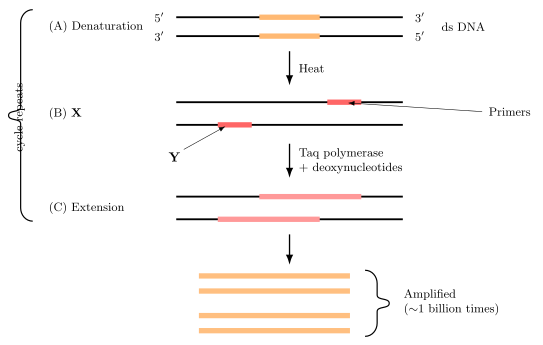
- CBSE 2025Set ANNUAL1 markQ.From the above diagram - Identify X and Y
›Reveal solutionSolution
In this PCR-cycle diagram, step (B) — where short primer sequences bind to the separated single DNA strands — is Annealing, and the structure labelled Y is the pair of Primers.
The diagram shows the three repeating steps of a PCR (Polymerase Chain Reaction) cycle: (A) Denaturation, (B) X, and (C) Extension.
- Step (A), Denaturation: the double-stranded DNA (ds DNA) is heated so the two strands separate into single strands.
- Step (B), labelled X: after denaturation, short primer sequences bind (anneal) to complementary sequences on each of the single DNA strands — this step is called Annealing.
- Step (C), Extension: Taq polymerase, using deoxynucleotides, extends the annealed primers to synthesise new complementary DNA strands. …
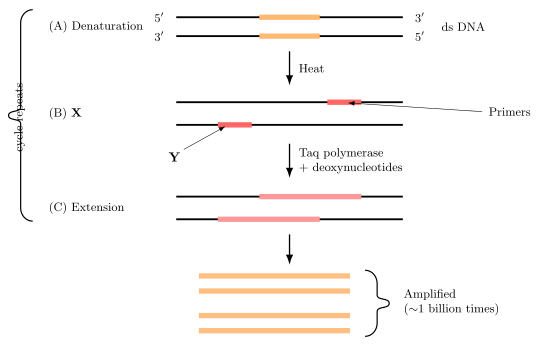
- CBSE 2025Set ANNUAL1 markQ.From the above diagram - Name the microbe from which a heat stable (thermostable) enzyme is isolated.
›Reveal solutionSolution
The heat-stable DNA polymerase used in PCR, called Taq polymerase, is isolated from the thermophilic bacterium Thermus aquaticus, which naturally lives in hot springs.
PCR requires the DNA polymerase to remain functional through repeated heating cycles (denaturation at ~94-95°C), which would destroy/denature an ordinary DNA polymerase. To overcome this, PCR uses a thermostable DNA polymerase called Taq polymerase, isolated from the bacterium Thermus aquaticus — a thermophilic (heat-loving) bacterium naturally found in hot springs, where it survives and functions at very high temperatures. Because this enzyme remains stable and active even after re …
- CBSE 2025Set ANNUAL1 markQ.From the above diagram - What is the role of Y ?
›Reveal solutionSolution
Primers (Y) are short DNA sequences that bind to the template strands and give Taq polymerase the free 3'-OH end it needs to start building the new strand.
Y refers to the primers used in PCR. Primers are short, chemically synthesised, single-stranded oligonucleotide sequences (typically about 18–24 bases long) that are complementary to the sequences flanking the region of DNA to be amplified.
Role of the primers: After the DNA is denatured into single strands, the primers anneal (bind by complementary base pairing) to their specific matching sequences on each of the single template DNA strands, one primer for each strand. DNA polymerase enzymes (like Taq polymerase) cannot initiate synthesis of a new DNA strand on their own — they can only extend an existing strand that already has a free 3'-hydroxyl (3'-OH) end. The bound primer supplies exactly this free 3'-OH end, giving Taq polymerase the starting point it needs to begin adding new nucl …
- CBSE 2025Set ANNUAL1 markQ.From the above diagram - What will happen to this biological process if X did not take place ?
›Reveal solutionSolution
Without annealing, the primers never attach to the template DNA, so DNA polymerase has no free 3'-OH end to extend from — no new DNA strand can be made, and PCR amplification does not occur.
X refers to the annealing step, in which the primers bind to their complementary sequences on the single-stranded template DNA. If this step did not take place:
- The primers would remain unbound/free in the reaction mixture, not attached anywhere on the single-stranded template DNA.
- Taq polymerase requires a primer already annealed to the template, providing a free 3'-OH end, in order to begin adding nucleotides and synthesising a new complementary strand — without an annealed primer, the polymerase has no site to begin extension.
- As a result, no new DNA strand synthesis (extension) could occur in that cycle. …
- CBSE 2024Set 57/3/11 markMCQQ.Which one of the following represents the correct annealing of primers to the DNA to be amplified in the PCR ? (A) [diagram: two template strands each with a short primer annealed] (B) [diagram: two template strands each with a short primer annealed] (C) [diagram: two template strands each with a short primer annealed] (D) [diagram: two template strands each with a short primer annealed]
›Reveal solutionSolution
Primers must anneal to the 3' ends of each template strand in opposite orientations, with their own 3' ends pointing toward each other, to allow DNA polymerase to synthesize new strands in the 5' to 3' direction toward the target region.
The polymerase chain reaction depends entirely on the precise placement and orientation of primers. To understand which diagram is correct, you need to grasp what primers actually do and how DNA polymerase works.
DNA polymerase can only add nucleotides to the 3' end of an existing strand — it synthesizes in the 5' to 3' direction exclusively. This directional constraint shapes everything about primer design. When you want to amplify a specific segment of DNA, you need two primers: one that binds to the 3' end of the sense strand and another that binds to the 3' end of the antisense strand. Because the two strands of DNA run antiparallel (one 5' to 3', the other 3' to 5'), the primers must face each other from opposite ends of the target region.
Picture the target sequence you want to amplify sitting between two boundary points. The forward primer anneals to one template strand at one boundary, with its 3' end pointing inward toward the target. The reverse primer anneals to the complementary strand at the other boundary, also with its 3' end pointing inward. When polymerase extends both primers, the new strands grow toward each other, copying the entire region in between.
ImportantThe key recognition feature: both primers must have their 3' ends oriented toward the interior of the target sequence, not away from it. If a primer's 3' end points outward, polymerase will synthesize away from the target region, defeating the entire purpose of amplification. …
- CBSE 2024Set A11 markMCQQ.Which of the following statements are correct for the enzyme Taq polymerase? I. Taq polymerase is thermally unstable. II. It requires primers for carrying out the process of polymerisation. III. Taq polymerase is thermally stable. Choose the correct option.(a) I and II(b) I and III(c) II and III(d) I, II and III
›Reveal solutionSolution
Taq polymerase is thermally stable and requires primers, so statements II and III are correct.
Taq polymerase is a DNA polymerase isolated from the thermophilic bacterium Thermus aquaticus. It is used in PCR because it is thermally stable — it remains active and does not denature at the high temperatures (around 94-95 °C) used for denaturation. Like all DNA polymerases, it requires primers to initiate poly …
🎓Unlock everything free for 14 days
- ✓Full step-by-step solutions
- ✓Concept-first explanations
- ✓Methods, shortcuts & mistakes
- ✓PYQ mapping + timed mock tests
Full access for 14 days. No credit card required.