Biology · Ch 8 — Cell: The Unit of Life
Cell Membrane
Cell Membrane
The cell membrane, or plasma membrane, is the boundary that separates the inside of the cell from its surroundings. Understanding its structure explains how it manages to be both a barrier and a gateway.
How its structure was worked out
The fine detail of the membrane could only be seen after the electron microscope came into use in the 1950s. Before that, chemical studies — especially on human red blood cells — allowed scientists to deduce the likely structure of the plasma membrane. These studies showed that the membrane is made mainly of lipids and proteins.
The lipid arrangement
- The main lipids are phospholipids, arranged in a bilayer (a double layer).
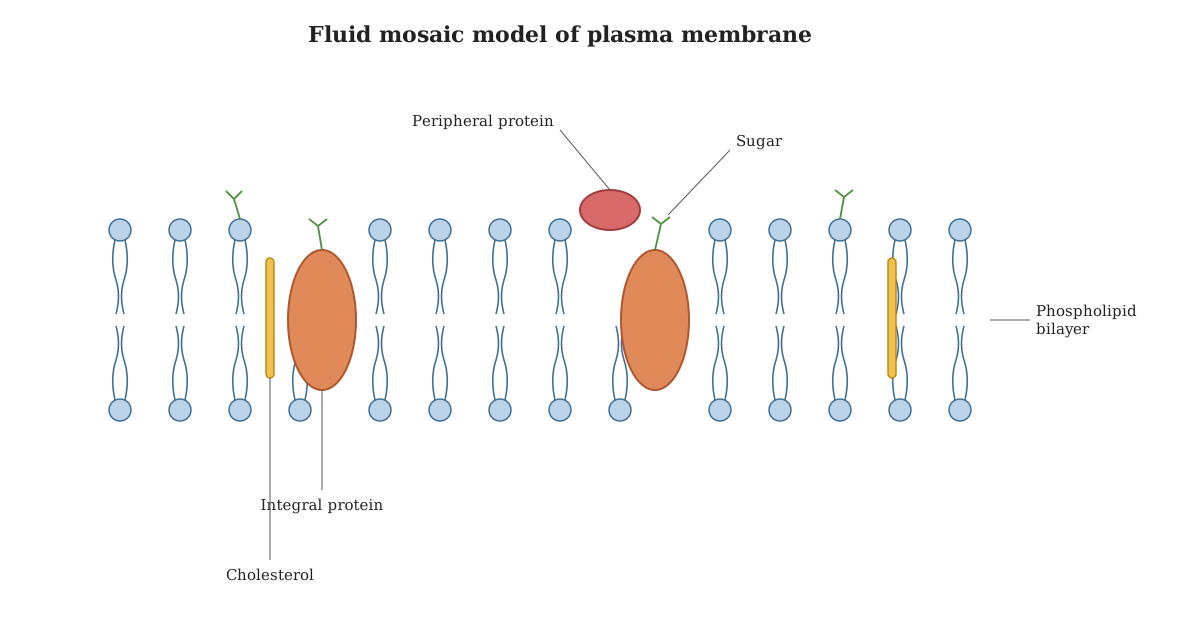
- Within this bilayer, each phospholipid is oriented so that its polar head faces the outer sides and its hydrophobic (non-polar) tail points inwards. This arrangement keeps the non-polar tails of the saturated hydrocarbons shielded from the watery environment.
- Besides phospholipids, the membrane also contains cholesterol.
Later biochemical work confirmed that cell membranes carry protein and carbohydrate as well. The proportion of protein to lipid varies widely between cell types; in humans, the red blood cell (erythrocyte) membrane is roughly 52 per cent protein and 40 per cent lipid.
Membrane proteins
Based on how easily they can be extracted, membrane proteins fall into two classes:
- Peripheral proteins lie on the surface of the membrane.
- Integral proteins are partially or wholly buried within the membrane.
The fluid mosaic model
An improved picture of membrane structure was proposed by Singer and Nicolson (1972) and is widely accepted as the fluid mosaic model. According to this model:
- The lipid has a quasi-fluid nature, which allows proteins to move laterally within the bilayer.
- This ability of components to move about is measured as the membrane's fluidity.
- Fluidity matters for many functions, including cell growth, formation of intercellular junctions, secretion, endocytosis and cell division.
Transport across the membrane
One of the most important jobs of the plasma membrane is moving molecules across it. The membrane is selectively permeable, letting some molecules through while restricting others.
Passive transport
Many molecules cross the membrane without any input of energy; this is passive transport.
- Simple diffusion: Neutral solutes move across the membrane along the concentration gradient, that is, from a higher concentration to a lower one. …
Drawn by us to help you understand the concept clearly, and verified to make sure it's accurate. For exams, practice from your textbook's own diagram.
This figure shows the accepted picture of how a plasma membrane is arranged. Its foundation is a double layer of phospholipids, each with a water-loving head and two water-fearing tails. The heads face the watery fluids on either side while the tails tuck inward away from water, giving a stable two-layered sheet. Studded through this bilayer are proteins: integral proteins span the whole membrane, and peripheral proteins rest on one surface. Short carbohydrate chains attach to some outer proteins and lipids, helping cells recognise one another. Because the lipids and many proteins can drift sideways, the membrane behaves like a fluid, while the scattered proteins make it look like a mosaic. This fluid mosaic view, proposed by Singer and Nicolson, explains how membranes stay flexible yet …