Biology · Ch 8 — Cell: The Unit of Life
Plastids
Plastids
Plastids are organelles found in all plant cells and also in euglenoids. They are large enough to be seen easily under the microscope, and they carry particular pigments that give plants their characteristic colours.
The three kinds of plastid
Based on the type of pigment they contain, plastids are grouped into three categories:
- Chloroplasts — these hold chlorophyll together with carotenoid pigments. These pigments trap the light energy that is essential for photosynthesis.
- Chromoplasts — these contain fat-soluble carotenoid pigments such as carotene and xanthophylls, among others. Their presence gives the plant part a yellow, orange or red colour.
- Leucoplasts — these are colourless plastids of various shapes and sizes that act as stores of nutrients.
Types of leucoplast
The leucoplasts are further distinguished by what they store:
- Amyloplasts store carbohydrates in the form of starch, as seen in the potato.
- Elaioplasts store oils and fats.
- Aleuroplasts store proteins.
Where chloroplasts are found, and their form
Most of the chloroplasts of green plants occur in the mesophyll cells of the leaves. In shape they may be lens-like, oval, spherical, discoid or even ribbon-shaped. Their length is variable, roughly five to ten micrometres, and their width about two to four micrometres. Their number differs greatly between organisms — from just one per cell in the green alga Chlamydomonas to about twenty to forty per cell in the mesophyll.
Internal structure of the chloroplast
Like the mitochondria, chloroplasts are bounded by a double membrane. Of the two membranes, the inner one is comparatively less permeable. The internal organisation is as follows:
- The space enclosed by the inner membrane is called the stroma.
- Within the stroma lie a number of organised, flattened membranous sacs called thylakoids.
- The thylakoids are arranged in stacks resembling piles of coins, and each such stack is a granum (the plural is grana); these are sometimes referred to as the intergranal thylakoids.
- Connecting the thylakoids of the different grana are flat membranous tubes called the stroma lamellae. …
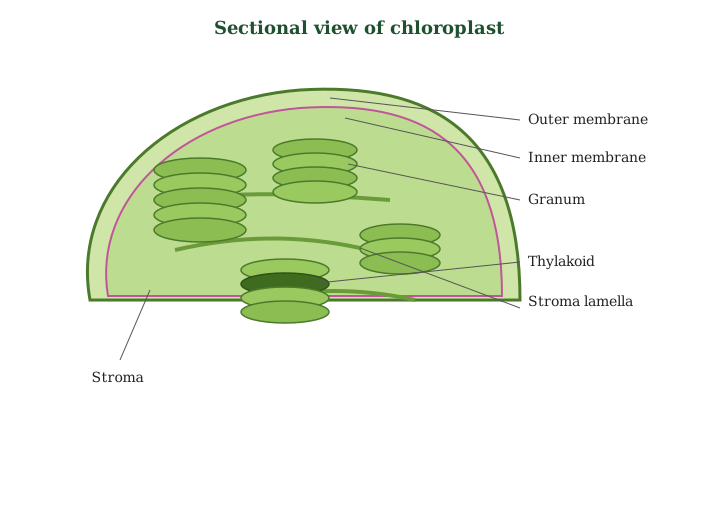
Drawn by us to help you understand the concept clearly, and verified to make sure it's accurate. For exams, practice from your textbook's own diagram.
This sectional view opens up a chloroplast to show where photosynthesis happens. Two membranes wrap the organelle and enclose a colourless ground fluid called the stroma. Suspended in the stroma are flattened sacs called thylakoids, many of them stacked into pile-like groups called grana. Bands of membrane known as stroma lamellae connect one granum to another so the interior forms one linked system. The thylakoid membranes hold chlorophyll and other pigments and carry out the light reaction, trapping sunlight and splitting water. The stroma around them holds the enzymes that use this captured energy to build sugars. The idea to remember is that a chloroplast keeps …