Chemistry · Ch 4 — Chemical Bonding and Molecular Structure
The Valence Shell Electron Pair Repulsion (VSEPR) Theory
The Valence Shell Electron Pair Repulsion (VSEPR) Theory
4.4 The Valence Shell Electron Pair Repulsion (VSEPR) Theory
The Lewis concept tells us which atoms are connected and how many bonds they form, but it says nothing about the three-dimensional shape of the molecule. The VSEPR theory fills this gap. It was first proposed by Sidgwick and Powell in 1940, then refined by Nyholm and Gillespie in 1957. The central idea is beautifully simple: electron pairs repel each other, so they arrange themselves as far apart as possible.
Main Postulates of VSEPR Theory
The theory rests on six clear postulates:
-
The shape of a molecule depends only on the number of valence shell electron pairs — both bonded and nonbonded — around the central atom.
-
Electron pairs repel one another because their electron clouds are negatively charged.
-
These pairs occupy positions that minimise repulsion, which means they maximise the distance between themselves.
-
The valence shell is treated as a sphere, with all electron pairs localised on its surface at maximum separation.
-
A multiple bond (double or triple) is treated as a single "super pair" — the two or three electron pairs of a multiple bond count as one unit for shape determination.
-
Where resonance structures exist, the VSEPR model applies to any one of them.
Postulate 5 is crucial: when counting electron pairs around the central atom, a double bond counts as one region of electron density, not two. This is why (which has two double bonds) is linear — it has only two regions of electron density, not four.
The Repulsion Hierarchy
Not all electron pairs repel equally. The repulsive interaction decreases in this order:
Why does this order exist? Nyholm and Gillespie explained it clearly. A lone pair is localised entirely on the central atom, so its electron cloud occupies more space around that atom. A bond pair, by contrast, is shared between two nuclei — its electron density is pulled away from the central atom toward the bonded atom. This makes a bond pair "smaller" in terms of the space it occupies near the central atom. The more space an electron pair occupies, the stronger its repulsive effect on neighbouring pairs.
A common mistake is to think that lone pairs repel more because they are "stronger" in some absolute sense. The real reason is spatial: a lone pair's electron cloud is closer to the central nucleus and spreads out more, so it pushes harder against adjacent pairs.
Two Categories of Molecules
For predicting shapes, it is convenient to divide molecules into two types:
- Category 1: Central atom has no lone pairs — only bond pairs.
- Category 2: Central atom has one or more lone pairs.
Molecules with No Lone Pairs on the Central Atom
When the central atom has only bond pairs, the shape is determined solely by the number of bond pairs (which equals the number of regions of electron density). Table 4.6 of the NCERT text gives the complete picture.
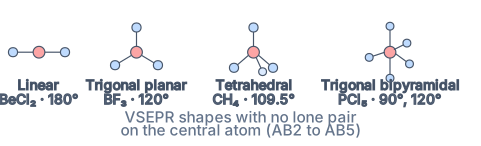
Drawn by us to help you understand the concept clearly, and verified to make sure it's accurate. For exams, practice from your textbook's own diagram.
| Bond pairs | Arrangement (bond angle) | Molecular geometry | Example |
|---|---|---|---|
| 2 | Linear () | Linear | |
| 3 | Trigonal planar () | Trigonal planar | |
| 4 | Tetrahedral () | Tetrahedral | |
| 5 | Trigonal bipyramidal () | Trigonal bipyramidal |
What Fig. 4.6 Shows
The figure is a visual summary of four molecular geometries that arise when a central atom A is surrounded by 2, 3, 4, or 5 bonding pairs of electrons — and no lone pairs — illustrated with one real example molecule for each. Each geometry is drawn as a simple ball-and-stick model.
From left to right, the figure presents:
- (2 bond pairs) → linear geometry, bond angle . The two Cl atoms lie on opposite sides of Be.
- (3 bond pairs) → trigonal planar geometry, bond angle . The three F atoms occupy the corners of an equilateral triangle, all in one plane.
- (4 bond pairs) → tetrahedral geometry, bond angle . The four H atoms sit at the vertices of a regular tetrahedron, with C at its centre.
- (5 bond pairs) → trigonal bipyramidal geometry, with two distinct bond angles: (between axial and equatorial positions) and (between equatorial positions). Three Cl atoms lie in a plane (equatorial), and two are above and below that plane (axial).
The figure does not show any lone pairs on the central atom — that is its entire point. It stops at five bond pairs (AB5); a sixth case, octahedral (, six equivalent bond pairs), is a real and important VSEPR shape but is shown separately elsewhere in the chapter (Fig. 4.18), not in this figure.
The Physical Idea
The VSEPR theory rests on a single, intuitive principle: electron pairs repel each other. Because all electron clouds carry negative charge, they try to get as far apart as possible. The central atom's valence shell is treated as a sphere, and the electron pairs (whether bonding or lone) arrange themselves on that sphere's surface to maximise the angles between them.
For molecules with only bonding pairs, the geometry is determined purely by the number of such pairs. Each pair is pulled toward an outer atom, but the repulsion between the pairs themselves forces them into the symmetrical arrangements shown in the figure. These are the "ideal" shapes — the ones that occur when all electron pairs are identical and no lone pairs are present.
The bond angles in Fig. 4.6 are the ideal VSEPR angles for molecules with no lone pairs. Any deviation from these angles in real molecules is caused by the presence of lone pairs or by differences in the size/electronegativity of the bonded atoms.
The Key Formula
There is no single algebraic formula for VSEPR shapes. Instead, the theory uses a counting rule:
The steric number determines the electron-pair geometry (the arrangement of all electron pairs around the central atom), and the molecular geometry is then obtained by ignoring the lone pairs and looking only at the positions of the outer atoms.
For the four molecules in Fig. 4.6, the steric number equals the number of bond pairs (since lone pairs = 0), so the electron-pair geometry and the molecular geometry are identical. …
Table 4.6: Geometry of Molecules with No Lone Pairs on the Central Atom
| Electron pairs | Arrangement (bond angle) | Molecular geometry | Examples |
|---|---|---|---|
| 2 | Linear () | Linear | , |
| 3 | Trigonal planar () | Trigonal planar | |
| 4 | Tetrahedral () | Tetrahedral | , |
The key point: when there are no lone pairs, the arrangement of electron pairs and the positions of the surrounding atoms are identical. The molecular geometry equals the electron-pair geometry.
For , two electron pairs repel each other and go to opposite sides of the sphere — a angle, linear. For , three pairs arrange at in a plane — trigonal planar. For , four pairs point to the corners of a tetrahedron with bond angles of . For , five pairs go to the corners of a trigonal bipyramid — three equatorial positions at and two axial positions at to the equatorial plane. For , six pairs point to the corners of a regular octahedron with all angles .
In a trigonal bipyramid (), the axial and equatorial positions are NOT equivalent. Axial bonds are slightly longer than equatorial bonds because axial positions experience more repulsion (they are at to three equatorial pairs).
Molecules with Lone Pairs on the Central Atom
When lone pairs are present, the molecular geometry differs from the electron-pair geometry. The lone pairs occupy positions in the electron-pair arrangement, but we only describe the shape using the positions of the atoms (the bond pairs). Table 4.7 of the NCERT text lists these cases.
Table 4.7: Shapes of Molecules with Lone Pairs on the Central Atom
| Type | Bond pairs | Lone pairs | Electron-pair arrangement | Shape | Examples |
|---|---|---|---|---|---|
| 2 | 1 | Trigonal planar | Bent | , | |
| 3 | 1 | Tetrahedral | Trigonal pyramidal | ||
| 2 | 2 | Tetrahedral | Bent | ||
| 4 | 1 | Trigonal bipyramidal | See-saw | ||
| 3 | 2 | Trigonal bipyramidal | T-shape |
The letter E denotes a lone pair on the central atom.
Why Bond Angles Deviate from Ideal Values
The repulsion hierarchy (lp–lp > lp–bp > bp–bp) causes bond angles to shrink when lone pairs are present. Table 4.8 of the NCERT text explains these distortions in detail.
Table 4.8: Distortions in Geometry Due to Lone Pairs
| Type | Bond pairs | Lone pairs | Example (angle) | Shape | Reason |
|---|---|---|---|---|---|
| 2 | 1 | (O–S–O ) | Bent | lp–bp repulsion > bp–bp, so the angle drops from | |
| 3 | 1 | (H–N–H ) | Trigonal pyramidal | one lp; lp–bp > bp–bp reduces the angle from | |
| 2 | 2 | (H–O–H ) | Bent | two lp; lp–lp > lp–bp > bp–bp, angle drops further from |
A quick way to remember the trend: each lone pair reduces the bond angle by roughly – from the ideal tetrahedral angle. has one lone pair (), has two ().
The Special Case of Trigonal Bipyramidal Molecules with Lone Pairs
When lone pairs appear in a trigonal bipyramidal arrangement ( type), they always occupy equatorial positions, never axial. Why? Consider a molecule like ().
If the lone pair goes to an axial position, it experiences three lp–bp repulsions at (with the three equatorial bond pairs). If it goes to an equatorial position, it experiences only two lp–bp repulsions at (with the two axial bond pairs). The equatorial position is more stable because it minimises strong repulsions. …