Chemistry · Ch 3 — Classification of Elements and Periodicity in Properties
(e) Electronegativity
(e) Electronegativity
(e) Electronegativity
Definition: A Qualitative Measure
Electronegativity is a qualitative measure of the ability of an atom in a chemical compound to attract shared electrons to itself. It is fundamentally different from ionization enthalpy and electron gain enthalpy because it is not a directly measurable quantity. It is a relative, derived property.
Several numerical scales have been developed to assign electronegativity values to elements. The most widely used is the Pauling scale. Linus Pauling arbitrarily assigned a value of 4.0 to fluorine, the element with the greatest ability to attract electrons. All other elements are assigned values relative to this standard.
The electronegativity of an element is not a fixed constant. It can vary depending on the element to which it is bonded. However, the assigned values are useful for predicting the nature of chemical bonds.
The Trends in Electronegativity
The trends in electronegativity are very similar to those of ionization enthalpy.
Trend 1: Electronegativity generally increases across a period.
Consider the second period: Li (1.0), Be (1.5), B (2.0), C (2.5), N (3.0), O (3.5), F (4.0). The values increase steadily.
(a) Across the periods
| Atom (Period II) | Li | Be | B | C | N | O | F |
|---|---|---|---|---|---|---|---|
| Electronegativity | 1.0 | 1.5 | 2.0 | 2.5 | 3.0 | 3.5 | 4.0 |
| Atom (Period III) | Na | Mg | Al | Si | P | S | Cl |
Why? Across a period, the atomic radius decreases. The nucleus can attract the shared pair of electrons more strongly. Therefore, the atom's ability to attract electrons (its electronegativity) increases.
Trend 2: Electronegativity generally decreases down a group.
Consider Group 1: Li (1.0), Na (0.9), K (0.8), Rb (0.8), Cs (0.7). The values decrease.
(b) Down a family
| Atom (Group 1) | Electronegativity | Atom (Group 17) | Electronegativity |
|---|---|---|---|
| Li | 1.0 | F | 4.0 |
| Na | 0.9 | Cl | 3.0 |
| K | 0.8 | Br | 2.8 |
Why? Down a group, the atomic radius increases. The shared pair of electrons is farther from the nucleus and is more shielded. The attraction is weaker, so the electronegativity decreases.
Relationship with Metallic and Non-Metallic Character
Electronegativity is directly related to the non-metallic character of an element. Non-metals have a strong tendency to gain electrons, which is reflected in their high electronegativity values. Conversely, electronegativity is inversely related to the metallic character of an element. Metals have a low tendency to attract electrons, reflected in their low electronegativity values. …
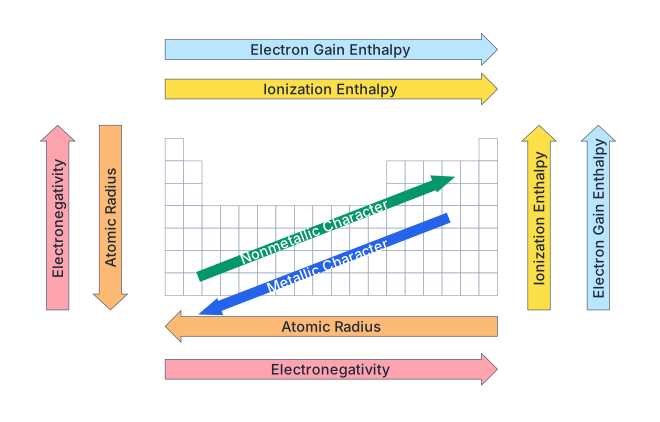
Drawn by us to help you understand the concept clearly, and verified to make sure it's accurate. For exams, practice from your textbook's own diagram.
Fig. 3.7 is a schematic periodic table that summarises the two fundamental trends in atomic properties — how they change as you move across a period (left to right) and down a group (top to bottom). The figure uses colour-coded arrows to show the direction of increase or decrease for each property.
Across a period, the arrows point in one direction: atomic radius decreases; ionisation enthalpy, electron gain enthalpy, and electronegativity all increase; non-metallic character increases. Down a group, the arrows reverse: atomic radius increases; ionisation enthalpy, electron gain enthalpy, and electronegativity all decrease; metallic character increases.
The physical idea is simple but powerful. As you go across a period, electrons are added to the same valence shell, but the nuclear charge (number of protons) increases. The effective nuclear charge experienced by the outermost electrons rises, pulling them closer to the nucleus. That is why the atom shrinks, and why it becomes harder to remove an electron (higher ionisation enthalpy), more favourable to gain an electron (more negative electron gain enthalpy), and stronger at attracting bonding electrons (higher electronegativity). The element becomes less metallic and more non-metallic.
Down a group, a new principal energy level (shell) is added. The valence electrons are farther from the nucleus, and the inner electrons shield them from the full nuclear pull. So the atom grows larger, the outermost electron is easier to remove (lower ionisation enthalpy), the atom is less eager to gain an electron (less negative electron gain enthalpy), and its pull on bonding electrons weakens (lower electronegativity). The element becomes more metallic.
The textbook develops no single formula directly from this figure, but the trends are explained using the concept of effective nuclear charge, , which is the net positive charge experienced by an electron after accounting for shielding by inner electrons. A simple approximation is:
where is the atomic number (number of protons) and is the shielding constant (a measure of how much inner electrons block the nuclear charge). Across a period, increases faster than , so increases — this drives the contraction in size and the rise in ionisation enthalpy, electron gain enthalpy, and electronegativity. Down a group, the increase in is offset by a larger increase in because new inner shells are filled, so increases only slightly or even decreases for the outermost electron — hence the atom expands and the other properties weaken.
A common mistake is to think that atomic radius increases across a period because more electrons are added. The opposite is true: the added electrons go into the same shell, and the rising nuclear charge pulls them inward, making the atom smaller. …