Chemistry · Ch 3 — Classification of Elements and Periodicity in Properties
Electronic Configurations and Types of Elements: s-, p-, d-, f-Blocks
Electronic Configurations and Types of Elements: s-, p-, d-, f-Blocks
From Electronic Configuration to Four Blocks
The Aufbau principle and each element's electronic configuration give a solid theoretical footing for periodic classification. Elements in the same vertical column of the Periodic Table share the same outer-shell electronic configuration, which is exactly why elements within a group show similar chemical behaviour.
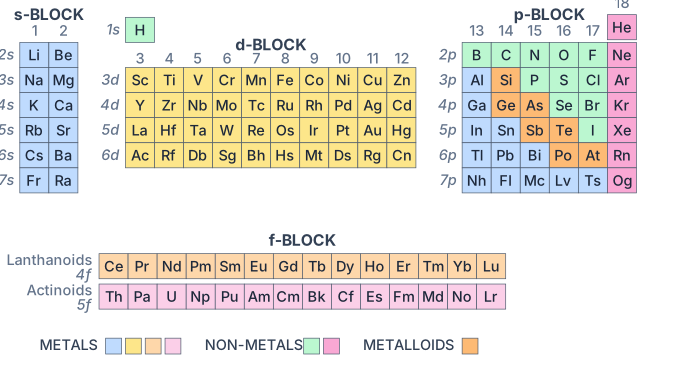
Building on this idea, every element in the Periodic Table can be sorted into one of four blocks — s, p, d, or f — according to which sub-shell its highest-energy (differentiating) electron enters. Fig. 3.3 marks out this division, and also overlays a second, independent classification: metals, non-metals, and metalloids.
Drawn by us to help you understand the concept clearly, and verified to make sure it's accurate. For exams, practice from your textbook's own diagram.
Fig. 3.3 draws the periodic table as four separate block panels, one per type of orbital being filled — exactly how the book prints it:
- s-BLOCK (groups 1–2): the alkali and alkaline earth metals, rows to (Li/Be down to Fr/Ra). Hydrogen sits in its own detached cell — it belongs to no block-panel, reflecting its unique position.
- d-BLOCK (groups 3–12): the four transition series, rows (Sc–Zn) to (Ac–Cn). All metals.
- p-BLOCK (groups 13–18): rows to , with helium placed at the top of group 18 despite its configuration.
- f-BLOCK: the lanthanoids (, Ce–Lu) and actinoids (, Th–Lr) as two separate strips.
Overlaid on the block structure is the figure's second classification, by colour: metals, non-metals and metalloids. The metalloid cells in the figure are Si, Ge, As, Sb, Te, Po and At — the staircase zone between metals and non-metals in the p-block. (The chapter text's own list in Section 3.6.5 names Si, Ge, As, Sb and Te; the figure additionally shades Po and At. Boron is coloured as a non-metal in the figure.) The non-metals cluster in the upper right of the p-block — H, C, N, O, F, P, S, Cl, Se, Br, I — and the noble gases (He–Og) carry their own shade. Everything to the left and below — the entire s, d and f blocks plus Al, Ga, In, Sn, Tl, Pb, Bi and the metals — is metallic.
The block tells you which subshell receives the last electron (the basis of Section 3.6's classification); the colour tells you the broad chemical character. Metallic character strengthens toward the lower left, non-metallic toward the upper right, and the metalloids straddle the divide — which is why silicon and germanium behave as semiconductors. …
…