Mathematics · Ch 10 — Conic Sections
Relationship Between Semi-major Axis, Semi-minor Axis and the Distance of the Focus From the Centre of the Ellipse
Relationship Between Semi-major Axis, Semi-minor Axis and the Distance of the Focus From the Centre of the Ellipse
The Fundamental Relation of an Ellipse
Every ellipse is defined by three key numbers: the semi-major axis , the semi-minor axis , and the distance from the centre to each focus. These three are not independent — they are tied together by a single, elegant relationship that follows directly from the definition of the ellipse itself.
Recall the definition: an ellipse is the set of all points such that the sum of the distances to the two fixed foci and is constant. That constant is , the length of the major axis. We will now use two special points on the ellipse — one at the end of the major axis and one at the end of the minor axis — to discover how , , and are connected.
Using a Point on the Major Axis
Consider the point at the right end of the major axis. Its coordinates are . The foci are at and .
The sum of the distances from to the two foci is:
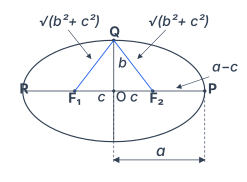
From the geometry of the figure, , where is the centre. Since and , we have . The distance is simply (the distance from the focus at to the point ).
Therefore:
This is exactly the constant sum we expect from the definition. No new relation yet — it simply confirms that the constant is .
Using a Point on the Minor Axis
Now take the point at the top end of the minor axis. Its coordinates are . The foci are still at and .
The distance from to the focus is:
Similarly, the distance to is:
So the sum of the distances is:
Equating the Two Results
Since both and lie on the same ellipse, the sum of the distances to the foci must be the same for both points. From the definition, that constant sum is . Therefore:
Divide both sides by 2:
Square both sides:
This is the fundamental relationship.
Rearranging, we can also write:
and
This relation is the Pythagorean identity of the ellipse. It tells you that is always the largest of the three numbers — the hypotenuse of a right triangle whose legs are and .
What This Tells Us Geometrically …
Drawn by us to help you understand the concept clearly, and verified to make sure it's accurate. For exams, practice from your textbook's own diagram.
The figure shows a standard ellipse centred at , with its major axis horizontal. The two foci are labelled and , placed symmetrically on the major axis at distances from the centre. Two special points are marked: at the right vertex (the end of the major axis) and at the top of the minor axis (the end of the minor axis). Dashed lines and arrows indicate the lengths (semi-major axis, from centre to vertex), (semi-minor axis, from centre to the top), (distance from centre to each focus), and (the distance from the right focus to the vertex ). Two blue line segments from to and to are drawn, each of length .
The physical idea is to use the definition of an ellipse — that the sum of distances from any point on the ellipse to the two foci is constant — and apply it to two convenient points: the vertex and the top of the minor axis . By equating the two sums, we derive the fundamental relation among , , and .
For point at the right vertex, the distances to the foci are:
- Adding them gives .
For point at the top of the minor axis, the distances to the foci are equal by symmetry. Using the right triangle formed by , , and either focus, each distance is . So the sum is .
Since both and lie on the same ellipse, these two sums must be equal:
Cancelling the factor of 2 gives , and squaring both sides yields the central relation:
This is the Pythagorean relation for an ellipse. It tells us that is the hypotenuse of a right triangle whose legs are and . Rearranging, we also get , which is how the focal distance is computed from the semi-axes. …