Mathematics · Ch 10 — Conic Sections
Standard Equations of an Ellipse
Standard Equations of an Ellipse
Standard Equations of an Ellipse
The equation of an ellipse takes its simplest form when the centre is at the origin and the foci lie on one of the coordinate axes. There are two natural orientations: the major axis along the x‑axis, or the major axis along the y‑axis. We derive the equation for the first case; the second follows by symmetry.
Derivation for an Ellipse with Foci on the x‑axis
Place the foci and on the x‑axis, symmetric about the origin. Let be the midpoint of . Choose as the origin, the ray as the positive x‑axis, and the line through perpendicular to the x‑axis as the y‑axis.
Let and , where . Let be any point on the ellipse. The defining property of an ellipse is that the sum of the distances from to the two foci is constant. Denote this constant by (the reason for will become clear). Thus
Using the distance formula:
Isolate one square root:
Square both sides:
Expand the squares:
Cancel from both sides:
Bring the terms together:
Divide through by 4:
Rearrange:
Square again:
Expand:
This gives:
The terms cancel. Bring all terms to one side:
Group the terms:
Since , we have:
Divide through by (provided , which we will see is necessary):
Now define . Since (the foci are inside the ellipse), is a positive real number. Then the equation becomes:
Thus any point on the ellipse satisfies equation (2).
The step where we divided by requires . If , the sum of distances equals the distance between foci, which gives a line segment, not an ellipse. If , no real points satisfy the geometric condition.
Converse: Every Point Satisfying the Equation Lies on the Ellipse
We must also show that if a point satisfies equation (2) with , then . This completes the proof that (2) is indeed the equation of the ellipse.
From (2), . Using , we compute :
Since and (as we will see below), , so the square root gives the positive value:
Similarly,
Adding:
Thus any point satisfying (2) also satisfies the geometric condition (1). Therefore, equation (2) is the equation of the ellipse with centre at the origin and foci on the x‑axis.
Domain and Range of the Ellipse
From equation (2), , so , i.e., . Similarly, , so .
The ellipse therefore lies entirely within the rectangle bounded by and , and touches these lines at the four vertices and .
The Second Standard Form: Major Axis Along the y‑axis
If the foci lie on the y‑axis, the roles of and are swapped. By an identical derivation (or by interchanging and in the above), the equation becomes:
where now , , and the foci are at .
These two equations — (major axis along x‑axis) and (major axis along y‑axis) — are called the standard equations of an ellipse.
In both standard forms, the centre is at the origin, and the major and minor axes are the coordinate axes. The study of ellipses with centre elsewhere or with axes not aligned to the coordinate axes is beyond the scope of this class.
Observations from the Standard Equations …
Drawn by us to help you understand the concept clearly, and verified to make sure it's accurate. For exams, practice from your textbook's own diagram.
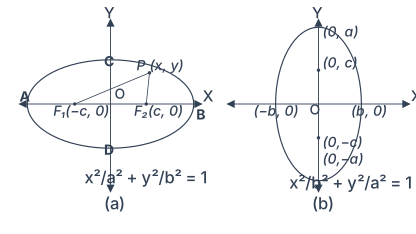
Fig 10.24 shows the two standard orientations of an ellipse centred at the origin. In panel (a), the ellipse is stretched horizontally; in panel (b), it is stretched vertically. Both are drawn on the same - coordinate axes, and the figure is the starting point for deriving the simplest equations of an ellipse.
Panel (a) — horizontal ellipse. The major axis lies along the -axis. The two foci are and , symmetric about the origin. The vertices (the farthest points on the ellipse along the major axis) are labelled and ; they lie at and respectively. The ends of the minor axis are labelled and , located at and . A general point on the ellipse is shown with line segments joining it to both foci. The defining geometric condition is that the sum of these two distances is constant: , where . The equation derived from this condition is
Here is the semi-major axis length (half the major axis), is the semi-minor axis length, and is the distance from the centre to each focus.
Panel (b) — vertical ellipse. The major axis is now along the -axis. The foci are at , the vertices at , and the ends of the minor axis at . The equation becomes
with the same relation but now and the larger denominator is under .
The key physical idea is that an ellipse is the set of all points for which the sum of distances to two fixed points (the foci) is constant. The figure makes this concrete: the two panels show the two possible orientations when the centre is at the origin and the foci lie on a coordinate axis. The formulas that follow are the standard equations, and the figure tells you which denominator belongs to which axis.
A common mistake is to assume is always the -intercept. In panel (b), is the -intercept because the major axis is vertical. Always check which denominator is larger — that denominator corresponds to the square of the semi-major axis length .
The textbook uses panel (a) to carry out the full derivation: starting from , applying the distance formula, squaring twice, and simplifying using to obtain . It then verifies that any point satisfying this equation also satisfies the distance-sum condition, confirming the equivalence. Panel (b) is handled by symmetry, swapping and roles.
…
Drawn by us to help you understand the concept clearly, and verified to make sure it's accurate. For exams, practice from your textbook's own diagram.
What Fig. 10.25 Actually Shows
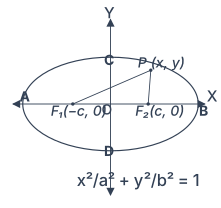
The figure is a clean, two-dimensional coordinate plot. The x-axis and y-axis are drawn, crossing at the origin O. On the x-axis, two points are marked: F₁ at and F₂ at — these are the two foci of the ellipse. Further out along the x-axis, the two vertices are labelled A and B, located at and respectively. On the y-axis, the ends of the minor axis are marked C and D at and .
A single point P with coordinates is shown somewhere on the upper-right quadrant of the ellipse. Two dashed lines connect P to F₁ and F₂, visually representing the distances PF₁ and PF₂. The ellipse itself is drawn as a smooth, symmetric oval centred at the origin, stretching from to horizontally and from to vertically. The major axis lies along the x-axis, the minor axis along the y-axis.
The Physical Idea the Figure Teaches
The figure makes the defining property of an ellipse visible. For any point P on the curve, the sum of its distances to the two fixed points F₁ and F₂ is constant. That constant is , where is the semi-major axis length. The two dashed lines from P to the foci are not just decoration — they are the heart of the definition. The geometry is set up so that the centre of the ellipse coincides with the origin, the foci lie symmetrically on the x-axis, and the entire shape is symmetric about both axes.
The figure deliberately places the foci inside the ellipse, between the centre and the vertices. This is not accidental — it reflects the condition , which ensures the ellipse is a closed curve. If , the foci would coincide with the vertices and the ellipse would degenerate into a line segment.
The Key Formula the Textbook Develops
Starting from the distance condition PF₁ + PF₂ = , the textbook works through algebra to arrive at the standard equation:
Here:
- is the semi-major axis length — half the distance between the two vertices A and B along the x-axis. It is also the constant half-sum of distances to the foci.
- is the semi-minor axis length — half the distance between C and D along the y-axis.
- is the distance from the centre to each focus, related to and by .
- The point is any point on the ellipse. …