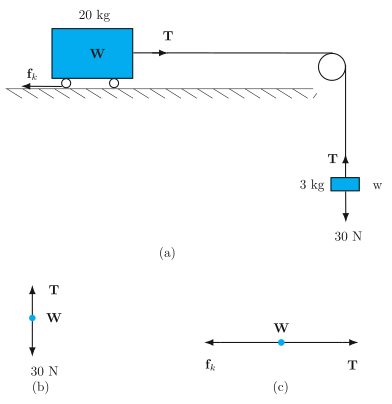
Q.A trolley of mass rests on a horizontal table. A light (massless) inextensible string is attached to the trolley, runs horizontally to a frictionless pulley fixed at the edge of the table, and then hangs vertically downward, supporting a hanging block of mass (weight ). When released, the hanging block descends and pulls the trolley along the table. The coefficient of kinetic friction between the trolley and the table surface is . Taking and neglecting the mass of the string, find the acceleration of the block-and-trolley system and the tension in the string.
You're viewing a preview — the full solution, concept, methods & PYQ mapping are locked.
Start your 14-day free trial to unlock the full solution →The hanging block drives the system; the trolley is held back by kinetic friction. A light inextensible string over a frictionless pulley makes both bodies share one acceleration and one tension . Solving the two Newton's-second-law equations gives and .
Concept
Because the string is inextensible, whatever distance the block falls, the trolley moves the same distance, so both have the same magnitude of acceleration . Because the string is light and the pulley frictionless, the tension is the same throughout the string. We apply to each body separately, taking the direction of motion as positive for each.
Step 1 — Friction on the trolley
The trolley presses on the table with normal force equal to its weight:
The kinetic friction opposing its motion is
Step 2 — Newton's second law for the hanging block ()
Its weight is downward, and the tension acts upward. Taking downward (the direction it accelerates) as positive:
Step 3 — Newton's second law for the trolley () …
Unlock everything free for 14 days
- Full step-by-step solutions
- Concept-first explanations
- Methods, shortcuts & mistakes
- PYQ mapping + timed mock tests
Full access for 14 days. No credit card required.