Q.A square lead slab of side 50 cm and thickness 10 cm is subject to a shearing force (on its narrow face) of . The lower edge is riveted to the floor. How much will the upper edge be displaced?
You're viewing a preview — the full solution, concept, methods & PYQ mapping are locked.
Start your 14-day free trial to unlock the full solution →A shearing force causes the top face of the lead slab to slide horizontally relative to the fixed bottom face. Using the shear modulus of lead and the geometry, the displacement is m or 0.16 mm.
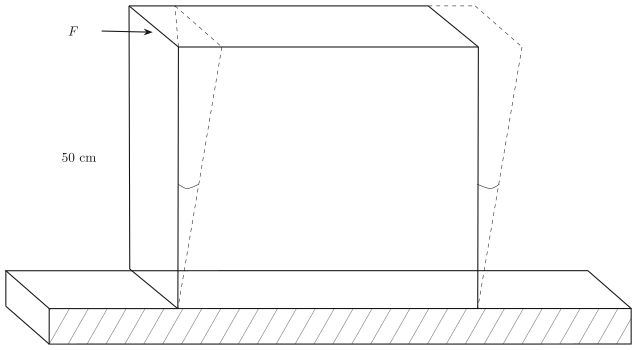
When a force acts parallel to a surface rather than perpendicular to it, we're dealing with shear stress. Imagine pushing the top of a deck of cards sideways while the bottom stays fixed—each card slides a tiny bit relative to the one below. The lead slab behaves similarly: the shearing force tries to slide the top face horizontally while the bottom is riveted in place.
The material's resistance to this sliding deformation is quantified by its shear modulus (or modulus of rigidity) , which relates shear stress to shear strain just as Young's modulus relates normal stress to normal strain.
where is the shearing force, is the area over which it acts, is the horizontal displacement, and is the height (the dimension perpendicular to the displacement).
For lead, the shear modulus is (a standard value you'd find in data tables).
Step-by-step solution:
- Identify the area experiencing shear stress. The force acts on the narrow face. Since the slab is square with side 50 cm and thickness 10 cm, the narrow face has area:
- Calculate the shear stress.
-
Determine the relevant height.
The displacement occurs over the height of the slab, (the side over which the shear strain develops).
-
Apply the shear modulus relation. …
Unlock everything free for 14 days
- Full step-by-step solutions
- Concept-first explanations
- Methods, shortcuts & mistakes
- PYQ mapping + timed mock tests
Full access for 14 days. No credit card required.