Physics · Ch 3 — Motion in a Plane
Equality of Vectors
Equality of Vectors
Equality of Vectors
Two vectors are said to be equal only when they have the same magnitude and the same direction. This is a stricter condition than equality of numbers. For example, a displacement of 5 metres east is not equal to a displacement of 5 metres north, even though the magnitudes are the same. The direction must match exactly.
A common mistake is to think that two vectors are equal if they have the same magnitude. This is false. Direction is an essential part of a vector; without it, the quantity is just a scalar. Two vectors with the same magnitude but opposite directions are not equal — they are negatives of each other.
Consider two vectors and . They are equal, written , if and only if:
- (magnitudes are equal), and
- and point in the same direction.
Because a vector is defined by its magnitude and direction, its location in space does not matter. A vector can be moved parallel to itself without changing it. This property is called free translation of vectors. So, if you shift a vector to a new position without rotating it or changing its length, the shifted vector is exactly equal to the original.
This freedom to move vectors parallel to themselves is what makes vector addition and subtraction possible. It allows us to place the tail of one vector at the head of another, which is the foundation of the triangle law of addition.
Properties of Vector Equality
The equality of vectors follows three fundamental properties, which are the same as the properties of equality for real numbers.
Property (I): Reflexivity
Every vector is equal to itself.
Property (II): Symmetry
If one vector equals a second, then the second equals the first.
If , then .
Property (III): Transitivity
If a first vector equals a second, and the second equals a third, then the first equals the third.
If and , then .
›Proof
Proof of Transitivity
Given , we know and and have the same direction.
Given , we know and and have the same direction.
From the two magnitude equalities, , so .
From the two direction equalities, has the same direction as , and has the same direction as . Therefore, has the same direction as .
Since both conditions for equality are satisfied, .
Negative of a Vector …
Drawn by us to help you understand the concept clearly, and verified to make sure it's accurate. For exams, practice from your textbook's own diagram.
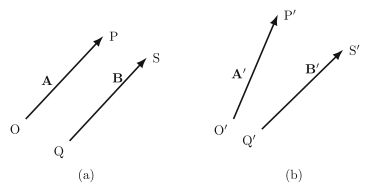
Figure 3.2 is a simple two-panel diagram that drives home the most fundamental idea in vector physics: a vector is defined by both its magnitude and its direction. The figure does not show any axes, curves, or numerical labels — it is purely a visual comparison of arrows.
Panel (a) shows two arrows, labelled A and B, that are identical in length and point in exactly the same direction. They are drawn parallel to each other. This panel teaches that two vectors are equal when they have the same magnitude (the length of the arrow) and the same direction. It does not matter where the arrows are placed in space; if you slide them so their tails meet, they would coincide perfectly. The physical idea is that a vector quantity like displacement, velocity, or force is unchanged by a parallel shift — only its magnitude and orientation matter.
Panel (b) shows two arrows, labelled A′ and B′, that have the same length but point in different directions. The arrows are not parallel. This panel teaches that two vectors are unequal even if their magnitudes are identical, because their directions differ. A common beginner mistake is to think that two arrows of the same length are the same vector — this figure explicitly corrects that error.
A common pitfall: do not confuse the length of an arrow (its magnitude) with the vector itself. Two vectors of equal length but different directions are different vectors. For example, a velocity of north is not the same as east, even though both have magnitude .
The textbook uses this figure to ground the formal definition of vector equality. The key result is:
…