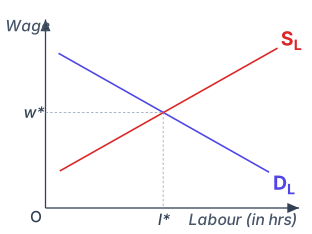
Let’s start with something you already know from everyday life. Think about the market for mangoes. If the price of mangoes rises, sellers bring more mangoes to the market, and buyers buy fewer. The market clears — price adjusts, quantity adjusts, and everyone is happy. Now think about the market for labour. You are a worker. If your boss says, “I’ll pay you half your current salary,” would you work twice as many hours? Probably not. You might quit, or you might work the same hours because you still need to pay rent. The labour market does not behave like the mango market. That is the first clue: labour is not a commodity like fruit or steel.
What is Labour Market Peculiarity?
The term “labour market peculiarity” refers to the unique features that make the market for labour fundamentally different from markets for goods and services. These peculiarities are not minor quirks — they are structural differences that shape how wages are determined, how employment rises and falls, and why government intervention (like minimum wage laws or labour unions) exists.
The NCERT Class-12 Economics textbook (Macroeconomics, Chapter 7: “Employment: Growth, Informalisation and Other Issues”) does not give a single formula for this concept. It is a qualitative, institutional idea. So we will not invent a formula. Instead, we will understand the four main peculiarities that NCERT emphasises.
1. Labour is inseparable from the labourer
When you buy a mango, the mango and the seller are separate. You take the mango home; the seller stays in the shop. But when you hire a worker, you are hiring the person — their time, effort, emotions, health, and dignity. You cannot separate the labour from the human being. This means:
- A worker cannot be “stored” like inventory. If a factory shuts down for a month, the worker’s time is lost forever.
- Working conditions matter directly to the worker’s well-being. A bad environment affects not just output but the person’s life.
- Labour is not homogeneous. Each worker has different skills, attitudes, and productivity. You cannot replace one worker with another the way you replace one kilogram of rice with another.
Because labour is inseparable from the labourer, the human element — motivation, health, safety, dignity — becomes a central concern in labour markets. This is why labour laws exist.
2. Labour is perishable
A worker’s time today cannot be saved and used tomorrow. If a worker is idle today, that day’s labour is lost forever. You cannot “inventory” labour. This gives employers a bargaining advantage: they know that a worker who does not get hired today loses that day’s income permanently. Workers, especially those with no savings, are forced to accept lower wages or worse conditions rather than remain unemployed.
This perishability is the root of exploitation in labour markets. It is also why trade unions and minimum wage laws exist — to protect workers from being forced into a race to the bottom.
3. Labour supply is not perfectly flexible
In the mango market, if price rises, sellers can quickly bring more mangoes from the farm. In the labour market, you cannot instantly produce more skilled workers. A doctor takes years to train. A carpenter takes months to learn. Even unskilled labour is constrained by geography — a worker in Bihar cannot instantly move to Mumbai for a job.
Moreover, workers have reservation wages: the minimum wage at which they are willing to work. If the offered wage is below that, they will choose to remain unemployed rather than work. This is not irrational — it reflects the cost of commuting, the loss of leisure, or the social stigma of a low-status job.
The NCERT textbook discusses the concept of “disguised unemployment” (especially in agriculture) as a direct consequence of this peculiarity: many workers are employed but their marginal productivity is zero. They cannot be easily moved to other sectors because of skill mismatches and immobility.
4. Labour market is not perfectly competitive
In a perfectly competitive market, many buyers and many sellers exist, and no single agent can influence price. In the labour market, this is rarely true.
- Employers often have market power (monopsony). A single large factory in a small town is the only employer. Workers have no alternative, so the employer can set wages below the competitive level.
- Workers organise into unions to counter this power. Collective bargaining replaces individual wage negotiation.
- Government sets minimum wages, regulates working hours, and provides social security. These interventions are not “market distortions” — they are responses to the peculiarities of labour. …