Physical Education · Ch 10 — Training in Sports
Flexibility
Flexibility
Flexibility — Meaning
Flexibility is also known as the range of motion around a joint — the ability to execute a movement with greater amplitude or range. It is related both to genetic factors and to the physical-activity programme a person follows. In everyday language, flexibility overlaps with words like stretchability, elasticity, litheness, mobility and pliancy.
An important point for the CBSE Class 12 Physical Education exam is that flexibility is a motor component that is NOT a conditional ability and NOT a coordinative ability — it stands on its own. It is affected by muscle strength, the structure of the joints, tendons, ligaments and other factors. A person with good flexibility performs daily tasks with greater ease, efficiency and effectiveness, and tends to carry a more attractive posture.
Tight joints hamper smooth, efficient movement, whereas good flexibility allows smooth and efficient workouts. Flexibility therefore helps in many ways — preventing injuries, improving posture, reducing back pain, maintaining healthy joints, improving balance during movement, and learning various skills quickly (for example the backstroke in swimming).
Flexibility is best treated joint by joint. A person may be very flexible at the shoulders yet stiff at the hips, so flexibility is specific to each joint rather than a single whole-body quality.
Importance of Flexibility
Flexibility has an important inter-relationship with the other factors that improve performance, so it has to be developed to an appropriate degree. Its importance can be summed up in five points:
- A greater range of motion allows the muscles to develop more force and speed.
- Flexibility lets movements be performed with minimum muscular tension, which improves movement economy.
- It reduces stiffness in the joints.
- It reduces the risk of injury, because pliable muscles are less likely to be strained.
- It helps in maintaining the correct posture while performing.
Types of Flexibility
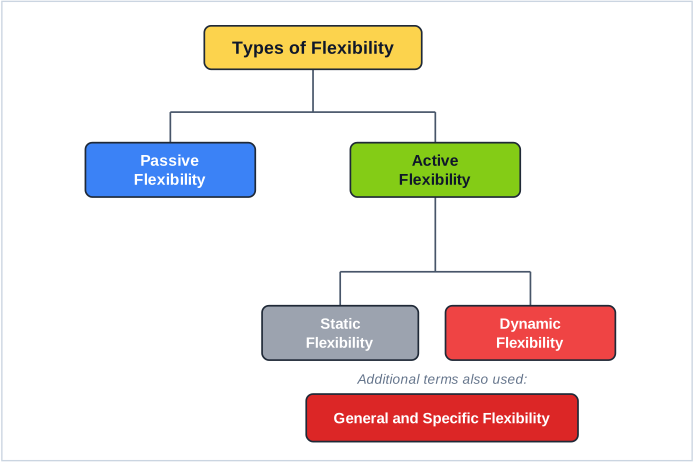
The NCERT/CBSE Class 12 Physical Education textbook classifies flexibility into two broad types — Passive and Active — and then divides active flexibility further. The terms General and Specific flexibility are also used.
Drawn by us to help you understand the concept clearly, and verified to make sure it's accurate. For exams, practice from your textbook's own diagram.
A classification tree. The top box 'Types of Flexibility' branches to two boxes: 'Passive Flexibility' and 'Active Flexibility'. 'Active Flexibility' branches down to 'Static Flexibility' and 'Dynamic Flexibility'. A separate box 'General and Specific Flexibility' is …
(A) Passive Flexibility. This is the ability to perform movements with greater amplitude with external help — for example, stretching with the assistance of a partner. Passive flexibility is always greater than active flexibility. It is determined mainly by the structure of the joint and the stretchability of the muscles and ligaments, and it is regarded as the base of operational flexibility.
(B) Active Flexibility. This is the ability to perform a movement with greater amplitude without any external help — for instance, a sportsperson performing a stretching exercise on their own. Active flexibility is always less than passive flexibility, and the gap between the two indicates a lack of muscular strength or coordination. Active flexibility is further classified into two kinds:
- (a) Static Flexibility — the flexibility needed for movements performed while the individual is in a static position, i.e. standing, sitting or lying.
- (b) Dynamic Flexibility — the flexibility needed for executing movements while the individual is moving.
General and Specific Flexibility. General flexibility refers to the flexibility of all the critical joints of the body — shoulder, hip and trunk — and is not tied to any particular sport. Specific flexibility is the ability to perform the specific movements demanded by a particular sport or event.
Methods to Improve Flexibility
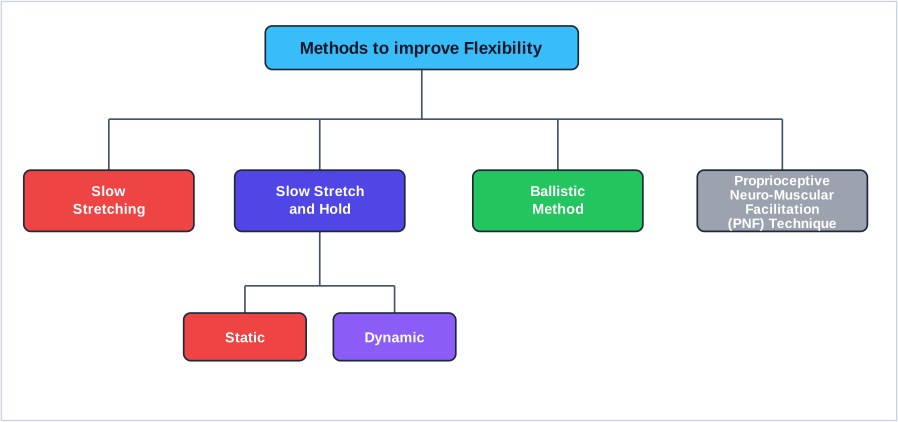
Four methods of developing flexibility are described in the syllabus. A board question may ask you to compare two of them or to recommend one for a given situation.
Drawn by us to help you understand the concept clearly, and verified to make sure it's accurate. For exams, practice from your textbook's own diagram.
A classification tree. The top box 'Methods to improve Flexibility' branches to four boxes: 'Slow Stretching', 'Slow Stretch and Hold', 'Ballistic Method' and 'PNF Technique'. The 'Slow Stretch and Hold' box branches down to t …
- Slow Stretching. The first and most basic method is to stretch the muscles around a joint slowly and without any jerky movement. The control of the stretch is what keeps it safe.
- Slow Stretch and Hold. The next stage is to reach the maximum stretching point and hold it for about 6-8 seconds. This is the method most commonly used in games and sports. The stretch-and-hold can be done either statically or dynamically:
- Static stretching eases slowly into the extended position and holds it. The hold is about 10 seconds for a cool-down and about 30 seconds when the aim is to improve flexibility.
- Dynamic stretching uses controlled movements (usually of the legs and arms) and suits events that themselves demand dynamic movement.
- Ballistic Method. Here the movement is performed with a swing and rhythm — the stretching is done rhythmically, which is why it is called the ballistic method. It uses the body's momentum to extend the range of motion. Though it was once popular, many physical therapists now caution against it because the rhythmic bouncing can cause injury. …