Question of 87
Q.(क) Explain the mechanism of esterification of carboxylic acids.
(3) (ख) Write the following name reactions with chemical equations –
(i) Cannizzaro reaction
(ii) Hell-Volhard-Zelinsky reaction (2)
Uttarakhand UbseUttarakhand Board Intermediate (Class 12) 2018Subjective· 5mImportance★★★★★
0% · 0/87 Questions
You're viewing a preview — the full solution, concept, methods & PYQ mapping are locked.
Start your 14-day free trial to unlock the full solution →Esterification: acid protonates C=O alcohol adds water eliminated ester. Cannizzaro: . HVZ: . (OR — identify A, B, C below.)
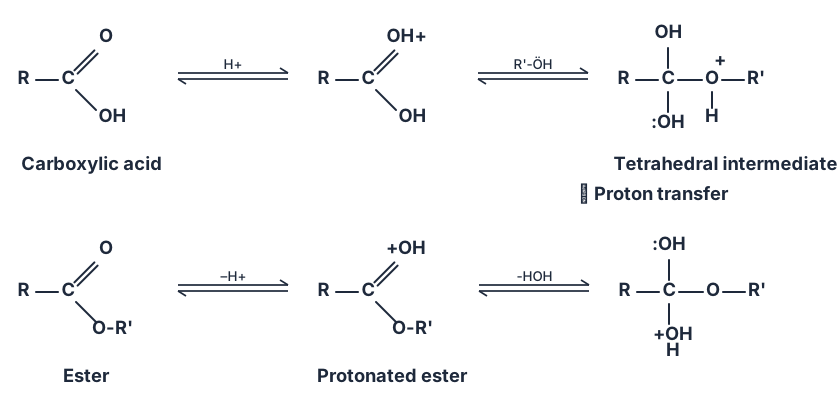
(k) Mechanism of esterification (Fischer esterification). A carboxylic acid reacts with an alcohol in the presence of a mineral-acid catalyst (conc. HSO) to give an ester and water. The steps are:
- Protonation of the carbonyl oxygen of the acid by H, making the carbonyl carbon more electrophilic.
- Nucleophilic addition of the alcohol oxygen to the carbonyl carbon, giving a tetrahedral intermediate.
- Proton transfer so that one of the two OH groups becomes OH (a good leaving group).
- Elimination of water and loss of the extra proton to regenerate the catalyst, giving the ester. Overall: The reaction is reversible; excess alcohol or removal of water drives it forward.
(kh) Name reactions.
- (i) Cannizzaro reaction — an aldehyde with no -hydrogen undergoes self oxidationreduction (disproportionation) with concentrated alkali: (one molecule is reduced to alcohol, the other oxidised to the acid salt).
- (ii) HellVolhardZelinsky (HVZ) reaction — a carboxylic acid having an -H is halogenated at the -carbon using Cl/Br in the presence of a little red phosphorus: …
Unlock everything free for 14 days
- Full step-by-step solutions
- Concept-first explanations
- Methods, shortcuts & mistakes
- PYQ mapping + timed mock tests
Full access for 14 days. No credit card required.