Q.(a) Following graph is a plot of the 'rate of a reaction' vs 'concentration of the reactant'. What is the order of the reaction. [1]
[FIGURE: graph with Rate (y-axis) plotted against Concentration (x-axis); the plotted line is horizontal — rate stays constant regardless of concentration]
🔒You're viewing a preview — the full solution, concept, methods & PYQ mapping are locked.
🔒 Start your 14-day free trial to unlock the full solution →Concept understanding — Factors Affecting Reaction Rate
Reaction Rate Stoichiometry – From Intuition to Precision
Imagine you are watching a simple reaction:
2NO2→2NO+O2
As NO₂ disappears, NO appears twice as fast as O₂ appears. Why? Because the balanced equation says: for every 2 molecules of NO₂ that break apart, you get 2 molecules of NO and 1 molecule of O₂. The numbers in front of the species — the stoichiometric coefficients — tell you the relative speeds at which reactants vanish and products appear.
That is the core idea: reaction rate stoichiometry is the relationship between the rates of change of different species in a chemical reaction, dictated by their coefficients in the balanced equation.
The Intuitive Picture
Think of a factory assembly line. The balanced equation is like a recipe:
- 2 units of raw material A → 2 units of product B + 1 unit of byproduct C
If the line runs steadily, every time 2 units of A are consumed, 2 units of B are produced and 1 unit of C is produced. So the rate at which A disappears must be twice the rate at which C appears. The rate at which B appears equals the rate at which A disappears (both have coefficient 2).
The stoichiometric coefficients are not speeds themselves — they are scaling factors that connect the speeds of different species.
The Precise Statement
For a general reaction:
aA+bB→cC+dD
The rate of reaction (often called the rate of the process, r) is defined as:
r=−a1dtd[A]=−b1dtd[B]=c1dtd[C]=d1dtd[D]
Here:
- dtd[X] is the instantaneous rate of change of concentration of species X (in mol L⁻¹ s⁻¹).
- The minus sign is used for reactants (their concentration decreases with time).
- The plus sign is used for products (their concentration increases with time).
- Dividing by the coefficient normalises the rate — so r is the same number for every species.
r=−a1dtd[A]=c1dtd[C]
This single value r is the intrinsic rate of the reaction, independent of which species you measure.
How to Use It (Step by Step)
Suppose you are given:
2H2+O2→2H2O
And you measure that dtd[H2]=−0.040 M/s (negative because H₂ is being consumed).
Step 1: Write the rate relation:
r=−21dtd[H2]=−11dtd[O2]=21dtd[H2O]
Step 2: Plug in the known value:
r=−21(−0.040)=+0.020 M/s
Step 3: Find the rate for O₂:
−dtd[O2]=r⇒dtd[O2]=−0.020 M/s
Step 4: Find the rate for H₂O:
21dtd[H2O]=r⇒dtd[H2O]=2r=0.040 M/s
A quick check: the coefficients tell you the relative rates. Here, H₂ disappears twice as fast as O₂, and H₂O appears at the same rate as H₂ disappears (both coefficient 2). Always verify your numbers match the coefficient ratios.
Common Pitfall to Avoid …
Why this formula?
Factors Affecting Reaction Rate: Understanding the Why Behind the Formulas
In chemical kinetics, the rate of a reaction depends on several factors. The key formulas are not arbitrary — they arise from collision theory and transition state theory. Let’s break down each factor and derive the reasoning step-by-step.
1. Effect of Concentration: The Rate Law
The Formula
For a reaction aA+bB→products, the rate is often:
Rate=k[A]m[B]n
where m and n are orders (not necessarily equal to a and b).
Why This Holds
- Collision theory: For a reaction to occur, reactant particles must collide with sufficient energy and correct orientation.
- Doubling concentration of A doubles the number of A particles per unit volume. This doubles the collision frequency between A and B (if B is constant). Hence, rate ∝ [A].
- But the order m is determined experimentally because:
- Not all collisions are effective.
- Some reactions involve multiple steps (mechanism). The rate depends on the slowest step (rate-determining step), which may involve only some reactants.
Example: For NO2+CO→NO+CO2, the rate law is Rate=k[NO2]2 — because the slow step involves two NO₂ molecules colliding.
2. Effect of Temperature: The Arrhenius Equation
The Formula
k=Ae−Ea/RT
where:
- k = rate constant
- A = frequency factor (collision frequency × orientation factor)
- Ea = activation energy (J/mol)
- R = gas constant (8.314 J/mol·K)
- T = temperature (K)
Why This Holds
- Boltzmann distribution: At a given temperature, molecules have a range of kinetic energies. Only those with energy ≥ Ea can react.
- The fraction of molecules with energy ≥ Ea is given by the Maxwell–Boltzmann distribution:
Fraction=e−Ea/RT
This is derived from integrating the energy distribution function.
- The frequency factor A accounts for how often collisions occur and the fraction with correct orientation.
- Temperature increase shifts the distribution to higher energies, exponentially increasing the fraction of molecules that can overcome Ea.
Key insight: A 10°C rise near room temperature roughly doubles the rate — because e−Ea/RT changes significantly.
3. Effect of a Catalyst
No Simple Formula, But a Key Principle
A catalyst lowers the activation energy Ea by providing an alternative reaction pathway (e.g., forming an intermediate).
Why This Works
- In the Arrhenius equation, k=Ae−Ea/RT.
- Lowering Ea increases the exponential factor e−Ea/RT dramatically.
- Example: If Ea drops from 100 kJ/mol to 80 kJ/mol at 300 K, the rate constant increases by a factor of:
e−100,000/(8.314×300)e−80,000/(8.314×300)=e(20,000)/(2494)≈e8.02≈3000
- The catalyst itself is not consumed — it participates in the mechanism but is regenerated.
4. Effect of Surface Area (for Heterogeneous Reactions) …
A rate that stays flat as concentration changes means the rate does not depend on concentration, which marks a zero order reaction, while several physical factors still govern how fast any reaction proceeds. The alternative parts turn on effective collisions, the activation-energy barrier, and how a large excess of one reactant makes a higher-order reaction behave as first order. …
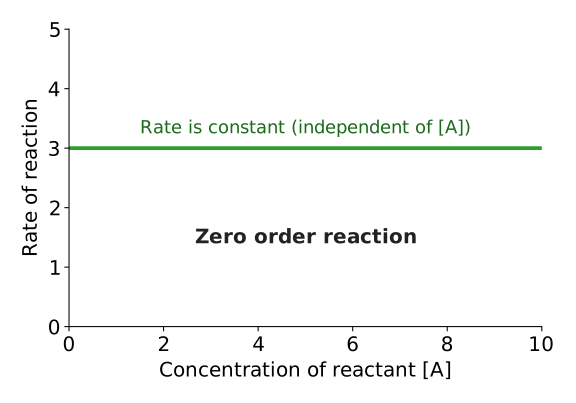
A horizontal rate-vs-concentration graph signals zero order; several physical/chemical factors govern reaction rate.
- Order of reaction from the graph: The graph shows rate as a horizontal line — i.e. the rate of reaction remains constant and does not change as the concentration of reactant changes. Since rate =k[A]n, a rate independent of concentration means n=0. This is a zero order reaction.
- Factors affecting the rate of a chemical reaction:
- Concentration of reactants — rate generally increases as reactant concentration increases (as given by the rate law).
- Temperature — rate increases with temperature, since a greater fraction of molecules then possess energy ≥ activation energy (Arrhenius equation).
- Catalyst — a catalyst increases the rate by providing an alternate reaction pathway of lower activation energy, without itself being consumed.
- Nature of reactants — the physical state and chemical bonding of the reactants affects rate (e.g. ionic reactions are usually faster than covalent-bond-breaking reactions).
- Surface area (for heterogeneous/solid reactants) — a larger surface area (finely powdered solid) increases the rate.
- Presence of light — some reactions (photochemical reactions) are accelerated by light.
OR:
(a) Effective collisions: collisions between reacting molecules that possess kinetic energy equal to or greater than the threshold/activation energy, and have the correct/favourable orientation at the moment of collision, so that they actually result in the formation of product(s) (as per collision theory).
(b) Activation energy (Ea): the minimum extra energy (over and above the average energy of the reactant molecules) that colliding molecules must possess in order to form the activated complex (transition state) and go on to give products.
…
Showing the 12 most recent of 27 on this concept.
- CBSE 2026Set ANNUAL1 markMCQQ.Rate constant depends on :(a) Temperature(b) Time(c) Initial concentration(d) None of the above
›Reveal solutionSolution
The rate constant k of a reaction depends only on temperature (and the nature of the reactants/catalyst); it is independent of the initial concentration of reactants and of time.
By definition, the rate law is Rate =k[A]m[B]n. Here k is a proportionality constant unique to a given reaction at a given temperature — it does NOT change if you alter the starting concentrations, and it does not vary with elapsed time during the reaction. What it DOES depend on is temperature, as captured by the Arrhenius equation:
k=Ae−Ea/RT
…
- CBSE 2026Set ANNUAL1 markMCQQ.For a chemical reaction with rise in temperature by 10°C the rate constant is nearly:(a) No change(b) Tripled(c) Doubled(d) Ten time increases
›Reveal solutionSolution
A 10 C temperature rise roughly doubles the rate constant.
As an empirical rule, for many reactions the rate (and rate constant) becomes about two to three times larger for every 10 C rise in temperature. This ratio, k(T+10)/k(T), is called the temperature coefficient and is nearly 2. The reason (from the Arrhenius equation) …
- CBSE 2025Set 56/5/11 markMCQQ.The role of a catalyst is to change : (A) equilibrium constant (B) enthalpy of reaction (C) Gibbs energy of reaction (D) activation energy of reaction
›Reveal solutionSolution
A catalyst provides an alternative reaction pathway with lower activation energy, speeding up both forward and reverse reactions equally without altering thermodynamic properties. The answer is (D).
Why catalysts work: the energy barrier concept
Every chemical reaction requires reactant molecules to climb an energy hill before they can transform into products. This hill—the activation energy Ea—represents the minimum energy needed to break old bonds and form new ones. Think of it as a mountain pass: molecules must reach the summit before they can descend into the product valley.
A catalyst doesn't push molecules harder or change where they start and end. Instead, it carves a tunnel through the mountain—a new reaction pathway with a lower summit. More molecules now have enough thermal energy to cross, so the reaction speeds up dramatically.
Crucially, the catalyst lowers the barrier in both directions by the same amount. The thermodynamic landscape—the relative energies of reactants and products—remains untouched.
What a catalyst does NOT change
Before examining what changes, let's eliminate what stays constant:
-
Equilibrium constant K
The equilibrium constant depends only on the standard Gibbs energy change: ΔG∘=−RTlnK. Since a catalyst doesn't alter the stability difference between reactants and products, K remains unchanged. The system reaches equilibrium faster, but the final composition is identical.
-
Enthalpy of reaction ΔH
This is the heat absorbed or released, determined by the difference in bond energies between products and reactants. A catalyst doesn't strengthen or weaken these bonds—it merely provides an alternative route between them.
-
Gibbs energy of reaction ΔG
The spontaneity and equilibrium position depend on ΔG=ΔH−TΔS, both state functions. The catalyst affects how fast the system reaches its natural destination, not where that destination lies.
Watch outA common misconception is that catalysts "shift equilibrium." They don't. Both forward and reverse rates increase proportionally, so the ratio kf/kr=K stays constant.
What a catalyst DOES change
- Activation energy Ea This is the catalyst's sole thermodynamic target. By stabilizing the transition state through temporary bond formation (in homogeneous catalysis) or by adsorbing reactants in favorable orientations (in heterogeneous catalysis), the catalyst lowers the energy barrier. …
-
- CBSE 2025Set ANNUAL1 markMCQQ.Which of the following does not affect the rate of reaction?(a) delta H(b) Temperature(c) Concentration(d) Catalyst
›Reveal solutionSolution
Rate of reaction depends on how fast reactants are converted to products (a kinetic quantity), while ΔH is a thermodynamic quantity describing the energy difference between reactants and products — the two are independent.
- Temperature: raises rate strongly (more molecules cross the activation-energy barrier; Arrhenius equation k = A·e^(−Ea/RT)).
- Concentration: higher concentration of reactants increases collision frequency, increasing rate (rate law dependence).
- Catalyst: provides an alternate pathway with lower activation energy, increasing rate without being consumed. …
- CBSE 2025Set ANNUAL1 markQ.Assertion [A] : A catalyst increases the rate of reaction without itself undergoing any permanent chemical change. Reason [R] : A catalyst does not alter Gibbs energy, ΔG of a reaction.
›Reveal solutionSolution
Both statements are individually true, but the reason a catalyst speeds up a reaction is that it LOWERS THE ACTIVATION ENERGY by providing an alternative pathway — not because ΔG is unchanged. ΔG being unaffected explains why equilibrium is unshifted, not why the rate increases.
[A]: A catalyst does increase reaction rate without itself being permanently consumed (it is regenerated at the end of the catalytic cycle) — TRUE.
[R]: A catalyst indeed does not alter the standard Gibbs energy change (ΔG) of a reaction, since ΔG is a thermodynamic (state-function) quantity depending only on the initial and final states, not on the pathway — TRUE.
…
- CBSE 2025Set ANNUAL1 markMCQQ.What happens to the value of ΔG for a reaction when a catalyst is added to it ?(a) It increases(b) It decreases(c) It remains unchanged(d) It is undefined on addition of catalyst
›Reveal solutionSolution
A catalyst is a thermodynamic bystander — it changes the rate of a reaction, not its free energy change.
ΔG (Gibbs free energy change) is a state function that depends only on the initial and final states (reactants and products) of a reaction, not on the pathway taken to reach the products. A catalyst works by providing an alternative reaction pathway with a lower activation energy, Ea, which speeds up both the forward and reverse reactions equally, but it does not alter the energies of the reactants or products themselves. Hence the equilibrium position and ΔG (and …
- CBSE 2024Set 56/2/11 markMCQQ.The addition of catalyst during a chemical reaction alters which of the following quantities of the reaction ? (A) Enthalpy (B) Activation energy (C) Entropy (D) Internal energy
›Reveal solutionSolution
A catalyst provides an alternative reaction pathway with a lower activation energy barrier, speeding up both forward and reverse reactions without changing the thermodynamic properties of reactants or products. The answer is (B) Activation energy.
Why catalysts work: the energy landscape
Chemical reactions occur when reactant molecules collide with enough energy to break existing bonds and form new ones. The minimum energy required for this transformation is the activation energy Ea. Think of it as an energy hill that molecules must climb before they can slide down into the product valley.
A catalyst doesn't push molecules harder or change where they start and end. Instead, it offers a different route over a lower hill—a new mechanism with intermediate steps that require less energy to traverse. The reactants and products remain chemically identical, so their inherent energy content (enthalpy, internal energy) and disorder (entropy) are unchanged.
Examining each quantity
Let's see what a catalyst does and doesn't alter:
-
Activation energy Ea
This is precisely what a catalyst reduces. By stabilizing the transition state or forming intermediate complexes, the catalyst lowers the energy barrier. For example, enzymes in biological systems can reduce Ea by factors of 106 or more, which is why reactions that would take years occur in milliseconds in living cells.
-
Enthalpy ΔH
Enthalpy change is the difference in heat content between products and reactants:
ΔH=Hproducts−Hreactants
Since the catalyst doesn't change the chemical identity of reactants or products, their bond energies and hence their enthalpies remain the same. The reaction is still exothermic or endothermic by the same amount.
-
Entropy ΔS
Entropy measures the disorder or number of accessible microstates. The initial and final states of the system are identical with or without a catalyst, so ΔS for the overall reaction is unchanged. The catalyst may create transient intermediate states, but these don't affect the entropy difference between reactants and products.
-
Internal energy ΔU
Internal energy is related to enthalpy by ΔH=ΔU+Δ(PV). For the same reason enthalpy is unaffected, internal energy change is also constant. The thermodynamic state functions depend only on the initial and final states, not the path taken. …
-
- CBSE 2023Set ANNUAL1 markQ.Write two factors that affect the rate of reaction.
›Reveal solutionSolution
The rate of a chemical reaction increases with an increase in the concentration of reactants and with an increase in temperature.
- Concentration of reactants: According to the law of mass action, the rate of reaction is directly proportional to the concentration(s) of the reacting species (raised to their respective orders). Increasing concentration increases the frequency of effective collisions between reactant molecules, increasing the rate. …
- CBSE 2023Set ANNUAL1 markQ.When the added substance reduces the rate of reaction, then it is called ________ in place of catalyst.
›Reveal solutionSolution
A substance that slows down (retards) a reaction, opposite in effect to a catalyst, is called an inhibitor or negative catalyst.
A catalyst speeds up a reaction without itself being consumed, by providing an alternative pathway of lower activation energy. When an added substance instead REDUCES the rate of reaction, it is called an inhibitor (or neg …
- CBSE 2023Set ANNUAL1 markQ.Write the name of enzyme used in decomposition of urea into ammonia and carbondioxide.
›Reveal solutionSolution
The enzyme urease specifically catalyses the breakdown of urea into ammonia and carbon dioxide, a classic textbook example of enzyme catalysis.
Urease is a biological (enzyme) catalyst that speeds up the hydrolysis reaction: NH2-CO-NH2 + H2O --urease--> 2NH3 + CO2. This is one of the standard examples use …
- CBSE 2022Set ANNUAL1 markQ.State law of Mass action. OR What is active mass?
›Reveal solutionSolution
The Law of Mass Action states that reaction rate is proportional to the product of the reactants' active masses (molar concentrations), each raised to the power of its stoichiometric coefficient.
Statement (Guldberg and Waage, 1864): At a constant temperature, the rate of a chemical reaction at any given instant is directly proportional to the product of the 'active masses' (i.e. molar concentrations, expressed in mol/L) of the reacting species, each concentration term raised to a power equal to that species' stoichiometric coefficient in the balanced chemical equation.
Mathematical form: For a general reaction
aA+bB⟶products
the law of mass action gives:
Rate∝[A]a[B]b
This relationship is the historical basis both for writing equilibrium constant expressions (at equilibrium, forward rate = backward rate) and, in its kinetic form, for rate laws of elementary reactions.
…
- CBSE 2020Set ANNUAL1 markQ.Read the given passage and answer the following questions: A substance which alters the rate of chemical reaction without itself undergoing any change in mass and chemical composition at the end of reaction is called catalyst. It may be noted that a catalyst which increase the speed of a reaction are called positive catalyst and catalyst which decrease the speed of reaction are called negative catalyst. The promoters are substances that enhance the activity of catalyst and poisons which decrease the activity of catalyst. What is catalyst?
›Reveal solutionSolution
A catalyst provides an alternate reaction pathway of lower activation energy, speeding up the reaction, while being chemically unchanged at the end.
A catalyst is a substance that changes the rate of a chemical reaction without itself undergoing any permanent change in mass and chemical composition at the end of the reaction. It works by adsorbing reactant molecules or forming a short-lived intermediate, opening up an alternative reaction pathway that has a lower activation energy than the uncatalysed path. Because more reactant molecules can then cross the (lower) energy barrier at a given temperature, the reaction proceeds faster. Although the catalyst actively participates in intermediate steps of …
🎓Unlock everything free for 14 days
- ✓Full step-by-step solutions
- ✓Concept-first explanations
- ✓Methods, shortcuts & mistakes
- ✓PYQ mapping + timed mock tests
Full access for 14 days. No credit card required.