Q.Suppose a company plans to produce a new product that incurs some costs (fixed and variable) and let the company plan to sell the product at a fixed price. Prepare a mathematical model to examine the profitability.
You're viewing a preview — the full solution, concept, methods & PYQ mapping are locked.
Start your 14-day free trial to unlock the full solution →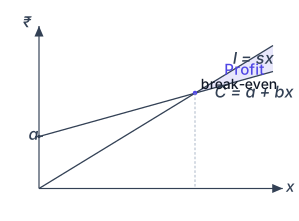
With units produced and sold, fixed cost , variable cost per unit and selling price per unit, the cost is , the income is and the profit is . The firm breaks even at ; above it there is profit, and is the profit earned per extra unit.
Step 1 — Identify. Build a relationship that tells the company, before production, whether and when the new product turns a profit.
Step 2 — Formulate the assumptions. Costs are of two kinds: fixed costs (rent, rates) that do not change with output, and variable costs that grow with output. Assume the variable cost is directly proportional to the number of units produced, and that every unit produced is sold immediately at a fixed price.
Step 3 — The mathematical model. Let
With fixed cost (rupees) and variable cost (rupees per unit),
With selling price (rupees per unit),
Profit is income minus cost:
Here is the independent variable, are dependent variables, and are parameters the manufacturer knows.
Step 4 — Solve for the break-even point. The break-even point is where the company makes neither profit nor loss, i.e. . From ,
…
Unlock everything free for 14 days
- Full step-by-step solutions
- Concept-first explanations
- Methods, shortcuts & mistakes
- PYQ mapping + timed mock tests
Full access for 14 days. No credit card required.