Q.Solve the following linear programming problem graphically: Maximise subject to the constraints: , , .
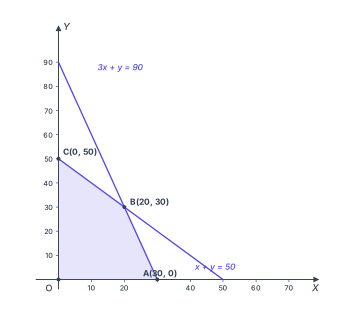
The problem is a two-variable linear program solved by the graphical method. The feasible region is bounded by the constraints, and the maximum of occurs at a corner point. The optimal solution is , , giving .
We have a linear programming problem with two decision variables, and , and a linear objective function to be maximised. The constraints are all linear inequalities. The graphical method works here because with only two variables, each inequality describes a half-plane in the -plane. The intersection of all these half-planes is the feasible region — the set of all points that satisfy every constraint. The fundamental theorem of linear programming tells us that if an optimal solution exists, it will be found at one of the corner points (vertices) of this feasible region. So our job is to draw the region, find its vertices, and evaluate at each vertex.
Let’s go step by step.
-
Plot each constraint as a line.
First, treat each inequality as an equation.
- : This line passes through and .
- : This passes through and .
- is the -axis.
- is the -axis.
The inequalities , restrict us to the first quadrant.
-
Determine which side of each line is feasible.
For , test the origin : is true, so the half-plane containing the origin is feasible.
For , test : is true, so again the origin side is feasible.
So the feasible region is the intersection of the two half-planes below both lines, in the first quadrant.
-
Find the corner points of the feasible region.
The region is a polygon bounded by the axes and the two lines. The vertices are:
- — intersection of and .
- — intersection of and . But check if it satisfies : , yes.
- — intersection of and . Check : , yes.
- The intersection of the two lines and . Solve: subtract the first from the second: gives , so . Then . So the point is . Check both constraints: (tight), (tight). This is inside the first quadrant.
So the vertices are: , , , .
Always check that each candidate vertex actually satisfies all constraints — sometimes the intersection of two lines falls outside the feasible region because a third constraint cuts it off. Here all four are valid.
-
Evaluate at each vertex.
Vertex 0 0 0 50 20 30 30 0 The largest value is at .
A common mistake is to assume the maximum occurs where the two constraint lines intersect (here ). But the objective function has a steeper slope in the -direction, so pushing as high as possible — all the way to on the line — yields a higher value, even though becomes zero. Always check all vertices.
- Interpret the result. The maximum value of is , achieved at , . This means that under the given constraints, the best strategy is to use all resources to produce (30 units) and none of .
The maximum value is , attained at , .
Unlock everything free for 14 days
- Full step-by-step solutions
- Concept-first explanations
- Methods, shortcuts & mistakes
- PYQ mapping + timed mock tests
Full access for 14 days. No credit card required.