Q.Minimise subject to the constraints: , , .
You're viewing a preview — the full solution, concept, methods & PYQ mapping are locked.
Start your 14-day free trial to unlock the full solution →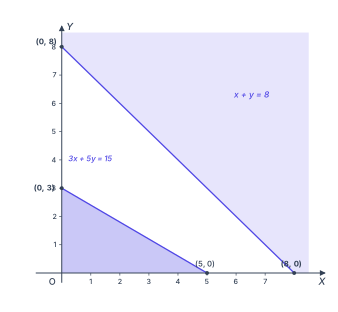
The constraints and together with define a feasible region. However, these constraints are contradictory — the half-planes do not overlap. Hence, there is no feasible solution, and the problem is infeasible.
Why this happens — the core idea
In Linear Programming, every constraint cuts the plane into two halves: one that satisfies it, one that doesn't. The feasible region is the intersection of all these half-planes. If that intersection is empty, no point satisfies all constraints simultaneously — the problem has no solution.
Here, the first constraint demands that be at least 8. The second demands that be at most 15. Since both and are non-negative, these two conditions pull in opposite directions. Let's see exactly why they cannot both hold.
Step-by-step reasoning
- Write down the constraints clearly
-
Interpret constraint (1)
The line has intercepts and . The inequality means we want points on or above this line. Since , the smallest possible in the first quadrant is (at the origin), but here we need it to be at least 8. So the feasible region for (1) is the half-plane that starts at the line and goes outward, away from the origin.
-
Interpret constraint (2)
The line has intercepts and . The inequality means we want points on or below this line. This half-plane includes the origin, because .
-
Check if the two half-planes overlap
The first half-plane lies above the line . The second lies below the line . For an overlap to exist, there must be some point with that is simultaneously above the first line and below the second.
Let’s test the extreme point of the second constraint: the point lies on . At this point, , which is less than 8 — so it fails (1).
The point also lies on the second line. Here , again less than 8.
In fact, every point that satisfies (2) has at most? Let's find the maximum possible under (2) and non-negativity.
-
Maximise subject to ,
This is a small LP itself. The feasible region for (2) alone is a triangle with vertices , , . The value of at these vertices:
- :
- : …
Unlock everything free for 14 days
- Full step-by-step solutions
- Concept-first explanations
- Methods, shortcuts & mistakes
- PYQ mapping + timed mock tests
Full access for 14 days. No credit card required.