Mathematics · Ch 11 — Three-Dimensional Geometry
Direction Cosines of a Line Passing Through Two Points
Direction Cosines of a Line Passing Through Two Points
Direction Cosines of a Line Through Two Points
Through two distinct points in space passes exactly one line, and we can find its direction cosines directly from the coordinates of the two points.
The Geometric Setup
Consider and , and let line have direction cosines , making angles with the , , axes. Drop perpendiculars from and to the -plane, meeting at and , and from draw a perpendicular to meeting it at . This creates right triangle with , where the vertical side equals .
Deriving the Direction Cosines
In right triangle , is opposite and is the hypotenuse, so:
By constructing analogous right triangles for the other axes:
Direction Cosines of Line Through Two Points
where
Direction Ratios: A Simpler Alternative
While direction cosines require division by , we often use direction ratios — any three numbers proportional to the direction cosines.
For the line joining and , the direction ratios can be taken as:
or equivalently:
The two sets differ only by a factor of , which reverses the direction of the line; both are valid. …
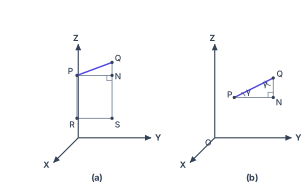
Drawn by us to help you understand the concept clearly, and verified to make sure it's accurate. For exams, practice from your textbook's own diagram.
The figure is built around a single geometric idea: to find the direction cosines of a line segment in space, drop perpendiculars to the coordinate planes and use the right triangles that appear.
Panel (a) shows the actual 3‑D setup. Points and are joined by the segment (often drawn in indigo). From each point a perpendicular is dropped to the -plane: from meets the plane at , and from meets it at . Because and lie in the -plane, the segment is horizontal — it lies parallel to the -plane. A line is drawn parallel to , meeting at . This construction creates a right triangle with the right angle at : is horizontal (parallel to ), is vertical (since is perpendicular to the -plane), so .
Panel (b) isolates that right triangle and places it in a clean coordinate frame with axes , , meeting at the origin . The hypotenuse is . The angle at in this triangle is labelled , and by alternate angles the same appears at . The side is the vertical separation between and — that is, (taking ). The side equals , which is the horizontal distance between the feet of the perpendiculars; but more directly, is the length of the projection of onto the -plane.
From the right triangle we get the fundamental relation:
The same reasoning applied to the other two coordinate planes gives:
where , , are the angles makes with the positive , , axes respectively.
Direction cosines of the line joining and
where .
The figure’s real teaching point is that direction cosines are simply the ratios of the coordinate differences to the length of the segment — they are not abstract numbers but come directly from the geometry of a right triangle. The perpendiculars to the -plane and the parallel line are the visual trick that turns a 3‑D problem into a familiar 2‑D right‑triangle calculation. …