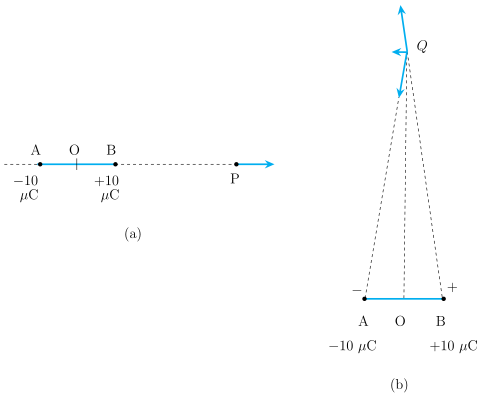
Q.Two charges ±10μC are placed 5.0mm apart. Determine the electric field at
🔒You're viewing a preview — the full solution, concept, methods & PYQ mapping are locked.
🔒 Start your 14-day free trial to unlock the full solution →Concept understanding — Coulomb Force Superposition
Coulomb Force Superposition – From Intuition to Precision
Imagine you're in a room with three friends. Each friend can push or pull you. If two friends push you from the same side, you feel a stronger push — the combined effect. If one pushes from the left and another from the right, you feel the net effect, which might be smaller or even zero if they push equally hard.
This is exactly how electric forces work. When multiple charged particles are present, each one exerts its own force on a given charge. The total force that charge feels is simply the vector sum of all the individual forces — as if each other charge were acting alone, completely ignoring the presence of the rest.
That's the core idea: forces add like arrows, not like numbers.
The Precise Statement
Fnet on q0=∑i=1nFi→0=4πε01∑i=1nri02q0qir^i0
Where:
- q0 is the charge you're calculating the force on
- qi are all other charges (excluding q0 itself)
- ri0 is the distance between qi and q0
- r^i0 is a unit vector pointing from qi to q0 (or away, depending on sign convention — be consistent)
The key point: Each pair of charges interacts independently. The presence of a third charge does not alter the force between the first two. This is what "superposition" means — the forces simply layer on top of each other.
Why This Matters (and a Common Trap)
Never add the magnitudes of forces directly unless all forces are along the same line and in the same direction. Force is a vector — direction matters.
If two forces point in opposite directions, they partially cancel. If they're at right angles, the net force is found using the Pythagorean theorem, not simple addition.
Example: Three charges on a line:
- q1=+2μC at x=0
- q2=−1μC at x=3cm
- q0=+1μC at x=1cm
Step 1: Force from q1 on q0 — both positive, so repulsive. q0 is pushed to the right.
Step 2: Force from q2 on q0 — opposite signs, so attractive. q0 is pulled to the right (toward q2).
Step 3: Both forces point right. Now you add magnitudes: Fnet=F1→0+F2→0.
If q2 were also positive, the force from q2 would push q0 left, and you'd subtract.
The Deeper Reason
Coulomb's law is a linear law — the force is proportional to each charge individually. If you double q1, the force from q1 doubles, but the force from q2 stays the same. This linearity is what makes superposition possible. It's not a coincidence — it's a fundamental property of electromagnetic interactions at the classical level.
Superposition works because electric forces obey a linear inverse-square law. If the force depended on products of three charges (like q0q1q2), superposition would fail. It doesn't — and that's why we can break down any multi-charge problem into a series of two-charge calculations.
--- …
Why this formula?
Coulomb Force Superposition — Why the Formula Holds
The principle of superposition for Coulomb forces states that the net electrostatic force on a given charge due to a collection of other charges is the vector sum of the individual forces from each charge, as if the others were absent.
The Key Formula
If we have a charge q0 at position r0, and N other point charges q1,q2,…,qN at positions r1,r2,…,rN, the net force on q0 is:
Fnet=4πε01∑i=1N∣r0−ri∣2q0qir^0i
where r^0i is the unit vector pointing from qi to q0.
Why This Works — The Physical Reasoning
1. Coulomb's Law is a Two-Body Interaction
Coulomb's law describes the force between exactly two point charges. It depends only on:
- The product of their charges (q0qi)
- The inverse square of the distance between them
- The direction along the line joining them
Crucially, the force between q0 and qi does not depend on the presence of any other charges qj.
2. Forces Add as Vectors (Newton's Third Law + Linearity)
Electrostatic forces are real physical forces — they obey Newton's laws. If multiple forces act on the same charge, the net effect is the vector sum of each individual force. This is a fundamental property of forces in classical mechanics.
3. The Electric Field is Linear
A deeper reason: the electric field E obeys superposition. Since F=q0E, and E from multiple sources adds linearly, the force automatically adds linearly.
The electric field at r0 due to qi is:
Ei(r0)=4πε01∣r0−ri∣2qir^0i
Then:
Fnet=q0∑iEi=∑iFi
The Crucial Assumption (Why It's Not Trivial)
Superposition holds because Maxwell's equations are linear in the electric field. If the equations were nonlinear (e.g., if the field depended on E2), then the force from two charges together would not be the sum of the individual forces.
In electrostatics, the electric field satisfies:
∇⋅E=ε0ρ,∇×E=0
Both equations are linear — if E1 and E2 are solutions, then E1+E2 is also a solution. This linearity is the mathematical reason superposition works.
--- …
For a short dipole (2a=5.0mm≪r=15cm) use the far‑field formulas. The dipole moment is
p=q(2a)=(10×10−6)(5.0×10⁻³)=5.0×10⁻⁸C⋅m,
with k=9×10⁹ and r3=(0.15)3=3.375×10⁻³m3.
- Axial point P.
directed along the dipole moment (from −q to +q).
EP=r32kp=3.375×10⁻³²(9×10⁹)(5.0×10⁻⁸)=2.7×10⁵N/C,
- Equatorial point Q. …
Since r=15cm≫2a=5mm, use the short‑dipole fields with p=5.0×10⁻⁸C⋅m: the axial field at P is EP=2kp/r3=2.7×105N/C (along p) and the equatorial field at Q is EQ=kp/r3=1.3×105N/C (opposite p), so EP=2EQ.
Setup. The charges are q=10μC=10−5C separated by 2a=5.0×10⁻³m, and the field is wanted at r=0.15m from the centre O. Since r/a=0.15/0.0025=60≫1, the point is far compared with the dipole size, so the short‑dipole approximation is excellent. The dipole moment is
p=q(2a)=(10−5)(5.0×10⁻³)=5.0×10⁻⁸C⋅m,
directed from the negative to the positive charge. Take k=1/4πε0=9×109N⋅m2/C2 and note r3=(0.15)3=3.375×10⁻³m3.
(a) Point P on the axis. For a short dipole the axial field is
EP=4πε01r32p=3.375×10⁻³²(9×10⁹)(5.0×10⁻⁸)=3.375×10−3900=2.67×10⁵N/C.
It is directed along the dipole moment (pointing away from the dipole on the positive‑charge side). …
Method: Superposition of Electric Fields (Vector Addition)
This problem uses the principle of superposition: the net electric field at any point is the vector sum of the fields due to each individual charge.
Steps for Part (a) — Point P on the axis
-
Identify the distances
- Dipole length: 2a=5.0 mm=5.0×10⁻³ m
- Half-length: a=2.5×10⁻³ m
- Distance from centre O to P: r=15 cm=0.15 m
- Distance from +q to P: r+=r−a=0.15−0.0025=0.1475 m
- Distance from −q to P: r−=r+a=0.15+0.0025=0.1525 m
-
Write the field magnitudes
Field due to +q at P:
E+=r+2kq(away from +q, i.e., to the right)
Field due to −q at P:
E−=r−2kq(toward -q, i.e., also to the right)
- Add as vectors (same direction) Since both fields point to the right:
Enet=E++E−=kq(r+21+r−21)
- Substitute values k=9×10⁹ N⋅m2/C2, q=10 μC=10−5 C
Enet=(9×10⁹)(10−5)((0.1475)21+(0.1525)21)
Computing:
(0.1475)21≈45.97, (0.1525)21≈43.00
Sum ≈88.97
Enet≈9×104×88.97≈8.01×10⁶ N/C
Direction: away from the dipole along the axis, toward the right.
Steps for Part (b) — Point Q on the perpendicular bisector
-
Identify geometry
- Distance from O to Q: r=0.15 m
- Distance from each charge to Q: R=r2+a2=(0.15)2+(0.0025)2 Since a≪r, R≈r=0.15 m
-
Field magnitudes are equal
E+=E−=R2kq
-
Resolve directions
- E+ points away from +q
- E− points toward −q
- The horizontal components cancel (equal and opposite)
- The vertical components add
-
Find vertical component
From the geometry, sinθ=Ra
Each vertical component: E⊥=R2kq⋅Ra=R3kqa
Net field (both vertical components add): …
Common Mistakes & How to Avoid Them
Mistake 1: Forgetting the Vector Nature of Electric Field
The Error: Students treat electric field as a scalar and simply add magnitudes without considering direction. For the axial point P, they might compute E=r12kq+r22kq directly.
Why It's Wrong: Electric field is a vector. The fields from +q and −q point in opposite directions at P. Simply adding magnitudes gives the wrong answer.
How to Avoid: Always draw arrows showing field directions before calculating. For point P:
- Field from +q points away from +q (to the right)
- Field from −q points toward −q (also to the right)
So they add vectorially: EP=E+q+E−q (both rightward)
Mistake 2: Using Wrong Distances
The Error: Using 15cm as the distance from both charges instead of calculating individual distances.
Why It's Wrong: The charges are 5.0mm apart, so distances from P to each charge differ slightly. For P at 15cm from centre:
- Distance to +q: r1=15−0.25=14.75cm
- Distance to −q: r2=15+0.25=15.25cm
How to Avoid: Always compute exact distances from each charge to the point. Draw a clear diagram with labelled distances.
Mistake 3: Unit Conversion Errors
The Error: Mixing cm and mm, or forgetting to convert to metres.
Why It's Wrong: Coulomb's law requires SI units: metres for distance, Coulombs for charge. Using 5.0mm as 5.0 in the formula gives nonsense.
How to Avoid: Convert everything to metres first:
- 5.0mm=5.0×10⁻³m
- 15cm=0.15m
- 10μC=10×10−6C
Mistake 4: Forgetting the Dipole Approximation
The Error: For point Q (equatorial position), students compute exact fields from each charge and add them vectorially, but make sign errors.
Why It's Tricky: At Q, the fields from +q and −q have equal magnitudes but point in different directions. Their horizontal components cancel, vertical components add.
How to Avoid: For the equatorial point:
- Both fields have magnitude E=r2+(d/2)2kq
- The vertical components cancel (opposite directions)
- The horizontal components add: EQ=2Esinθ where sinθ=r2+(d/2)2d/2
Mistake 5: Using the Wrong Formula for Dipole Field …
🎓Unlock everything free for 14 days
- ✓Full step-by-step solutions
- ✓Concept-first explanations
- ✓Methods, shortcuts & mistakes
- ✓PYQ mapping + timed mock tests
Full access for 14 days. No credit card required.