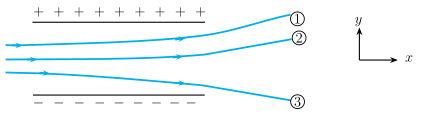
Q.Figure 1.30 shows tracks of three charged particles in a uniform electrostatic field. Give the signs of the three charges. Which particle has the highest charge to mass ratio?
You're viewing a preview — the full solution, concept, methods & PYQ mapping are locked.
Start your 14-day free trial to unlock the full solution →Particles bend toward the plate of opposite charge: tracks 1 and 2 (upward) are negative, track 3 (downward) is positive. The particle with the largest deflection for the same field and distance has the highest charge-to-mass ratio; particle 3 wins.
Why particles curve in an electric field
A charged particle entering a uniform electric field experiences a constant force perpendicular to its initial velocity. This is exactly analogous to projectile motion under gravity: the horizontal component of velocity remains unchanged, while the perpendicular component grows linearly with time. The result is a parabolic trajectory.
The key insight is that the amount of bending depends on the acceleration, which in turn depends on the charge-to-mass ratio . A particle with large feels a strong force; a particle with small responds with large acceleration. The combination determines how sharply the path curves.
Step-by-step analysis
-
Identify the field direction.
The positive plate is at the top, the negative plate at the bottom. The electric field points from positive to negative, so downward in the figure.
-
Determine the force on each particle.
A positive charge experiences force in the direction of the field (downward). A negative charge experiences force opposite to the field (upward).
-
Read the deflections.
- Tracks 1 and 2 curve upward (toward the positive plate) the force is upward the particles are negative.
- Track 3 curves downward (toward the negative plate) the force is downward the particle is positive.
-
Compare the magnitudes of deflection.
All three particles enter horizontally with (presumably) similar speeds and traverse roughly the same horizontal distance through the field. The vertical displacement in a uniform field is given by
…
Unlock everything free for 14 days
- Full step-by-step solutions
- Concept-first explanations
- Methods, shortcuts & mistakes
- PYQ mapping + timed mock tests
Full access for 14 days. No credit card required.