Physics · Ch 8 — Electromagnetic Waves
Nature of Electromagnetic Waves
Nature of Electromagnetic Waves
Nature of Electromagnetic Waves
Electromagnetic waves are self-sustaining oscillations of electric and magnetic fields. From Maxwell’s equations, a key result emerges: in an electromagnetic wave, the electric field and the magnetic field are perpendicular to each other, and both are perpendicular to the direction of wave propagation. This is a general feature.
Why are and perpendicular?
Consider a charging capacitor (Fig. 8.2). The electric field inside the plates is perpendicular to the plates. The displacement current produces a magnetic field that circles around the plates (parallel to them). Thus, and are perpendicular in this case. This property holds for all electromagnetic waves.
Mathematical Description of a Plane Wave
A typical plane electromagnetic wave propagating along the -direction is shown in Fig. 8.3. At a given time , the electric field oscillates along the -axis, and the magnetic field oscillates along the -axis. Both vary sinusoidally with .
The electric field and magnetic field are given by:
Here:
- and are the amplitudes of the electric and magnetic fields.
- is the magnitude of the wave vector (or propagation vector) . Its direction gives the direction of propagation.
- is the angular frequency.
- The wave propagates with speed .
Relation Between and
The wave number is related to the wavelength by:
Speed of Electromagnetic Waves in Vacuum
Using Maxwell’s equations with the wave equations for and , we find that , where is the speed of light in vacuum:
This is a fundamental constant. In terms of frequency and wavelength , the relation becomes:
Relation Between Electric and Magnetic Field Amplitudes
From Maxwell’s equations, the magnitudes of the electric and magnetic fields in an electromagnetic wave are related by:
This means that at any instant, the ratio of the electric field magnitude to the magnetic field magnitude is .
Electromagnetic Waves in a Material Medium
In a material medium with permittivity and magnetic permeability , the speed of light becomes:
Thus, the speed of light depends on the electric and magnetic properties of the medium. The refractive index of one medium relative to another is the ratio of the speeds of light in the two media. …
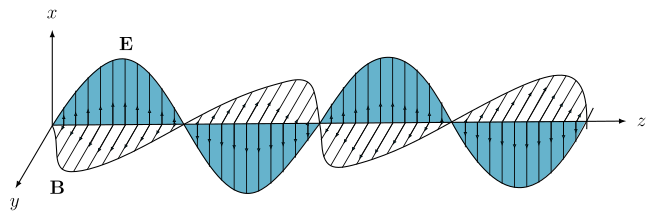
Drawn by us to help you understand the concept clearly, and verified to make sure it's accurate. For exams, practice from your textbook's own diagram.
What the Figure Shows
The figure is a 3‑axis perspective sketch of a plane electromagnetic wave.
- The z‑axis runs horizontally to the right — this is the direction of propagation of the wave.
- The x‑axis points vertically upward.
- The y‑axis is drawn down‑left in perspective, so all three axes are mutually perpendicular.
Two sinusoidal curves are drawn along the z‑axis:
- Electric field : a sine wave lying in the vertical x–z plane. Small vertical arrows along the curve show that oscillates along the x‑direction. The first crest is labelled E and points along .
- Magnetic field : a sine wave of the same wavelength and phase lying in the horizontal y–z plane. Arrows along the curve show that oscillates along the y‑direction. The first crest is labelled B and points along .
Both sine curves share the z‑axis, are in phase (crest‑to‑crest, trough‑to‑trough), and are transverse — their oscillations are perpendicular to the propagation direction .
The Physical Idea
The figure illustrates three essential properties of a plane electromagnetic wave in free space:
- Mutual perpendicularity: is along , is along , and the wave travels along . Each field is perpendicular to the other two directions.
- Transverse nature: Both and oscillate perpendicular to the direction of propagation.
- Same phase: The electric and magnetic fields reach their maxima and minima together — they are in phase, not out of phase.
This is a linearly polarised wave because the electric field oscillates along a fixed line (the x‑axis).
Key Formulas Developed from This Figure
From the sinusoidal variation shown in the figure, the textbook writes the fields as:
- : electric field component along the x‑axis
- : magnetic field component along the y‑axis
- , : amplitudes of the electric and magnetic fields
- : wave number (magnitude of the propagation vector ) …