Electric Potential
The Idea
When you lift a book onto a shelf you do work against gravity, and the book gains gravitational potential energy that depends on where it sits. Electric charges behave the same way in an electric field. Electric potential is the electrical analogue of "height" in a gravitational field: it tells you the potential energy a unit charge would have at a given point.
Formally, the electric potential at a point is the work done in bringing a unit positive charge from infinity to that point, slowly (without giving it kinetic energy), against the electric field.
V=q0W
Here W is the work done to move a small test charge q0 from infinity to the point. Because both W and q0 are scalars, electric potential is a scalar quantity — it has magnitude but no direction. Its SI unit is the volt:
1 V=1 J/C
Potential Due to a Point Charge
For a single point charge q, the potential at a distance r from it is
V=4πε01rq
Notice it falls off as 1/r, whereas the electric field of a point charge falls off as 1/r2. The potential is taken as zero at infinity, our chosen reference. A positive charge makes the potential around it positive; a negative charge makes it negative.
Potential Difference
Usually we care about the potential difference between two points A and B:
VA−VB=q0WB→A
the work per unit charge needed to move a charge from B to A. This is the quantity a voltmeter reads and the "voltage" that drives current in a circuit.
Relation Between Field and Potential
Field and potential are two views of the same thing. The electric field is the negative rate of change of potential with distance:
E=−drdV
The minus sign says the field points from high potential toward low potential — a positive charge, left free, rolls "downhill" in potential. Where the potential changes steeply, the field is strong.
Superposition
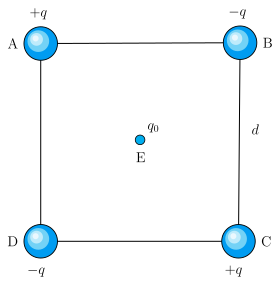
Because potential is a scalar, the potential due to several charges is just the algebraic sum of their individual potentials — no vectors, no angles:
V=4πε01(r1q1+r2q2+⋯)
This makes potential far easier to compute than the field, which needs vector addition. Once you have V everywhere, you can get the field by differentiating.
Equipotential Surfaces
An equipotential surface is a surface on which the potential has the same value everywhere.
- No work is done in moving a charge along an equipotential surface (since ΔV=0).
- The electric field is always perpendicular to an equipotential surface. …