Q.Read the following passage carefully and answer the questions given below: A prism is an optical medium bounded by three refracting plane surfaces. A ray of light suffers successive refraction on passing through its two surfaces and deviates by a certain angle from its original path. The refractive index of the material of the prism is given by: . If the angle of incidence on the second surface is greater than an angle called the critical angle, the ray will not be refracted from the second surface and is totally internally reflected. (क/a) [1 mark, MCQ] The critical angle for glass is θ₁ and that for water is θ₂. The critical angle for the glass-water surface would be (given: refractive index of glass w.r.t. air and refractive index of water w.r.t. air ): options —
You're viewing a preview — the full solution, concept, methods & PYQ mapping are locked.
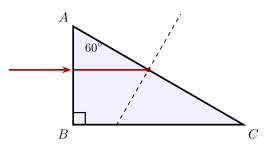
Start your 14-day free trial to unlock the full solution →Critical angle rises as the refractive-index mismatch across the interface falls, wavelength shortens (frequency stays fixed) on entering a denser medium, and in the right-angled prism the ray totally internally reflects once (at AC) before finally emerging through the base BC.
(क/a) Critical angle for glass–water interface [1 mark]: For total internal reflection between two media of refractive indices (denser) and (rarer), .
For glass–air: .
For water–air: .
For glass–water (going from denser glass into rarer water): .
Since , the glass–water critical angle is greater than θ₂.
(ख/b) Refraction into a denser medium [1 mark]: When light of wavelength and frequency enters a denser medium, its speed decreases. Since the frequency is determined by the source and does not change on refraction, and , the decrease in speed must be accompanied by a decrease in wavelength . So: wavelength decreases, frequency remains unchanged.
(ग/c) Path of the ray in the prism [2 marks]: The prism ABC has and a right angle at B, so .
The ray enters face AB normally (along the horizontal, perpendicular to the vertical face AB), so it passes straight through without bending and travels horizontally inside the prism until it strikes face AC.
Because the ray travels parallel to the base BC, and side AC makes an angle of with BC, by simple geometry the ray also makes an angle of with the surface AC at the point where it strikes it. So the angle of incidence at AC, measured from the normal to AC, is .
The critical angle for the prism material (refractive index ) is:
…
Unlock everything free for 14 days
- Full step-by-step solutions
- Concept-first explanations
- Methods, shortcuts & mistakes
- PYQ mapping + timed mock tests
Full access for 14 days. No credit card required.