Q.Diatoms are placed under which group of Kingdom Protista?
🔒You're viewing a preview — the full solution, concept, methods & PYQ mapping are locked.
🔒 Start your 14-day free trial to unlock the full solution →Concept understanding — Kingdom Protista
Kingdom Protista: The First Eukaryotes
Imagine a world of single cells that are far more complex than bacteria. These cells have a true nucleus and organelles — they are eukaryotes. But they are not plants, animals, or fungi. They are the pioneers of complex life: the protists.
The intuition is simple: Protista is the kingdom of all eukaryotes that are not plants, not animals, and not fungi. It is a catch-all group, a bit like a "miscellaneous" folder for single-celled life that doesn't fit neatly elsewhere. But calling it "miscellaneous" undersells it — these organisms are the evolutionary bridge between simple prokaryotes and the three great kingdoms of complex life.
The Precise Statement
Kingdom Protista includes all unicellular and simple multicellular eukaryotic organisms that do not form tissues or organs. They are primarily aquatic, and their cells show a level of organisation that bacteria lack — a membrane-bound nucleus, mitochondria, chloroplasts (in some), and often flagella or cilia for movement.
Protists are the first eukaryotes to appear on Earth. They are the ancestors from which plants, animals, and fungi evolved. This is why they show features of all three kingdoms — some are photosynthetic like plants, some ingest food like animals, and some absorb nutrients like fungi.
The Major Groups You Need to Know
Protista is divided into several distinct groups, each with its own character:
1. Chrysophytes (Golden Algae)
These include diatoms and desmids. They are photosynthetic, have cell walls made of silica (glass!), and are a major component of phytoplankton. Their glass shells do not decay — they accumulate on ocean floors as diatomaceous earth, used in filters and polishes.
2. Dinoflagellates
These are unicellular, mostly marine, and have two flagella — one in a groove around the body, one trailing. They can be photosynthetic, heterotrophic, or both. Some produce red tides — massive blooms that turn the sea red and release toxins. They are also bioluminescent in some species.
3. Euglenoids
These are freshwater protists with a flexible pellicle (not a rigid cell wall). They have a flagellum and an eyespot that detects light. Most are photosynthetic when light is available, but become heterotrophic in the dark — a perfect example of the plant-animal link. Euglena is the classic example.
4. Slime Moulds
These are saprophytic protists that feed on decaying organic matter. They have a fascinating life cycle: they exist as individual amoeboid cells, but under stress they aggregate into a multicellular slug-like mass that moves and eventually forms fruiting bodies to release spores. They are not fungi — they are protists that resemble fungi.
5. Protozoans
These are heterotrophic, animal-like protists that ingest food. They are classified by their mode of locomotion:
| Group | Locomotion | Example |
|---|---|---|
| Amoeboid | Pseudopodia (false feet) | Amoeba |
| Flagellated | Flagella | Trypanosoma (causes sleeping sickness) |
| Ciliated | Cilia | Paramecium |
| Sporozoans | No locomotion (parasitic) | Plasmodium (causes malaria) |
Why This Kingdom Matters …
[!TLDR]
Diatoms, with their silica-embedded two-part shell, are classified under the chr …
Diatoms are placed under the chrysophyte group of Kingdom Protista. Their cell wall forms two thin overlapping shells that fit together like a soap box, embedded with silica, making the walls virtually indestructible; accumulated diatom walls form 'diatomaceous earth,' used industrially for polishing and filtration. Dinoflagellates are a separate group with cellulose-plated walls and two flagella; …
Recall which of the five Protista groups is defined by a silic …
Mixing up chrysophytes (diatoms, golden algae) with dinoflagellates, since both are photosynthetic a …
- CBSE 2025Set ANNUAL1 markMCQQ.Single celled eukaryotes are included in(a) Protista(b) Fungi(c) Archaea(d) Monera
›Reveal solutionSolution
Whittaker's five-kingdom classification places all single-celled eukaryotic organisms in kingdom Protista.
In the widely used five-kingdom system of classification (Whittaker, 1969), organisms are grouped based on cell structure, body organisation, mode of nutrition and phylogenetic relationships. Protista is the kingdom reserved for eukaryotic organisms that are predominantly unicellular, such as diatoms, dinoflagellates, euglenoids, slime moulds and protozoans. Fungi and true multicellular kingdoms (Plantae, Animal …
- CBSE 2025Set ANN1 markMCQQ.Diatoms belong to the following classifications : ______(a) Chrysophytes(b) Protozoans(c) Dianoflagelletes(d) Euglenoids
›Reveal solutionSolution
Diatoms belong to the chrysophytes.
In the five-kingdom classification, the chrysophytes form a group within Kingdom Protista that includes diatoms and desmids. Diatoms are microscopic, mostly photosynthetic organisms with cell walls made of silica that fit together like a soap-box (the two overlapping halves are called frustules). Their indestructible silica walls accumulate over time to form 'diatomaceous earth'. Protozoans are heterotrophic proti …
- CBSE 2023Set ANNUAL1 markMCQQ.Who proposed the term protista for unicellular organism?(a) Lister(b) Pasteur(c) Haeckel(d) Koch
›Reveal solutionSolution
Ernst Haeckel proposed the term Protista.
The word 'Protista' for the single-celled organisms was introduced by Ernst Haeckel in 1866, when he proposed a third kingdom to accommodate microscopic forms that were neither typical plants nor animals. Lister, Pasteur and Koch are famous for work in microbiology/me …
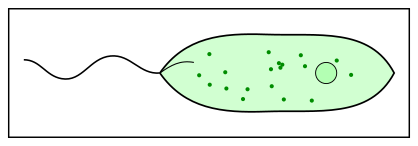
- CBSE 2020Set ANN1 markQ.Observe the figure given below. Name the organism.
›Reveal solutionSolution
The organism shown -- a single spindle-shaped cell with a whip-like flagellum at one end and internal granules -- is Euglena, a freshwater euglenoid.
Euglenoids are a group of protists (kingdom Protista) found mostly in fresh, stagnant water. Their cell is bounded not by a rigid cell wall but by a flexible protein-rich layer called a pellicle, which allows the body to be somewhat elongated/spindle-shaped as shown in the figure. A characteristic long flagellum arises from an anterior reservoir and is used for locomotion, matching the whip-like structure trailing from the pointed end of the figure. Euglena is mixotrophic: in sunlight it photosynthesises (it has chlorophyll-containing chloroplasts, seen as internal …
🎓Unlock everything free for 14 days
- ✓Full step-by-step solutions
- ✓Concept-first explanations
- ✓Methods, shortcuts & mistakes
- ✓PYQ mapping + timed mock tests
Full access for 14 days. No credit card required.