Q.Describe the structure of a skeletal muscle, starting from the whole muscle and going down to the level of a single sarcomere.
You're viewing a preview — the full solution, concept, methods & PYQ mapping are locked.
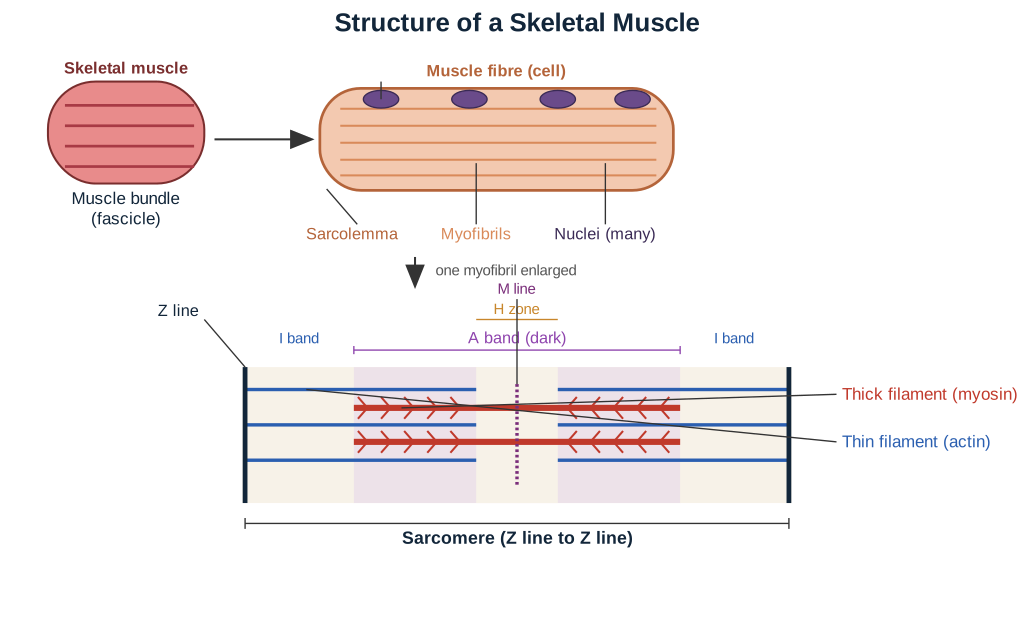
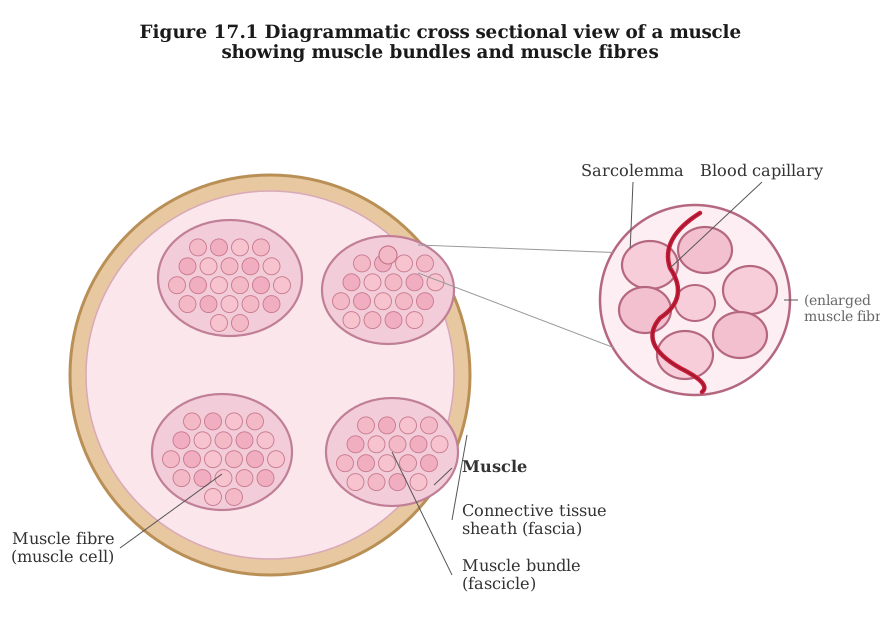
Start your 14-day free trial to unlock the full solution →A skeletal muscle is organised as a nested hierarchy of progressively finer structures. At the coarsest level, a whole muscle, such as the biceps, is made of a number of bundles called fascicles, each enclosed by its own connective-tissue sheath and running parallel to the direction of the whole muscle. Each fascicle is in turn made of many individual muscle fibres lying side by side along its length. A single muscle fibre is a long, cylindrical cell that is unusually multinucleate, containing many nuclei just beneath its surface, because it develops from the fusion of many separate embryonic cells. Its plasma membrane is called the sarcolemma and its cytoplasm the sarcoplasm; the sarcoplasm houses an extensive tubular network, the sarcoplasmic reticulum, which is the fibre's dedicated store of calcium ions, released during contraction as described in section 18.4. Packed lengthwise within the sarcoplasm of every fibre are hundreds to thousands of thread-like myofibrils, running the full length of the fibre. Each myofibril, rather than being a smooth, uniform thread, is built of a long chain of repeating units called sarcomeres, placed end to end -- and it is the sarcomere, described fully in section 18.2, that is the smallest unit at which contraction actually occurs, with its thick and thin filaments sliding over one another under the sliding filament mechanism. Because thousands of sarcomeres lie in series along each myofibril, and thousands of myofibrils run in parallel through each fibre, even a small individual shortening at …
Unlock everything free for 14 days
- Full step-by-step solutions
- Concept-first explanations
- Methods, shortcuts & mistakes
- PYQ mapping + timed mock tests
Full access for 14 days. No credit card required.