Business Mathematics and Basic Statistics · Ch 17 — Linear Inequalities and Linear Programming
Systems of Linear Inequalities and the Feasible Region
Systems of Linear Inequalities and the Feasible Region
A real business problem is almost never governed by a single limit alone — a production plan is typically constrained by machine hours AND labour hours AND raw material, AND the plain fact that a quantity produced cannot be negative, all at the same time. A system of linear inequalities is a collection of two or more linear inequalities considered together, and the set of ALL points that satisfy every inequality in the system simultaneously is called the feasible region (also called the solution region) of the system.
Graphically, the feasible region is found by graphing each inequality's own half-plane (by the boundary-line-and-test-point method of the previous section) on the SAME set of axes, and then identifying the area common to every one of the half-planes — the overlap of all of them together, never their combined outer area.
Non-negativity restrictions. In almost every business application, the two variables represent physical quantities — the number of units of a product, the number of hours of labour used, an amount of money — none of which can sensibly be negative. This is captured by adding the two inequalities and to the system, called the non-negativity restrictions, which by themselves restrict attention to the closed first quadrant only. Every LPP built later in this chapter carries these two restrictions.
Worked Example 3 below graphs the simplest possible system carrying non-negativity restrictions — a single structural inequality together with — and its feasible region turns out to be a triangle.
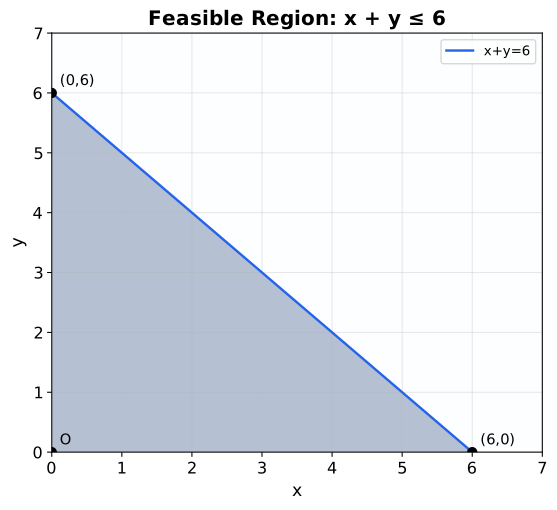
A feasible region built this way — as the intersection of half-planes — has an important geometric property: it is always a convex set, meaning that for ANY two points chosen inside the region, the entire straight segment joining them also lies inside the region (no dent or hole is possible). This convexity is exactly what makes the corner-point method of Section 4 work. …
Two or more linear inequalities considered together; a point is a solution of the system only if it satisfies every inequalit …
The set of all points satisfying every inequality of a system at once — found graphically as the overlap (intersection) of all the individual half- …
The two inequalities and , added to every business LPP because a negative quantity of a product, an hour, or a rupee …
A set with the property that the entire straight segment joining any two of its points also lies within the set; every feasible region formed by intersec …
A point where two of a feasible region's boundary lines (or a boundary line and an axis) meet; the objective function of an LPP is evaluated only at these points, never …