Business Studies · Ch 9 — Directing
Motivation
Motivation
Motivation: The Engine of Human Action
The case of Rashmi at the start of this chapter makes a crucial point: formal authority alone cannot extract the best work from employees. A manager might have highly committed workers or lazy, evasive ones. The question is — what makes people behave the way they do? Why do some capable workers refuse to work? The answer, psychologists say, lies in motivation — the force that stimulates people to take up work voluntarily.
Understanding the Three Key Terms
To grasp motivation, we must distinguish between three related but distinct concepts:
Motive: A motive is an inner state that energises, activates, and directs behaviour towards goals. Motives arise from the needs of individuals. When a motive is realised, it creates restlessness in the person, which prompts action to reduce that restlessness. For example, the need for food causes hunger, and a person searches for food. Common motives include hunger, thirst, security, affiliation, need for comfort, and recognition.
Motivation: Motivation is the process of stimulating people to action to accomplish desired goals. It depends on satisfying the needs of people. This is the active, managerial process — the doing of motivating.
Motivators: A motivator is the specific technique used to motivate people in an organisation. Managers use diverse motivators like pay, bonus, promotion, recognition, praise, and responsibility to influence people to contribute their best.
Features of Motivation
Analysis of various definitions reveals these key features:
-
Motivation is an internal feeling. The urges, drives, desires, aspirations, strivings, or needs of human beings are internal and influence behaviour. For example, the desire for a motorbike or a comfortable house is internal to the individual.
-
Motivation produces goal-directed behaviour. For instance, a promotion may be offered to improve performance. If the employee values promotion, it produces behaviour aimed at improving performance.
-
Motivation can be either positive or negative. Positive motivation provides rewards like increase in pay, promotion, or recognition. Negative motivation uses punishment, stopping increments, or threats — which may also induce a person to act in the desired way.
-
Motivation is a complex process. Individuals are heterogeneous in their expectations, perceptions, and reactions. Any single type of motivation may not have a uniform effect on all members.
The Motivation Process
The motivation process is based on human needs. Here is a simple model:
- An unsatisfied need creates tension in the individual.
- This tension stimulates the individual's drives.
- These drives generate search behaviour to satisfy the need.
- If the need is satisfied, the individual is relieved of tension.
Consider the example of Ramu. He is very hungry (unsatisfied need). This creates restlessness (tension). He starts walking in search of a hotel (search behaviour). He finds a hotel, pays Rs 10 for a meal, and feels satisfied (need satisfied, tension relieved).
Importance of Motivation
Motivation is critical because it helps identify and satisfy the needs of human resources, thereby improving performance. Its importance can be seen through these benefits:
-
Improves performance levels. Proper motivation satisfies employee needs, and satisfied employees devote their energies to optimum performance. Motivated employees contribute their maximum efforts towards organisational goals.
-
Changes negative attitudes to positive ones. A worker who is not rewarded properly may develop a negative attitude. If suitable rewards, encouragement, and praise are given, the worker may slowly develop a positive attitude.
-
Reduces employee turnover. Lack of motivation is a main reason for high turnover. When managers identify motivational needs and provide suitable incentives, employees are less likely to leave. This saves the cost of new recruitment and training.
-
Reduces absenteeism. Bad working conditions, inadequate rewards, lack of recognition, and poor relations with supervisors cause absenteeism. A sound motivational system addresses these deficiencies, making work a source of pleasure.
-
Helps introduce changes smoothly. People normally resist change. If a manager can convince employees that proposed changes will bring additional rewards, they may readily accept the change.
Maslow's Need Hierarchy Theory of Motivation
Abraham Maslow, a well-known psychologist, published his theory in 1943. It is considered fundamental to understanding motivation. His theory is based on human needs and assumes:
- People's behaviour is based on their needs. Satisfaction of these needs influences their behaviour.
- People's needs are in hierarchical order, starting from basic needs to higher-level needs.
- A satisfied need can no longer motivate a person; only the next higher-level need can motivate him.
- A person moves to the next higher level only when the lower need is satisfied.
The five levels of needs in the hierarchy are:
| Need Level | Description | Organisational Example |
|---|---|---|
| Basic Physiological Needs | Most basic needs — hunger, thirst, shelter, sleep, sex | Basic salary |
| Safety/Security Needs | Security and protection from physical and emotional harm | Job security, stability of income, pension plans |
| Affiliation/Belongingness Needs | Affection, sense of belonging, acceptance, friendship | Cordial relations with colleagues |
| Esteem Needs | Self-respect, autonomy, status, recognition, attention | Job title, recognition |
| Self-Actualisation Needs | Highest level — drive to become what one is capable of becoming; growth, self-fulfilment, achievement of goals | Achievement of goals, challenging work |
Maslow's theory focuses on needs as the basis for motivation. While some of his propositions have been questioned, the theory remains relevant because needs — no matter how classified — are important for understanding behaviour. It helps managers realise that the need level of each employee must be identified to provide appropriate motivation.
Financial and Non-Financial Incentives
An incentive means all measures used to motivate people to improve performance. These are broadly classified as financial and non-financial.
Financial Incentives
Money has purchasing power and satisfies physical needs, social position, and power. Financial incentives are in direct monetary form or measurable in monetary terms. They may be provided on an individual or group basis.
-
Pay and allowances: Salary is the basic monetary incentive, including basic pay, dearness allowance, and other allowances. Pay hikes and increments may be linked to performance.
-
Productivity-linked wage incentives: These plans link payment of wages to increase in productivity at individual or group level.
-
Bonus: An incentive offered over and above wages or salary.
-
Profit sharing: Provides a share to employees in the profits of the organisation, motivating them to improve performance and contribute to increased profits.
-
Co-partnership/Stock option: Employees are offered company shares at a set price lower than market price. This creates a feeling of ownership and makes employees contribute to the organisation's growth.
-
Retirement benefits: Provident fund, pension, and gratuity provide financial security after retirement and act as an incentive during service.
-
Perquisites: Car allowance, housing, medical aid, and education for children, offered over and above salary.
Non-Financial Incentives
Not all needs are satisfied by money alone. Psychological, social, and emotional factors play an important role. Non-financial incentives focus on these needs. Even when monetary aspects are involved, the emphasis is on psychological and emotional satisfaction.
-
Status: Status means ranking of positions in the organisation. Authority, responsibility, rewards, recognition, perquisites, and prestige indicate the status of a position. Status satisfies psychological, social, and esteem needs.
-
Organisational climate: This refers to characteristics that describe an organisation and distinguish it from others — individual autonomy, reward orientation, consideration to employees, risk-taking, etc. Positive measures regarding these aspects develop a better organisational climate. …
Motivation means a process of stimulating people to action to accomplish desired goals.
— William G. Scout
Motivation refers to the way in which urges, drives, desires, aspirations, strivings or needs direct, control and explain the behaviour of human beings.
— Mc Farland
Motivation is a complex force starting with keeping a person at work in an organisation. Motivation is something which moves the person to action and continues him in the course of action already initiated.
— Dubin …
In Tata Steel several initiatives have been taken to further improve the motivation levels and participation in the decision making process of the officers, greater impetus to training through a formalised system of a personal development programme, talent review and job rotation systems, compensation linked to the performance management system, formal rewards and recognition systems, knowledge management systems linked with appraisals, leadership opportunities in quality circles, continuous improvement and value engineering programmes and an extremely transparent and credible multi-path communication system to address queries and concerns of all employees through various dialogues both formal and online, with such tools as video conferencing, 'MD Online', special dialogues with senior management, meetings, conferences and seminars. These initiatives have helped to build a homogeneous and focused team in Tata Steel, increasing motivation and binding to the vision of the company and spurred employees to deliver targets on a participatory management basis leading to ownership of processes.
Tata Steel is a company that actively promotes freedom to work, freedom to innovate and even the freedom to fail. It is a nimble, fast, modern and forward-looking company on a strong growth path. The company has undergone a revolutionary change in terms of its production facilities and the technology in the manufacturing process. These changes have resulted in creating greater opportunities for taking up newer challenges for young recruits work and for performance based on IT enabled systems and high levels of automation. These have led to making the company one of the lowest cost producers of steel and the only Indian company to be recognised by the World Steel Dynamics as one of the top most 'World Class' steel makers. Tata Steel hopes not only to consolidate but better its leadership by robust leadership development systems that have seen the company create many CEOs for other companies.
Source: http://www.tata.com/tata_steel/releases/20030829.htm …
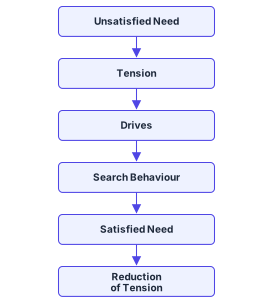
The motivation process begins the moment a need goes unmet. An Unsatisfied Need — hunger, for instance — creates Tension in the individual. This tension stimulates the person's Drives, the inner push to act. Those drives generate Search Behaviour: the person actively looks for a way to satisfy the need. Once the need is met, it becomes a Satisfied Need, and the individual experiences a Reduction of Tension — the cycle's natural resolution. …
Abraham H. Maslow was born in Brooklyn, New York, in 1908. He studied primate behavior at the University of Wisconsin, where he received his doctorate in psychology in 1934.
Early in his career, Maslow was drawn to the study of human motivation and personality. His work in this area upset strict behaviorists, whose explanations of motivation and personality failed to account for what Maslow called the whole person. His theory of the hierarchy of needs, which leads to the ‘self-actualised’ individual, was a strong catalyst for the founding of humanistic psychology. Maslow successfully bridged motivation and personality in his theories of needs, self-actualising persons, and peak experiences. …
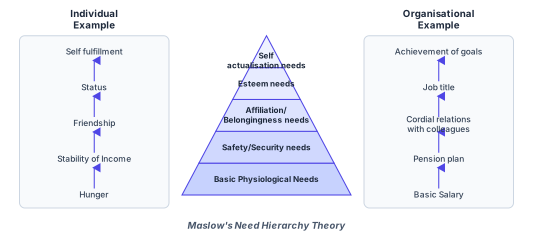
The diagram is a five-level pyramid, the classic shape for Maslow’s Need Hierarchy. At the very base is Basic Physiological Needs; above it, in order, come Safety/Security Needs, Affiliation/Belongingness Needs, Esteem Needs, and at the apex, Self Actualisation Needs. The pyramid is flanked by two vertical ladders that rise in step with these five levels.
On the left side, an Individual Example ladder runs alongside the pyramid. At the bottom, opposite Physiological Needs, is Hunger. Next, at the Safety level, is Stability of Income. At the Affiliation level is Friendship. At the Esteem level is Status. At the top, opposite Self Actualisation, is Self fulfillment.
On the right side, an Organisational Example ladder mirrors the same structure. At the base, opposite Physiological Needs, is Basic Salary. At the Safety level is Pension plan. At the Affiliation level is Cordial relations with colleagues. At the Esteem level is Job title. At the apex, opposite Self Actualisation, is Achievement of goals. …